Get Marketing Insights First
Subscribe to receive actionable strategies, growth tips, and industry insights delivered straight to your inbox.

Choose an SEO agency in India that can prove Google SEO, measure AI visibility, create direct-answer AEO content, adapt GEO work by platform, and report citations, mentions, recommendations, referrals and business outcomes — not just rankings and traffic.
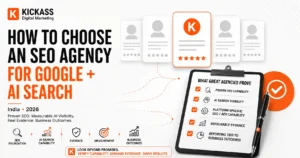
Choose an SEO agency in India that can prove conventional Google SEO, measure visibility in AI-generated discovery, create direct-answer content for AEO, adapt GEO work to the platforms that matter, and report business outcomes. Before signing, ask for relevant case studies, live work, a sample report, the named team, and a clear explanation of how the agency measures citations, brand mentions, recommendations, AI Share of Voice and referrals.
The 2026 buying problem is that agencies now use labels such as AI SEO, GEO, AEO, LLM optimisation and AI visibility for very different capabilities. Some genuinely extend SEO into AI-mediated discovery. Some mainly use AI to automate SEO work. Others present emerging tactics as settled ranking factors.
The useful test is therefore not the acronym on the services page. It is whether the agency can show the foundation, the additional capability, the evidence and the measurement.
Choose an SEO agency in India that can show four things: proven Google SEO capability, measurable AI-search visibility, platform-specific GEO/AEO capability where needed, and reporting tied to business outcomes. Ask to see relevant case studies, a sample report, the people who will manage the account, and how the agency separately tracks citations, brand mentions, recommendations, AI Share of Voice and AI referrals. Avoid ranking or AI-citation guarantees and vague “AI SEO” claims that cannot be demonstrated.
For Google Search specifically, the foundation is not optional. Google’s current guidance says SEO best practices remain relevant to AI Overviews and AI Mode because its generative Search features are built on core Search ranking and quality systems. Google also states that, from its perspective, work described as AEO or GEO for generative Search is still SEO. See Google Search Central’s guide to generative AI features.
That does not mean every AI-search problem is identical to conventional SEO.
It means the right agency should know what remains foundational, what genuinely needs to be added, and what is still uncertain.
Start by defining the business outcome you want the agency to improve: qualified leads, ecommerce revenue, local visibility, high-intent organic visibility, AI citations, brand mentions, recommendations or another measurable commercial outcome. The agency label matters less than whether its capabilities match that problem.
A local service business trying to generate qualified enquiries has a different requirement from an ecommerce brand trying to appear in Gemini product recommendations. A national B2B company may care about category authority and AI citations. A multi-location business may need local search visibility, entity consistency and contextual location coverage.
Useful goals might include:
The agency should ask about these outcomes before proposing a package.
Google makes the same basic point in its current guidance for hiring an SEO: a good SEO should be interested in your business, what makes it different, who the competitors are, how customers currently find you, and how Search can support the business.
If the pitch starts with a fixed list of deliverables before the agency understands the commercial problem, you are evaluating a package — not a strategy.
A credible AI SEO agency must first be able to do conventional SEO well: crawling and indexing, technical accessibility, information architecture, content, internal linking, authority, analytics and conversion measurement. AI Search expands the discovery environment; it does not remove that foundation.
A competent agency should still be able to diagnose and improve:
This matters because many AI-search experiences still depend on discoverable web information.
Google is particularly explicit: its generative Search features use core ranking and quality systems, retrieval from the Search index and techniques such as query fan-out. Our evidence review, SEO for AI Search: What Actually Changes — and What the Evidence Doesn’t Yet Prove, examines that boundary in detail.
A useful hiring principle is therefore:
Do not hire an “AI SEO agency” to compensate for weak SEO fundamentals. Hire an agency that can prove the foundation and then show what it adds above it.
An AI SEO agency should mean an SEO agency that optimises for both conventional search and AI-generated discovery. Some agencies also use the term simply to mean they use AI tools to perform SEO work; that is not the same capability. This distinction is one of the most important things to clarify before hiring.
Using AI to perform SEO means using AI tools to make SEO research, production, analysis or reporting faster; it does not by itself mean the agency optimises for AI-generated discovery. Common uses include:
These can make an SEO team faster or more efficient.
But using AI to perform SEO does not automatically mean the agency knows how to improve or measure visibility inside AI-generated discovery.
Optimising for AI-generated discovery means working to improve and measure whether a brand is surfaced, cited, mentioned, compared or recommended in relevant AI experiences. Depending on the buyer journey, those environments can include:
That work can involve additional measurement around retrieval, citations, brand mentions, recommendation visibility, source environments, crawler access, structured commercial data and platform-specific behaviour.
So ask the agency directly:
When you say “AI SEO”, do you mean that you use AI to perform SEO work, or that you optimise and measure my visibility inside AI-generated discovery?
A strong agency should be able to answer without retreating into buzzwords.
An agency selling AI Search Visibility should be able to measure AI citations, brand mentions, recommendations, Share of Voice and referrals; analyse the source environments around important queries; differentiate platforms where their behaviour materially differs; manage relevant crawler/access decisions; and identify entity or information inconsistencies. If it cannot demonstrate those capabilities, the AI-search proposition may be positioning rather than a distinct service.
Depending on your market and platforms, those capabilities may include:
A capable agency should monitor a defined, repeatable set of commercially relevant questions or prompts and separately record the visibility outcomes it can actually observe. That includes:
A screenshot of one favourable ChatGPT answer is not a measurement system.
A capable agency should analyse which domains and source types are repeatedly cited or surfaced around the questions your customers ask, because the evidence environment may extend well beyond your own website. Publishers, aggregators, reviews, communities, product sources and other third-party pages can all become relevant to the answer environment.
A capable agency should separate platforms when the retrieval, source, data or recommendation environment materially differs; one universal GEO checklist is not enough. Our platform-specific research illustrates why:
If an agency sells exactly the same “GEO checklist” for every AI platform, ask why.
A capable agency should distinguish relevant search and AI-related crawlers and make access decisions intentionally for the systems the business actually wants to support. Allowing every crawler does not automatically produce rankings, citations or recommendations.
A capable agency should identify material inconsistencies in how the business, people, products, locations, services and important facts are represented across owned and relevant third-party sources. This is especially important for multi-location businesses, regulated facts, product data, changing service lines and recommendation-led categories.
An AEO-capable agency should structure important question-led content so the first passage directly and completely answers the question, then adds evidence, examples, qualification and internal links. The reader — or a retrieval system — should not need to reconstruct the basic answer from several distant sections.
This is an answer-quality principle, not a universal word-count rule. A complete answer may be one sentence, a paragraph, a table or a short list depending on the intent.
Ask the agency to prove each major claim with implementation, methodology, attributable evidence, repeatable measurement and a business outcome where one can reasonably be measured. A services page proves only that the agency can make the claim.
The strongest agency proof moves from a marketing claim to a clear definition, visible implementation, repeatable methodology, attributable evidence, measurement and finally a business outcome.
| Level | What to verify | What it tells you |
|---|---|---|
| 1. Claim | What exactly is the agency promising? | Whether the proposition is specific enough to evaluate |
| 2. Definition | What does it mean by SEO, AI SEO, GEO and AEO? | Whether the terminology hides ambiguity |
| 3. Implementation | Can you see evidence that the agency practises the work itself? | Whether the capability exists beyond sales copy |
| 4. Methodology | Can the team explain how the work is done and where it differs from conventional SEO? | Whether there is a repeatable process |
| 5. Evidence | Can it show named case studies, attributable observations, audits or published research? | Whether the claim has support |
| 6. Measurement | Can it measure the visibility outcome it claims to improve? | Whether progress can be evaluated |
| 7. Business outcome | Can the work be connected to qualified traffic, leads, sales or another agreed commercial objective? | Whether the activity matters commercially |
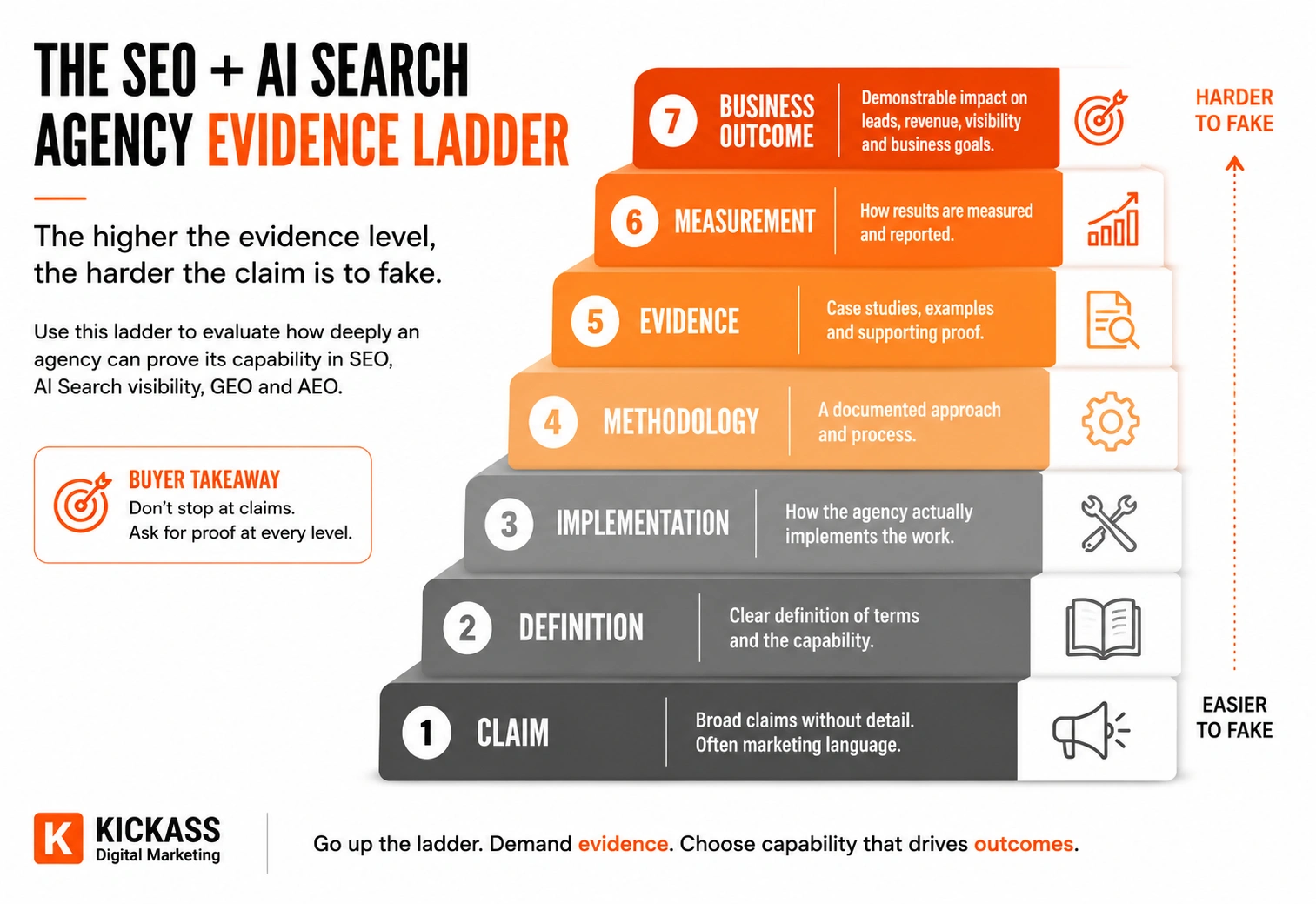
Figure 1: The SEO + AI Search Agency Evidence Ladder: moving from what an agency claims to what it can implement, evidence, measure and connect to business outcomes.
The higher you move up the ladder, the harder it becomes to rely on marketing language alone.
A named case study is stronger than an anonymous percentage.
A repeatable reporting method is stronger than a screenshot.
A documented methodology is stronger than “our proprietary AI framework” with no explanation.
And a commercial outcome is more useful than a large volume of activity that cannot be tied to the business.
If you want to inspect examples of how an agency documents outcomes, look at its case studies and ask whether the evidence is attributable, relevant to your situation and sufficiently detailed to understand what changed.
An SEO agency should report conversions, organic traffic, rankings/search visibility, technical health, relevant authority/backlink signals, completed work and next actions. An AI SEO agency should report all of that plus AI citations, brand mentions, recommendations, AI Share of Voice, platform-specific visibility and AI referrals where those outcomes can be measured reliably.
Conventional SEO metrics have not become obsolete. But if an agency also sells AI Search Visibility, GEO, AEO or AI SEO, those metrics no longer describe the full outcome it claims to influence.
If an agency sells AI Search Visibility but its reporting still ends at rankings, traffic and backlinks, the service claim has outrun the measurement system.
A conventional SEO report should cover business outcomes, traffic, rankings, technical health, authority, completed work and next actions; an AI SEO report should include all of those plus citations, brand mentions, recommendations, AI Share of Voice, platform-specific visibility and attributable AI referrals where measurable.
| Outcome / Reporting Parameter | SEO Agency | AI SEO Agency |
|---|---|---|
| Business impact / conversions | Leads, sales, enquiries and agreed commercial outcomes from organic search | The same, plus attributable AI-search referrals and downstream conversions where measurable |
| Organic traffic | Organic sessions, clicks, landing-page performance and qualified traffic | Still required; AI Search does not make conventional organic traffic irrelevant |
| Keyword rankings / SERP visibility | Priority queries, pages, locations and conventional search visibility | Still required, but should not be treated as the complete AI-visibility picture |
| Backlinks / authority | Links earned/lost, referring domains and relevant authority indicators | Still useful, alongside analysis of the wider source environment where AI systems may retrieve corroborating information |
| Technical SEO health | Crawling, indexing, rendering, Core Web Vitals, architecture and technical issues | The same foundation, plus relevant AI crawler/access and machine-readable information checks where applicable |
| Completed work | Technical fixes, content, links and optimisation completed | The same, with AI-specific experiments or platform work clearly identified rather than hidden inside a generic “GEO” label |
| Next-period priorities | Planned actions based on performance and business priorities | The same, including which AI-visibility gaps or platform-specific tests will be addressed next |
| AI retrieval / source inclusion | Usually outside conventional reporting | Track where directly observable; where it is not observable, do not present inference as certainty |
| AI citations | Usually not measured | Track visible citations or linked sources across a defined query/prompt set |
| Brand mentions | Often secondary to SEO reporting | Track whether the brand is named, including cases where its own URL is not cited |
| Recommendations / shortlist inclusion | Usually not measured | Track whether the brand is recommended, compared or included in generated shortlists |
| AI Share of Voice | Not normally part of conventional SEO reporting | Compare visibility with relevant competitors across a defined and repeatable prompt/query set |
| Platform-specific visibility | Primarily conventional search engines | Separate Google AI Overviews/AI Mode, ChatGPT, Perplexity, Gemini, Claude or other target systems where relevant |
| AI referrals | Often absorbed into referral/direct reporting | Track visits and conversions attributable to AI platforms where referrer or analytics data makes this observable |
| Evidence confidence | Rarely required as a distinct field | Distinguish documented platform behaviour, repeatable observation, correlation and experimental hypothesis |
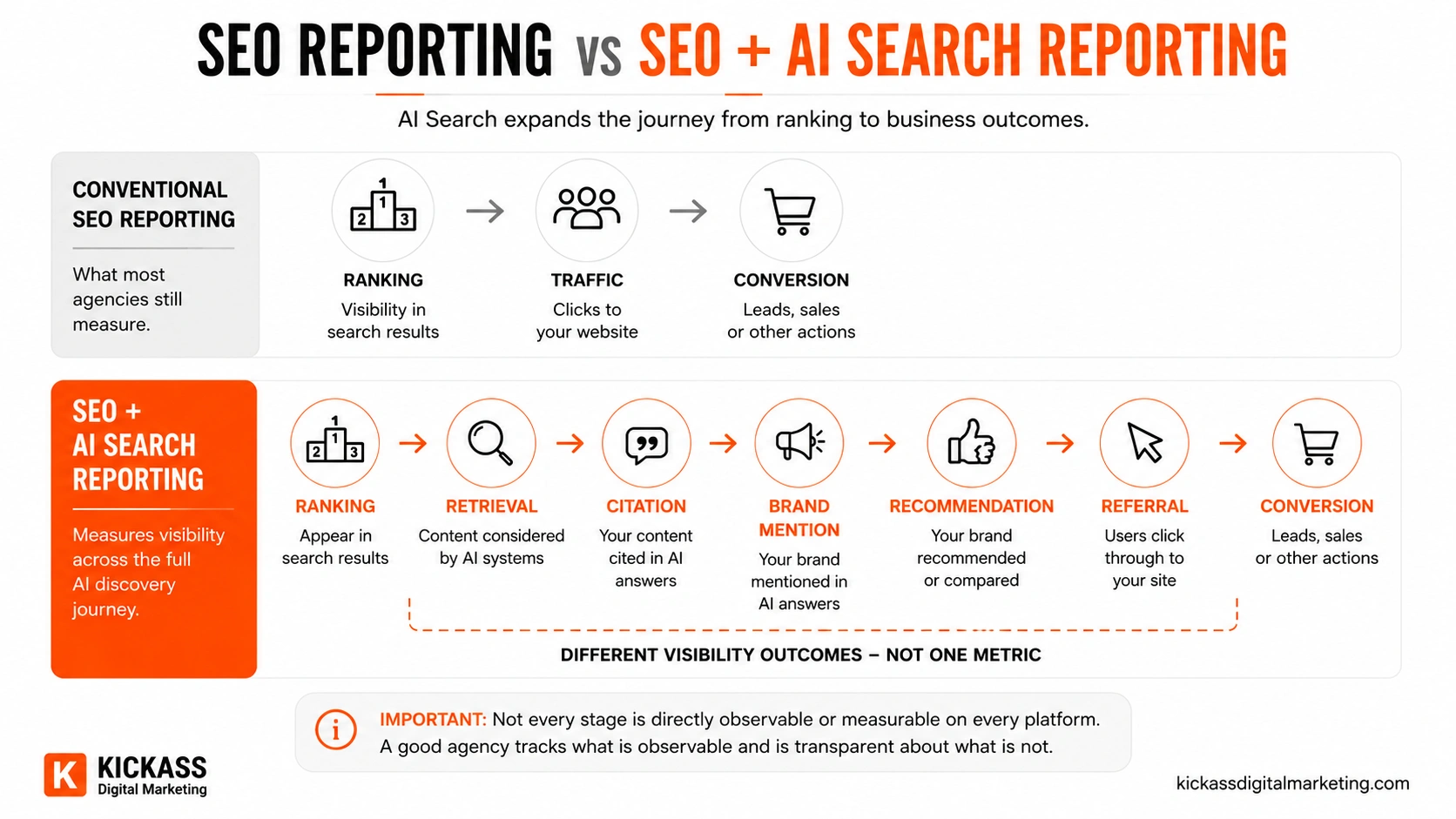
Figure 2: SEO + AI Search reporting expands beyond rankings, traffic and conversions to distinguish additional visibility states such as retrieval, citation, brand mention, recommendation and referral.
For Google specifically, its current guidance also points site owners toward Search Console reporting for generative AI features rather than relying on claims that third-party tools have access to proprietary Google ranking or AI data. See Google’s generative AI optimisation guide.
The principle is simple:
An AI SEO agency should report everything a competent SEO agency already reports, plus the additional discovery outcomes it claims to influence.
An agency can directly record visible citations, brand mentions, recommendations and some AI referrals. It cannot see every model’s complete internal retrieval or ranking process, so inferred retrieval and causal claims should be labelled as inference rather than direct measurement.
AI visibility is therefore not one metric. A useful reporting model separates the stages:
Eligibility / accessibility → retrieval → citation → brand mention → recommendation → referral → conversion
Not every stage is directly observable on every platform.
That qualification matters.
For example:
So an agency should not present an inferred mechanism as if it has direct access to the model’s internal decision process.
Google explicitly warns buyers that third-party SEO tools do not have access to its internal ranking data and recommends evaluating third-party recommendations against official Search documentation. Its June 2026 SEO hiring guidance now specifically tells buyers to check whether AEO or GEO advice aligns with Google’s official generative-AI guidance.
That is a useful standard beyond Google too:
Ask what the agency observed, what the platform documents, and what the agency is inferring.
Every AI-search recommendation should be classified as documented, repeatedly observed, experimental/inferred, or unsupported. A good agency should be comfortable saying:
“The platform documents this.”
“We observe this repeatedly.”
“We are testing this.”
“We do not have enough evidence to claim this yet.”
We use the KickAss BASE™ Model for SEO & AI Search for that separation:
Build means keep the established SEO foundation: technical accessibility, indexability, relevant content, useful information architecture, authority and accurate business information.
Add means introduce capabilities that genuinely expand the SEO problem: new measurement surfaces, query fan-out analysis, source/citation analysis, platform-specific data or crawler requirements, AI visibility monitoring and recommendation testing where relevant.
Study means test patterns that look useful but are not established universal mechanisms, including citation patterns, source preferences, recency effects, passage selection, emerging agent behaviour and platform-specific correlations.
Exclude means reject universal ranking-factor lists, guaranteed AI citations, fixed answer-length rules, fake mentions, special-markup claims and other tactics presented more confidently than the evidence allows.
For Google Search, this distinction is particularly easy to test against first-party documentation. Google’s current guide says publishers can ignore supposed requirements such as special AI markup, mandatory content “chunking” and llms.txt for Google Search. See Google’s generative AI mythbusting guidance.
An agency can still test emerging practices.
It should simply label the evidence honestly.
Ask questions that force the agency to define its capability, show proof, explain measurement and connect the work to business outcomes. The quality of the answers matters more than the number of services on the proposal.
A good answer should distinguish AI-assisted SEO workflows from optimisation for AI-generated discovery. If the agency means both, it should explain both separately rather than treating the use of AI tools as proof of AI Search capability.
A good answer should name the exact outcomes being tracked: visible citations, brand mentions, recommendations, AI Share of Voice, platform-specific visibility and attributable AI referrals where available. Rankings and screenshots alone are not a complete AI Search measurement system.
A good answer should separate Google AI Overviews/AI Mode, ChatGPT, Perplexity, Gemini, Claude or other target systems whenever their source, data, retrieval or recommendation environments materially differ. The agency should also explain when a shared methodology is appropriate.
Yes — the agency should be able to show relevant, attributable evidence of work and outcomes. If client confidentiality prevents naming a company, it should still explain what can be independently verified, what changed, over what period and how the result was measured.
Yes — ask to see real websites, research, content, technical implementation or reporting produced by the team that will do the work. Presentation slides and sales decks are not substitutes for live execution.
The agency should name the strategist or account lead, explain who owns technical SEO, content and AI-search measurement, and identify the day-to-day point of contact. You should know whether senior expertise exists only in the pitch or remains involved after signing.
Yes — a credible agency should be willing to show a representative report or reporting structure before you sign. The report should reveal whether the agency measures business outcomes and, if it sells AI Search Visibility, whether citations, mentions, recommendations and platform visibility are actually included.
A credible agency should be able to classify its recommendations by evidence level instead of presenting every tactic as a proven mechanism. A good answer will distinguish platform documentation, repeatable observation, experiments or inference, and unsupported claims.
A good agency should be able to tell you what not to buy. Depending on the situation, that may be a separate GEO programme, more content, a site migration, another tool or a large technical project that does not address the real visibility gap.
The agency should define the commercial KPI, the attribution method and the reporting path before the work begins. Visibility metrics are useful, but the agency and client should agree on how rankings, AI visibility, traffic, enquiries, sales or other outcomes will be connected.
Google’s own SEO hiring checklist also recommends asking for previous work, expected results and timelines, measurement methods, market experience, communication expectations and detailed explanations of recommendations.
Major red flags include guaranteed #1 rankings or AI citations, hidden methods, no verifiable case evidence, vanity-only reporting, one-size-fits-all packages, “AI SEO” that is only content automation, one universal GEO checklist for every platform, fixed answer-length claims presented as ranking rules, and no distinction between citations, mentions and recommendations.
Some red flags have not changed. Others are specific to the AI-search market.
Guaranteed #1 rankings are a red flag because no SEO agency controls Google’s ranking systems. Google explicitly warns against firms that guarantee first place.
Refusing to explain what will be changed, why it will be changed and how it will be measured is a red flag. A strategy can contain proprietary know-how without requiring the agency to hide the work being done on your website.
Reporting only traffic, impressions or rankings is a red flag when the agency cannot connect those metrics to qualified demand or another agreed business outcome. The metrics still matter; the missing context is the problem.
No attributable or verifiable proof is a red flag. Be cautious when every case study is anonymous, every result is a percentage without context, and no live implementation can be shown.
A fixed package with the same strategy for every business is a red flag. A national ecommerce brand, a Goa hotel, a B2B services firm and a local professional practice should not receive the same search programme.
Calling content automation “AI SEO” is a red flag if the agency cannot also demonstrate AI-discovery optimisation and measurement. Using an LLM to produce briefs or blog posts does not prove that capability.
Guaranteed AI citations or recommendations are a red flag because an agency cannot deterministically control third-party AI outputs. It can test, optimise and measure visibility; it should not promise the output.
One identical GEO checklist for every platform is a red flag when the source, retrieval, data or recommendation environment differs materially by platform or use case.
A universal “40-to-60-word answer” rule is a red flag when it is presented as a proven ranking or citation mechanism. Direct, self-contained answers are useful because the first passage should satisfy the question without forcing readers or retrieval systems to reconstruct the answer from distant sections; the correct length depends on the intent.
“Add schema and get cited by AI” is a red flag when presented as a guaranteed mechanism. Structured data can make information explicit and support eligible search features, but it does not guarantee AI citations.
llms.txt sold as a Google AI ranking factorSelling llms.txt as a Google AI ranking factor is a red flag. Google currently says Search does not use llms.txt for visibility or ranking; other systems may make their own choices, so crawler and AI-file decisions should be platform-specific.
Treating citation, brand mention and recommendation as one undifferentiated “AI visibility” metric is a red flag. Ask exactly what is being counted and how each outcome is measured.
Presenting every observation as a proven AI-search mechanism is a red flag. A credible agency should distinguish documented behaviour, repeatable observation, correlation, experiment and inference.
Yes — for most businesses, the same agency should be able to coordinate SEO, GEO and AEO if it can prove all three capabilities. SEO should protect crawlability, indexability, relevance and organic visibility; GEO should address generative citations, mentions and recommendations where relevant; AEO should make important question-led content directly and completely answerable. Use a separate specialist only when the current agency lacks the specific capability you need.
| Capability | What the agency should be able to do | Typical outcome to measure |
|---|---|---|
| SEO | Improve technical accessibility, relevance, content architecture, authority and conventional search visibility | Rankings, qualified organic traffic, conversions |
| GEO | Analyse generative source environments and improve measurable citation, mention and recommendation visibility where possible | Citations, mentions, recommendations, AI Share of Voice |
| AEO | Map real questions to direct, complete, self-contained answer passages and supporting evidence | Answer visibility, citations/mentions where observable, assisted discovery |
SEO, GEO and AEO are frequently sold as separate disciplines, but much of the foundation overlaps. Our analysis in SEO vs GEO vs AEO: What’s Actually Different — and What Should Businesses Prioritise? explains why the practical differences often emerge from the platform, retrieval environment and desired outcome rather than from the acronym alone.
For many businesses, one coordinated search strategy is operationally cleaner than three agencies making overlapping changes to the same website and content.
A separate specialist may still make sense when:
The decision should follow the capability gap.
Not the label.
If the primary requirement is broad organic visibility across Google and AI-mediated discovery, see our SEO & AI Search Visibility service.
If the specific problem is generative citations, mentions and recommendations, see Generative Engine Optimization (GEO) Agency in India.
If the requirement is direct-answer visibility — complete, self-contained answers to the questions buyers actually ask — see Answer Engine Optimization (AEO) Agency in India.
A practical 2026 planning range for SEO agency retainers in India is about ₹10,000 to ₹1,50,000+ per month, while complex enterprise or specialist programmes can reach ₹1,00,000 to ₹5,00,000+ per month. Basic local SEO is commonly quoted around ₹10,000–₹30,000; growth, ecommerce or national programmes commonly move into ₹40,000–₹1,50,000+ territory. These are observed market ranges, not an official industry tariff.
The number only becomes meaningful when the scope is defined. A 20-page local service website, a national ecommerce catalogue, a multi-location brand and an enterprise site with AI Search measurement are different engagements.
When comparing quotes, ask exactly what the retainer covers: technical SEO, content, authority work, products or locations, reporting, analytics, and whether AI citations, mentions, recommendations and platform-specific visibility are included.
The fee should be determined by the size and difficulty of the search problem: market competition, site complexity, number of products/services/locations, content and authority requirements, international scope, analytics, and the depth of AI Search measurement required.
| Scope driver | Why it changes the cost |
|---|---|
| Market size and competition | National and highly competitive categories require more research, content, authority and monitoring |
| Technical complexity | Large sites, JavaScript applications, migrations and ecommerce platforms require deeper technical work |
| Number of services, products or locations | More entities and landing-page contexts expand the optimisation surface |
| Content and evidence requirements | Expert-led content, original data and research require more than commodity production |
| Authority / off-page work | Building credible third-party evidence can require sustained outreach and editorial work |
| AI Search measurement | Defined prompt sets, multi-platform monitoring and citation/recommendation analysis add reporting scope |
| International or multilingual work | Market, language and technical complexity increase |
| Analytics and attribution | Connecting search and AI referrals to commercial outcomes requires stronger measurement infrastructure |
A low price is not automatically bad.
A high price is not automatically good.
The useful comparison is scope, evidence, expertise, reporting and expected business value.
If two agencies quote very different retainers, ask both to map the fee to the work and measurement system. The difference usually becomes easier to understand.
You need an SEO + AI Search agency when organic search materially affects revenue and your buyers also use AI-generated search, answer or recommendation surfaces that your current team cannot reliably measure or optimise. You may not need an agency when the search footprint is simple and the required SEO work can be handled competently in-house.
Google’s own guidance says a small local business can often perform much of the basic SEO work itself. That remains a reasonable starting point.
You are more likely to benefit from specialist support when:
The key is not whether “AI Search is important” in the abstract.
It is whether the discovery behaviour of your buyers and the complexity of your search environment justify the capability.
After the first audit, a good SEO + AI Search agency should be able to tell you where your current visibility is strong or weak, which search and AI-discovery gaps matter commercially, why competitors or other sources are appearing instead of you, what should be fixed first, what should not be funded, and exactly how the next 90 days will be measured.
A useful first audit should not end with a 100-point score and a list of generic errors. It should answer questions such as:
That is the difference between an audit designed to sell deliverables and an audit designed to support a business decision.
Before signing, the agency should pass five tests: it can prove SEO, define AI SEO clearly, measure the additional outcomes it sells, explain platform differences and evidence limits, and connect the work to the business.
They should be able to prove conventional SEO competence before you buy an AI-search layer. If they cannot show technical, content, authority and measurement capability, stop.
They should distinguish using AI to perform SEO from optimising visibility in AI-generated discovery. If those two ideas are blurred together, ask for clarification.
They should be able to report the AI visibility outcomes they sell — citations, mentions, recommendations, Share of Voice, platform visibility or referrals where measurable. If the service includes AI visibility but the report does not, there is a mismatch.
They should be able to explain where platforms differ and which recommendations are documented, observed, experimental or inferred. Good answers include both confidence and uncertainty.
They should be able to connect the programme to qualified demand, revenue, leads, sales or another agreed commercial objective. If they cannot, activity can become the product.
That is the decision.
The acronym comes later.
If you are unsure whether your current SEO agency can handle AI Search, GEO or AEO, the next step is to audit what it already does, what it actually measures, and which visibility gaps remain. The answer may be better SEO execution, additional AI-search capability, or no additional programme at all.
KickAss Digital Marketing is an AI-first SEO agency in India, based in Goa, working across conventional organic search and emerging AI discovery environments.
Choose an SEO agency in India by checking its technical SEO capability, relevant case evidence, transparency, reporting, understanding of your market and ability to connect search performance to business outcomes. If the agency also sells AI SEO, verify that it can measure AI-search visibility beyond rankings and explain how its GEO or AEO work differs from conventional SEO.
Look for proven SEO fundamentals, a strategy tailored to your business, clear communication, attributable evidence, realistic expectations and reporting tied to commercial outcomes. In 2026, also check whether the agency can distinguish AI-assisted SEO workflows from actual AI Search Visibility work.
A good SEO company should be able to explain what it will change, why the change is recommended, how success will be measured and what evidence supports the strategy. It should avoid ranking guarantees, be transparent about methods, show relevant proof and connect reporting to qualified traffic, leads, sales or another agreed business objective.
An AI SEO agency optimises a brand for both conventional search and AI-generated discovery, with measurement that can include citations, brand mentions, recommendations, platform-specific visibility and AI referrals. Some agencies also use “AI SEO” simply to mean they use AI tools to perform SEO work, so buyers should verify which capability is actually being offered.
You need AI SEO capability when AI-generated search, answers or recommendations materially influence how customers discover your category and your current SEO team cannot measure or optimise that visibility. You do not necessarily need a separate agency if your existing SEO partner already has those capabilities.
Yes, in most cases, if it has genuine GEO capability. GEO builds on much of the same technical, content and authority foundation as SEO, so coordinating the work can reduce duplication. Use a separate GEO specialist when the existing agency lacks citation, source-environment or recommendation-visibility expertise.
Usually, no. You do not need a separate GEO agency if your SEO agency can already analyse and measure generative citations, mentions, recommendations, platform-specific visibility and relevant source environments. Hire a separate specialist when that capability is missing.
Yes. An SEO agency can provide GEO and AEO when it can prove the additional capabilities required. GEO adds generative source, citation, mention and recommendation analysis; AEO adds direct, complete answer architecture for the questions users actually ask. Both still depend on a strong SEO foundation.
AEO, or Answer Engine Optimization, means structuring important information so a user’s question is answered directly and completely in the first relevant passage, with supporting evidence and context added afterwards. When evaluating an agency, ask to see whether its own content follows that answer-first pattern rather than hiding the answer behind long introductions.
An SEO agency should report business outcomes, organic traffic, rankings/search visibility, technical health, relevant authority indicators, completed work and next actions. If it sells AI Search Visibility, the report should also cover AI citations, brand mentions, recommendations, Share of Voice, platform-specific visibility and AI referrals where those outcomes can be measured reliably.
Red flags include guaranteed rankings, secretive methods, no attributable case evidence, one-size-fits-all packages and reporting built only around vanity metrics. For AI SEO, also watch for guaranteed AI citations, “AI SEO” that is only content automation, universal GEO ranking-factor claims, unsupported fixed-answer rules and no distinction between citations, mentions and recommendations.
In 2026, a practical planning range for SEO agency retainers in India is about ₹10,000 to ₹1,50,000+ per month, while complex enterprise or specialist programmes can reach ₹1,00,000–₹5,00,000+. The exact fee depends on competition, site scale, technical complexity, content and authority work, locations/products covered, analytics and whether AI Search monitoring is included.
This guide was pressure-tested against 17 live buyer-intent and agency-evaluation searches on 27 August 2026, using an incognito, non-personalised Google session from an Indore, India IP address. The exercise was used to identify the questions buyers actually ask, recurring agency-selection criteria, AI-search reporting gaps and common claims that needed verification.
The generated AI Overview answers were treated as outputs synthesised from retrieved sources, not as Google’s official position. Claims about Google Search itself were checked separately against official Google Search Central documentation.