Get Marketing Insights First
Subscribe to receive actionable strategies, growth tips, and industry insights delivered straight to your inbox.

Claude doesn't query a shopping API or index a product feed — it reads the web the way a cautious editor would. Here's what our first-party testing showed about how Claude actually picks what to recommend, and what that means for your off-page footprint.
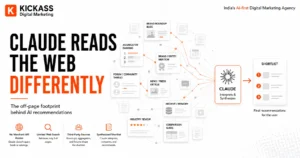
Claude has no direct API access to marketplace catalogs like Amazon, Flipkart, or Shopify. It relies on a native web-search tool that retrieves a small number of pages (typically 5–8) plus, for common queries, its own pre-trained memory.
In our testing, Claude’s picks were shaped almost entirely by third-party consensus — brand-roundup blogs, aggregator rankings, and forum sentiment — rather than anything on the brand’s own website. If your brand isn’t visible on those third-party surfaces, Claude has no path to it.
No. Claude is ad-free and does not process transactions or accept sponsorship for recommendations, based on its own disclosures during testing.
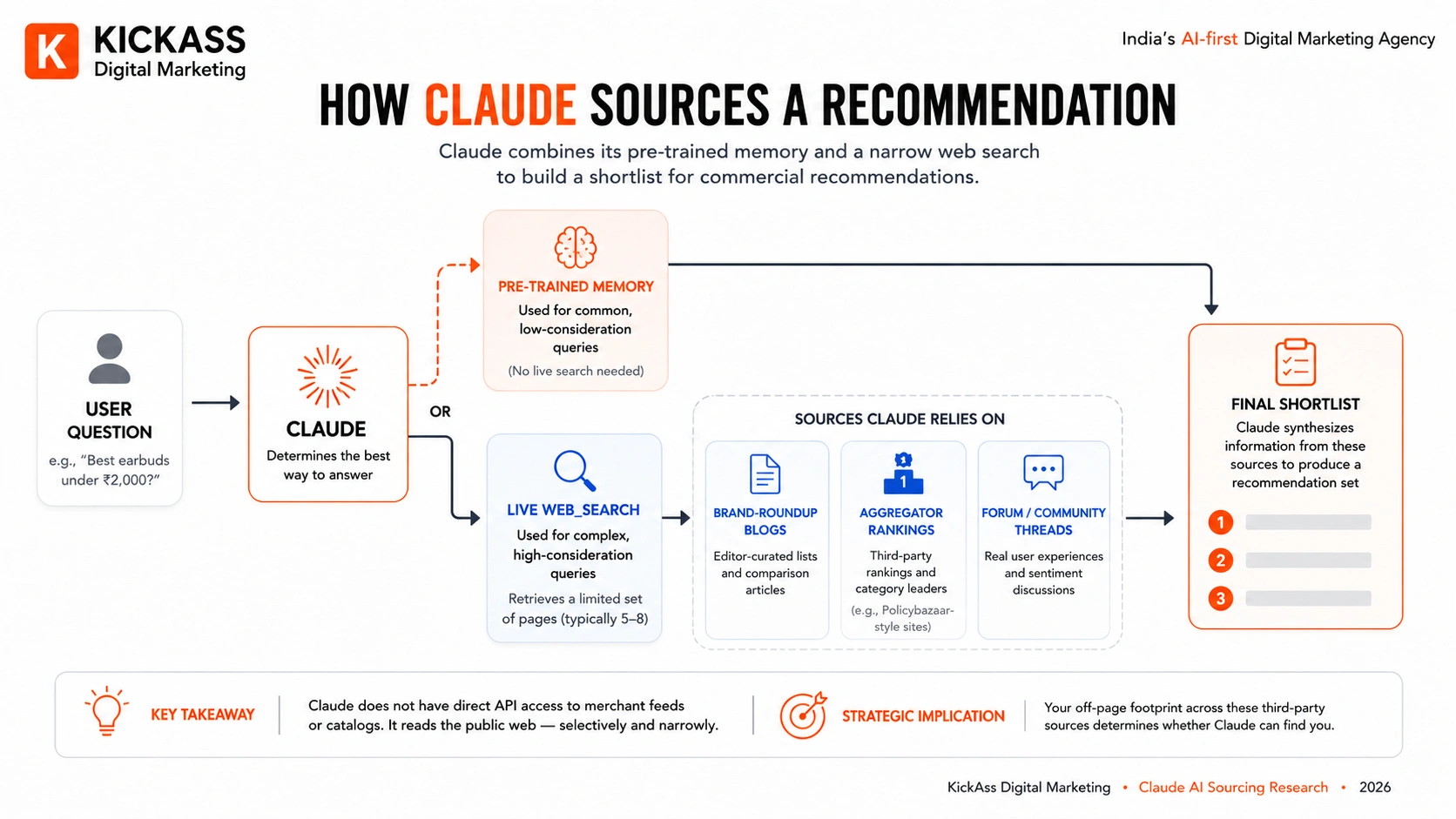
Figure 1: Claude checks pre-trained memory first, then a narrow 5-to-8-page web search across roundup blogs, aggregator rankings, and forum threads.
Most B2B teams building an AI-visibility strategy start with the same assumption: if we optimize our Google Merchant Center feed, our Shopify catalog, and our structured product schema, we’re covered on every AI platform. On Claude, that assumption breaks down completely.
Where Gemini queries a live shopping API and ChatGPT pulls from the Shopify Catalog and the Agentic Commerce Protocol, Claude has no direct pipeline into any of that. It cannot look up your live price, stock level, or size chart. What it can do is run a native search tool that retrieves a handful of web pages — our testing consistently found this capped around 5 to 8 pages — and extract whatever it finds there.
If your entire digital footprint lives on your own domain and your own product feed, you are functionally invisible to that retrieval loop. Claude never sees your feed. It sees whatever a handful of external pages say about you. This is also why a well-structured llms.txt file is worth having, even though Claude isn’t the platform it was originally built for — it gives any crawler that respects it a clean, pre-parsed summary of who you are, rather than forcing an inference from raw page HTML within that narrow 5-to-8-page window.
For everyday retail categories — moisturizers, formal shirts, earbuds — we found Claude often skips a live search entirely and answers from its own training data. Asked for the best moisturizer under ₹500, Claude generated its shortlist from memory rather than a fresh lookup, which meant the brands surfaced were the long-established, widely-discussed ones already baked into its training corpus — not necessarily the best current option, and not necessarily current on price.
That has two direct implications for brands. First, newer or smaller D2C brands are structurally disadvantaged in Claude’s memory, regardless of product quality. Second, even when Claude does search live, it isn’t reading your product page — it’s reading brand-roundup blogs and comparison articles that mention you. The optimization target shifts from your own site to the third-party pages Claude actually retrieves.
The pattern sharpens in regulated, high-consideration categories like health insurance and real estate. Claude has no way to independently analyze a policy wording or verify a project’s registration status, so in our tests it didn’t try. Instead, it openly attributed its shortlist to existing aggregator rankings — for insurance, naming platforms like Policybazaar, Ditto, and Beshak as its source; for real estate, citing portals like MagicBricks, Housing.com, and PropTiger.
We call this Shortlist Inheritance: Claude isn’t running its own evaluation of the market, it’s mirroring whatever the dominant aggregator in that category has already ranked. Practically, this means a brand’s presence — and standing — on those specific aggregator platforms functions as a gatekeeper. If you’re absent or poorly ranked there, Claude has no independent path to recommending you regardless of how strong your own site or product actually is.
This behavior is a direct expression of what ShodhDynamics’ lexicon calls Source Gravity — the tendency of AI systems to concentrate trust in a narrow cluster of frequently-referenced sources rather than evaluating every claim independently. Aggregators like Policybazaar or MagicBricks carry high Source Gravity in Claude’s retrieval loop; your own domain, by contrast, carries almost none unless it’s already been absorbed into that cluster.
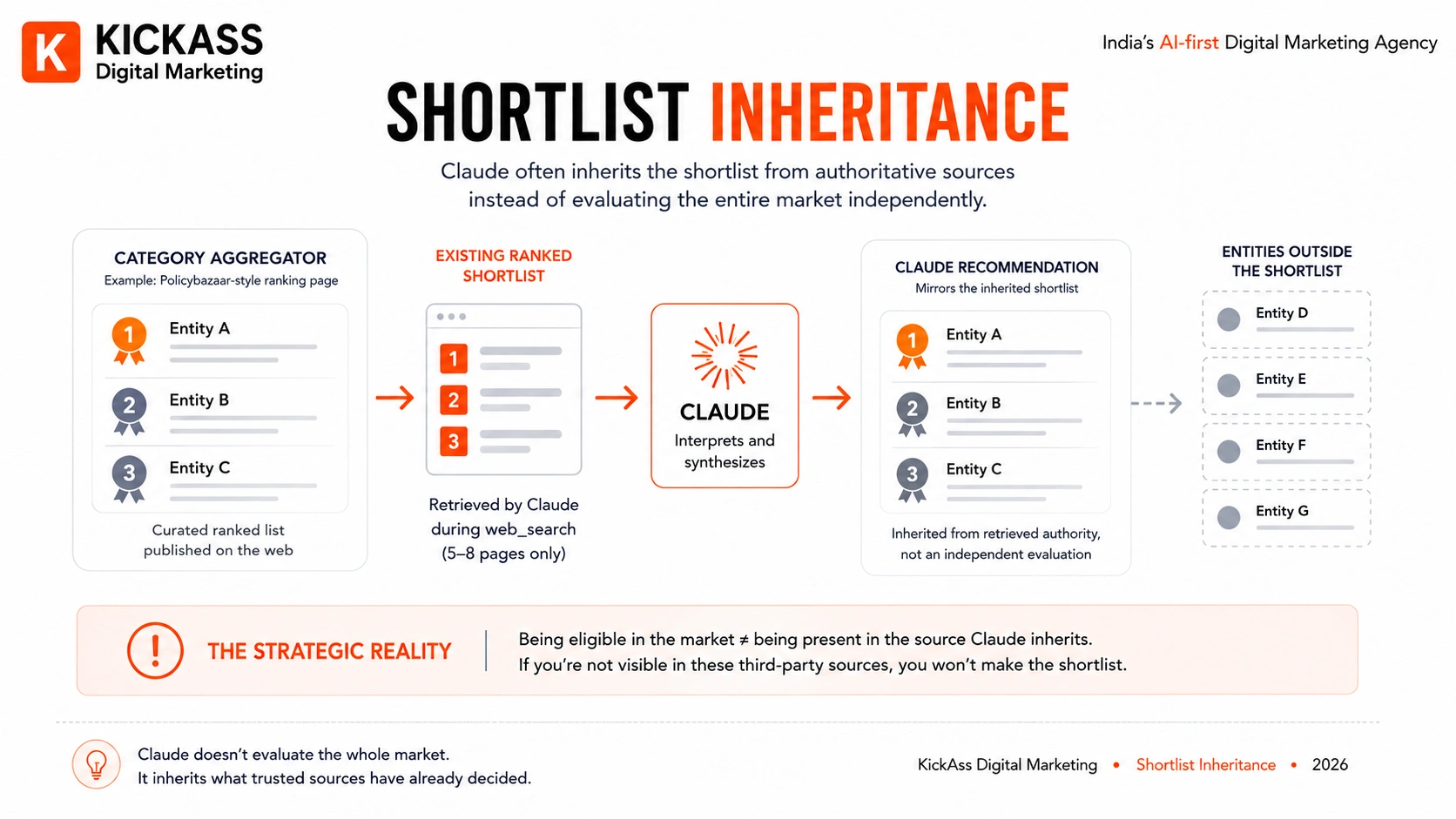
Figure 2: Claude doesn’t independently evaluate high-stakes categories — it inherits and reproduces the aggregator’s existing ranking.
As covered in our foundational research, The 5-Layer AI Commerce Engine, AI platforms shift behavior sharply once financial or regulatory risk rises — a pattern we call the Liability Wall. Claude showed this clearly in our health insurance testing: instead of naming a single “best” plan, it hedged extensively, described itself as a research starting point rather than a recommendation, and refused to pick a single winner in favor of a criteria-based shortlist.
For brands in finance, insurance, or real estate, this means Claude needs to see your regulatory standing reflected clearly across the public web — not just claimed on your own site — before it will treat you as a safe option to surface at all.
Winning visibility on Claude isn’t a technical SEO exercise — it’s a trust-building exercise conducted almost entirely off your own domain. That does not mean the SEO foundation disappears. In the KickAss BASE™ Model for SEO & AI Search, crawlability, indexability, relevance and useful content remain under Build; Claude’s unusually strong dependence on the wider public-web evidence environment is an Add to that foundation. What still belongs under Study is the exact weight Claude gives aggregators, community discussion and other third-party sources when moving from retrieval to recommendation. Four things matter most, based on what we observed:
This is also, structurally, an entity-clarity and cross-source-trust problem rather than a keyword problem — the same territory ShodhDynamics’ ESC™ Framework (Entity Clarity, Semantic Authority, Cross-Source Trust) was built to address.
Frequently Asked Questions on How Claude AI Selects Information Sources
No. Claude has no advertising or sponsored-placement layer connected to its recommendation output, based on its own disclosures in testing. Visibility is earned through third-party authority, not paid placement.
ChatGPT and Gemini both connect to structured, real-time commercial data — Shopify/ACP for ChatGPT, the Shopping Graph for Gemini. Claude has neither. It operates on web-synthesized consensus and static training memory instead, which makes it the platform most dependent on off-page authority rather than on-page or feed data. ChatGPT’s organic behavior described here is separate from its paid lane — see our coverage of ChatGPT Ads in India if you’re evaluating that channel too.
Claude generates standard, un-monetized URLs with no affiliate codes, consistent with its stated position that it doesn’t process transactions or take commissions on referrals.
Not sure where your brand stands with Claude and the other three engines? Run a self-assessment with our AI Discovery Readiness check.