Get Marketing Insights First
Subscribe to receive actionable strategies, growth tips, and industry insights delivered straight to your inbox.

llms.txt is an emerging convention for publishing website context at a predictable URL. It can make important information easier for an AI agent to retrieve if that agent chooses to use it — but it is not a Google ranking factor, no universal format is mandatory, and there is no evidence that every major LLM routinely fetches it.
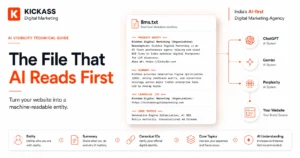
llms.txt is an optional plain-text file, usually published at yourdomain.com/llms.txt, that gives machines a concise route into the information a website considers important. It can contain a site summary, important pages, services, documentation, articles, datasets, entity information or other context that is useful to an AI agent.
It is not a Google ranking file, it does not replace robots.txt, and no public evidence shows that every major LLM routinely visits /llms.txt or prefers one universal format.
That makes the useful question in 2026 less dramatic than “Do I need llms.txt to rank in AI?”
The better question is:
If an AI agent chooses to look for machine-readable context about my website, have I made useful, accurate information easy to retrieve?
That is where llms.txt can be useful.
llms.txt is a plain-text website resource intended to give AI agents a clean, machine-readable summary of a site and direct them to important information. It is commonly published at /llms.txt, although some implementations also use files within specific subdirectories.
A widely referenced public proposal by Jeremy Howard suggests using Markdown because it is simple for both humans and machines to read. The proposal uses a site name, a short summary and grouped links to useful resources.
That is a sensible starting point. It is not, however, a governing web standard that every publisher must follow exactly.
The broader idea is more important than any single template:
put useful website context at a predictable, lightweight URL that an agent can retrieve without navigating a full visual website.
For a documentation site, that may primarily mean links to Markdown documentation.
For a business, it may also be useful to expose:
The file should reflect what the website actually says. It should not become a separate layer of marketing claims that cannot be verified elsewhere.
The filename refers to large language models, but “llms.txt” is best treated as the name of the file rather than a formally governed acronym with an official expansion.
You will often see it described informally as a “Large Language Models text file.” That communicates the idea, but there is no standards authority assigning an official full form in the way an established protocol might.
For implementation purposes, the important part is the location and purpose:
https://example.com/llms.txt
A predictable text resource intended to make useful website context easier for an AI system or agent to retrieve.
Jeremy Howard proposed the best-known /llms.txt convention in September 2024, but llms.txt is still a community proposal rather than an official web standard or requirement imposed by AI platforms.
The proposal at llmstxt.org recommends a Markdown structure with an H1 site or project name, a short blockquote summary and H2 sections containing links to useful resources.
The proposal has become influential. Documentation systems and publishers have adopted variations of it, and developer documentation from companies including OpenAI and Anthropic currently exposes its own llms.txt resources.
That demonstrates that the idea is useful enough to be implemented.
It does not prove that:
/llms.txt;There is currently no governing body that certifies a website as “llms.txt compliant” in a way that changes its eligibility for AI search.
So treat public templates as implementation guidance, not as a ranking specification.
Some agents, tools and documentation workflows use llms.txt, but there is no conclusive public evidence that all major LLMs routinely fetch /llms.txt from arbitrary websites.
This distinction matters.
There is clear evidence of adoption around documentation and agent workflows. The llmstxt.org project lists documentation platforms and tools that generate or consume these files, while OpenAI and Anthropic publish llms.txt resources for their own developer documentation.
But publishing an llms.txt file is not the same as documenting that a consumer product automatically fetches every third-party /llms.txt file before answering a question.
For a business website, the defensible position is therefore:
llms.txtmakes additional context available at a predictable URL. Its value depends on whether a specific crawler, agent or retrieval workflow chooses to discover and use it.
That is useful infrastructure.
It is not a guaranteed distribution channel.
No. Google says Google Search does not use llms.txt for rankings or visibility, including its generative AI features.
Google’s current guidance for generative AI features in Search is unusually explicit on this point.
Google says websites do not need new machine-readable AI files, special Markdown or special markup to appear in Google Search, AI Overviews or AI Mode. It says creating and maintaining an llms.txt file for other services is fine, but that doing so neither helps nor harms Google Search visibility.
That means llms.txt should not be sold as:
For Google Search, the fundamentals remain crawlability, indexability, useful content, quality, relevance and the other established Search requirements. Our deeper analysis of SEO for AI Search separates those documented foundations from the additional AI-search tactics that remain observational or experimental.
If you maintain llms.txt, do it for broader machine-access and agent-context reasons — not because Google requires it.
OpenAI publishes an llms.txt file for its own developer documentation, but OpenAI does not publicly guarantee that ChatGPT Search routinely fetches or uses every website’s /llms.txt file.
That is the distinction the older version of this article did not make clearly enough.
OpenAI’s current publisher guidance for appearing in ChatGPT search focuses on making public pages accessible to OAI-SearchBot and configuring robots.txt correctly.
OpenAI also publishes a machine-readable documentation index at developers.openai.com/llms.txt.
Those two facts tell us different things:
So a business should not assume:
“I added
/llms.txt, therefore ChatGPT will read it and recommend me.”
The stronger implementation principle is:
Make important information accessible through the channels an AI crawler may use — crawlable pages, clear content, sensible structured data where appropriate, and an optional llms.txt context layer.
There is no universal public commitment from major AI answer engines saying that they all retrieve arbitrary third-party llms.txt files as part of normal recommendation or citation workflows.
Anthropic publishes an extensive llms.txt for its developer documentation. Google’s Gemini developer ecosystem has also used LLM-friendly documentation formats.
That shows that LLM-readable text manifests can be useful to AI-oriented publishing and developer workflows.
It still does not establish a universal consumer-side behaviour.
Different systems use different combinations of:
That is why it is risky to talk about “the LLM crawler” as though every AI product has one shared retrieval architecture. The same platform-specific distinction matters when businesses compare SEO, GEO and AEO: the shared foundation can be similar while retrieval, sourcing and answer behaviour differ by system.
No. llms.txt, robots.txt, sitemap.xml and Schema.org structured data solve different problems and should not be treated as interchangeable files.
| Resource | Primary purpose | What it does not do |
|---|---|---|
| robots.txt | Declares crawler access rules for user agents that respect it | Does not describe your business or content in detail |
| sitemap.xml | Lists URLs to help supported crawlers discover site content | Does not explain which resources are most useful to an AI agent |
| Schema.org / JSON-LD | Expresses structured entities, attributes and relationships | Does not act as a universal AI crawler access policy |
| llms.txt | Provides optional plain-text context and/or curated navigation at a predictable URL | Does not control crawler permissions or guarantee rankings/citations |
This distinction is especially important for crawler governance.
robots.txt is where crawler access decisions belong.
llms.txt can provide context after a system chooses and is permitted to retrieve it.
The two can complement each other, but one does not replace the other.
For businesses reviewing crawler access, machine-readable context and entity consistency together, these checks belong within a broader AI Readiness Audit rather than being treated as an isolated llms.txt task.
A website can use both because schema and llms.txt are different representations of information, and different retrieval systems may consume different parts of a website.
Well-implemented JSON-LD can expose formal entities and relationships directly in the raw HTML source. That is valuable and should not be replaced by llms.txt.
An llms.txt file can still offer a separate advantage:
it places selected context and navigation in a lightweight text resource at a predictable URL.
If an agent chooses to request that file, it does not have to first navigate the full visual page structure to find the information the publisher considers important.
That does not mean an LLM “cannot read schema.”
It means redundant, consistent machine-readable representations can reduce dependence on a single extraction path.
The critical word is consistent.
If your visible page says one thing, your schema says another and your llms.txt says a third, you have created more ambiguity rather than less.
There is no established evidence that adding llms.txt directly improves Google rankings, AI citations, brand mentions or recommendations.
For Google Search, we have an explicit answer: Google says it ignores the file for Search visibility.
For other AI systems, the evidence is less settled.
The plausible value of llms.txt is retrieval and context efficiency:
If a relevant agent retrieves the file, those properties can make useful information easier to access.
But that is different from claiming a causal outcome such as:
“Add llms.txt and ChatGPT will cite you.”
That claim is not supported.
If the commercial objective is broader visibility across conventional search and AI-generated discovery, llms.txt should sit inside an integrated SEO & AI Search Visibility programme rather than being sold as a standalone visibility lever.
This is how we classify it using the KickAss BASE™ Model for SEO & AI Search:
Build — keep the crawlable website, content, SEO and entity foundation strong.
Add — expose useful machine-readable context where the implementation cost is reasonable.
Study — observe which agents and crawlers actually request or use the file.
Exclude — ranking guarantees, citation guarantees and invented universal requirements.
A useful llms.txt file should contain enough accurate context to orient a machine quickly, then point it toward the resources most likely to answer deeper questions.
There is no evidence that every business needs the same fields.
A practical file can include:
State the site, organisation, project or primary entity clearly.
# KickAss Digital Marketing

> KickAss Digital Marketing is an AI-first digital marketing agency in India, based in Goa, specialising in SEO, AI Search Visibility, GEO, AEO and AI Readiness.Use clear headings and direct links.
## Services

- [SEO & AI Search Visibility](https://kickassdigitalmarketing.com/services/seo-ai-search-visibility/): SEO, AI visibility, GEO and AEO services for businesses seeking visibility across Google Search and emerging AI discovery environments.
- [AI Readiness Audit](https://kickassdigitalmarketing.com/services/ai-readiness/): AI readiness, crawler governance, entity clarity and machine-readable infrastructure assessment.
- [GEO Agency in India](https://kickassdigitalmarketing.com/geo-agency-in-india): Generative Engine Optimization focused on citations, mentions, recommendations and AI visibility.
- [AEO Agency in India](https://kickassdigitalmarketing.com/aeo-agency-in-india): Answer Engine Optimization focused on direct-answer content and answer visibility.Include resources that materially help someone understand the subject.
## Articles

- [SEO for AI Search: What Actually Changes — and What the Evidence Doesn't Yet Prove](https://kickassdigitalmarketing.com/seo-for-ai-search/): Research-led analysis separating documented AI-search behaviour from observation, inference and unsupported claims.
- [SEO vs GEO vs AEO: What's Actually Different — and What Should Businesses Prioritise?](https://kickassdigitalmarketing.com/seo-vs-geo-vs-aeo/): Explains where SEO, GEO and AEO overlap, where they differ and how businesses should prioritise them.
- [How to Choose an SEO Agency for Google and AI Search in India](https://kickassdigitalmarketing.com/choose-seo-agency-ai-search-india/): Practical guide to evaluating SEO, AI Search, GEO and AEO capability before hiring an agency.A business may also choose to include concise information about:
This is where implementations can differ.
The file does not become “better” merely because it is longer.
The objective is useful context, not maximum text volume.
No. There is no evidence that a website must follow the llmstxt.org proposal exactly to remain eligible for any major AI platform.
The Markdown proposal is useful because it establishes simple conventions:
# for a primary title;## sections;Those conventions are sensible for fast parsing and human inspection.
But modern language models and agents routinely process formats far more complex than a simple Markdown file. There is no evidence that adding useful structured context beneath a clear Markdown hierarchy automatically makes the file unusable.
At KickAss Digital Marketing, we therefore use a hybrid declaration approach.
The beginning of the file follows simple Markdown conventions for fast orientation. Deeper sections can expose additional entity, service, article, dataset and relationship context where that information is useful.
You can see the live implementation at:
https://kickassdigitalmarketing.com/llms.txt
That is an implementation choice — not a claim that AI platforms require our format.
A hybrid llms.txt keeps the easy-to-scan Markdown layer while allowing richer context beneath it when the site has more to declare.
A simplified business example might look like this:
# KickAss Digital Marketing

> KickAss Digital Marketing is an AI-first digital marketing agency in India, based in Goa, focused on SEO, AI Search Visibility, GEO, AEO and AI Readiness.

This file provides machine-readable context and canonical links for important services, articles, research, entities and infrastructure.

## Priority Entity

KickAss Digital Marketing (Organization)
Description: AI-first digital marketing agency in India with Goa HQ.
Language: en-IN
Preferred Citation: KickAss Digital Marketing — https://kickassdigitalmarketing.com/

## Services

- [SEO & AI Search Visibility](https://kickassdigitalmarketing.com/services/seo-ai-search-visibility/)
  Description: SEO, AI visibility, GEO and AEO services across Google Search and emerging AI discovery environments.

- [AI Readiness Audit](https://kickassdigitalmarketing.com/services/ai-readiness/)
  Description: Entity clarity, crawler governance and machine-readable infrastructure assessment.

## Articles

- [SEO for AI Search: What Actually Changes — and What the Evidence Doesn't Yet Prove](https://kickassdigitalmarketing.com/seo-for-ai-search/)
  Description: Evidence-led analysis of what changes in SEO for AI Search and what remains unproven.

- [How to Choose an SEO Agency for Google and AI Search in India](https://kickassdigitalmarketing.com/choose-seo-agency-ai-search-india/)
  Description: Practical agency-selection guide covering SEO, AI Search, GEO, AEO, reporting and evidence.

## Canonical IDs

KickAss Digital Marketing (Organization): https://kickassdigitalmarketing.com/#organization
KickAss Digital Marketing (WebSite): https://kickassdigitalmarketing.com/#website

## Entity Relationships

How to Choose an SEO Agency for Google and AI Search in India → Publisher → KickAss Digital Marketing
SEO for AI Search → Publisher → KickAss Digital Marketing
The point is not that every website should copy this structure.
The point is that plain text can remain easy to parse while carrying more context than a basic link directory when the publisher has a legitimate reason to provide it.
No. An llms.txt file is more useful as a curated orientation layer than as a duplicate XML sitemap containing every URL.
A sitemap already exists for broad URL discovery.
An llms.txt file should prioritise resources that help a machine understand or navigate the site:
If the file becomes a dump of thousands of URLs with no hierarchy or description, it loses much of the reason to create it in the first place.
For large sites, grouping resources by topic, business area or path can be more useful than forcing everything into one root-level manifest.
It can, when an external URL genuinely helps identify, verify or understand the entity or subject — but external links are not a mandatory ranking requirement.
Examples might include:
Do not add dozens of profiles simply because you believe “more corroboration equals more AI confidence.”
The file should be useful, not performative.
A good rule:
If the external URL helps a machine answer “what is this entity or where is the canonical supporting information?”, it may belong. If it exists only to inflate the file, leave it out.
Create a plain-text Markdown file, put the most important context first, add useful links with concise descriptions, then publish it at /llms.txt.
A basic workflow is:
https://yourdomain.com/llms.txt.200 response and is publicly accessible.For a small site, this may be enough.
The maintenance problem appears when the site changes frequently.
A manually maintained file can become stale surprisingly quickly.
Yes. WordPress sites can generate llms.txt dynamically, which is usually more reliable than manually editing a static file when services, articles and entities change frequently.
The key requirement is not simply “does a plugin create /llms.txt?”
It is:
KickAss sites use the Zozo AI Entity LLMS (ZAEL) llms.txt generator WordPress plugin to generate and maintain our llms.txt output from the website’s current entities, services, articles, datasets and relationships.
That is why our own file changes when the site changes rather than functioning as a static document written once and forgotten.
For businesses that do not need that level of context, a simpler generator or a manually maintained Markdown file may be perfectly adequate.
Test an llms.txt file at two levels: first confirm that the endpoint is technically accessible; then evaluate whether the file gives a machine enough clear, current and internally consistent context to understand the site and reach its important resources.
A useful test should answer questions such as:
/llms.txt resolve with a normal 200 response?Where server or CDN logs expose crawler requests, you can also check whether known bots request /llms.txt. A bot request proves only that the endpoint was fetched; it does not prove that the file caused a citation, recommendation or ranking change.
This is why the most useful validation question is not “Did llms.txt make an LLM rank me?”
It is:
“If an AI agent chooses to retrieve this file, how complete, clear and trustworthy is the context we have made available?”
TestMyLLMs evaluates the quality of an llms.txt implementation against structural and contextual signals derived from the ESC™ Framework: Entity Clarity, Semantic Authority and Cross-Source Trust. It is a file-quality and entity-context diagnostic — not a claim that any particular AI platform requires these fields or that a higher score guarantees citations.
The ESC™ Framework was developed by Anurag Gupta at ShodhDynamics to evaluate whether a brand presents enough clear, corroborated and machine-usable information for AI-mediated discovery.
For llms.txt validation, the three layers translate practically into:
Entity Clarity asks whether the file makes it immediately obvious who or what the site represents, what it does and which URLs or identifiers should be treated as canonical.
A strong file should avoid making a machine infer the primary entity from scattered slogans or ambiguous navigation.
Useful signals can include:
Semantic Authority asks whether the file points to enough substantive content for a machine to understand the site beyond a one-line brand description.
That may include:
The goal is not keyword density. It is to expose the pages and context that support what the business claims to know or provide.
Cross-Source Trust asks whether important identity claims can be connected to credible external or independently verifiable sources where those references are relevant.
Depending on the entity, that can include:
External links are not mandatory simply to increase a score. They should be used when they genuinely help verify or disambiguate the entity.
The scanner fetches the published endpoint and evaluates the file as a machine-readable context document rather than as a keyword-density exercise.
A simplified flow is:
[Domain] → [Fetch /llms.txt] → [Check accessibility] → [Parse structure] → [Identify entities and resources] → [Evaluate context and relationships] → [Return diagnostic]
The exact parsing logic can evolve as ZAEL and the wider llms.txt ecosystem evolve, which is another reason not to frame one delimiter style or one community proposal as a permanent universal standard.
You can run the same check before implementation to establish a baseline, then run it again after publishing or updating the file:
Test your llms.txt at TestMyLLMs.com
The result should be interpreted as:
How well does this file expose usable entity and site context?
—not—
“How likely is ChatGPT to cite me?”
That distinction keeps the diagnostic useful without claiming visibility effects that cannot currently be proven.
A good llms.txt file is accurate, easy to parse, useful without being bloated, aligned with the rest of the website and maintained when important information changes.
The strongest characteristics are:
A machine should not have to guess what site, organisation, project or person the file describes.
Important resources should appear before peripheral ones.
Describe what a page actually contains. Avoid slogans where factual summaries would be more useful.
Point to the URLs you actually want systems and users to treat as the primary resources.
Names, services, people, dates, locations and relationships should not conflict with visible pages or structured data.
A simple documentation site may need little more than grouped links.
A complex business or research site may legitimately benefit from richer entity and relationship declarations.
A stale llms.txt is not a special source of truth. It is simply stale information at another URL.
Automation becomes valuable when it reduces that maintenance gap.
The biggest mistakes are treating llms.txt as a proven ranking factor, confusing it with crawler control, forcing one template onto every site and allowing the file to drift away from the website it describes.
Avoid these:
Google explicitly says it does not.
No public evidence supports that promise.
Crawler permission belongs in crawler-access controls such as robots.txt.
Use conventions that help. Do not invent compliance consequences that do not exist.
Machine-readable does not mean machine-believable.
Curate rather than dump.
An outdated service, author, pricing statement or canonical URL can create additional inconsistency.
llms.txt cannot compensate for a weak site, inaccessible content, poor SEO, contradictory information or no evidence of authority.
llms-full.txt is a convention used by some implementations to provide a much larger body of combined content, but it is not a universally required companion file for llms.txt.
The idea is straightforward:
llms.txt acts as orientation or navigation;That can be useful for some documentation or coding-agent workflows.
It can also create problems:
For most business websites, begin with a useful /llms.txt.
Add a larger combined context file only when there is a clear use case.
The Digital Today’s 2026 audit of 23 shortlisted SEO agency websites provides a useful practical lesson: creating an llms.txt file is not the same as creating a useful one.
Some websites had no file. Others used curated files that identified the organisation and prioritised important resources such as services, case studies and expertise. Some files appeared to be generated automatically by SEO or hosting tools, while at least one contained a large list of URLs with limited prioritisation.
This does not prove that one approach improves rankings or guarantees inclusion in AI-generated answers. llms.txt remains an optional and emerging convention, not a confirmed ranking requirement.
It does show why implementation quality matters more than file existence.
When reviewing your own file, ask:
The practical takeaway is simple:
Treat
llms.txtas a curated context file, not as another place to dump every URL on your website.
The underlying technical observations are available in The Digital Today’s 2026 India’s AI Visibility Leaders research dataset.
Disclosure: The Digital Today and KickAss Digital Marketing share a founder. The Digital Today publishes its research under a separate disclosed methodology in which related companies cannot purchase or influence inclusion, scoring or editorial findings.
No. llms.txt is optional infrastructure, not a universal requirement.
It becomes more compelling when a website has:
A simple five-page local business website may gain little from building an elaborate manifest.
The implementation cost matters too.
If maintaining the file means creating another stale artifact, fix the website itself first.
If it can be generated accurately and maintained with little overhead, the downside is much smaller.
That is why we treat llms.txt as optional machine-readable infrastructure, not as a prerequisite for AI visibility. If you are unsure whether your site needs this layer at all, an AI Readiness Audit should first identify whether the real gap is crawler access, entity clarity, content architecture, structured data, source corroboration or something else.
Add llms.txt if you can keep it accurate, lightweight and useful without sacrificing higher-priority SEO, content or crawler work. Do not add it because someone promised it will make ChatGPT or Google cite you.
The evidence currently supports a balanced position:
What we know
What we do not know universally
/llms.txt files;That uncertainty is not a reason to ignore useful infrastructure.
It is a reason to implement it without pretending the evidence is stronger than it is. The same evidence standard applies across SEO for AI Search, GEO and AEO: documented mechanisms should be separated from repeatable observations, correlations and hypotheses.
KickAss Digital Marketing uses a hybrid llms.txt implementation: simple Markdown structure for fast orientation, followed by richer site and entity context where it is useful.
Our live file is available at:
https://kickassdigitalmarketing.com/llms.txt
It is maintained by Zozo AI Entity LLMS (ZAEL) , so newly published services, articles, research and entity relationships can be reflected without manually rebuilding a static file every time the site changes. The implementation forms one part of our broader AI Readiness and SEO & AI Search Visibility work.
The implementation is deliberately more expressive than a basic list of links.
That is our engineering choice.
We do not claim that every AI platform requires our structure or that using it guarantees citations.
If your site needs only a short Markdown directory, use a short Markdown directory.
The right implementation is the simplest one that accurately exposes the context you actually need to expose.
No. llms.txt is not required for SEO, and Google says it neither helps nor harms visibility or rankings in Google Search. Use it as optional machine-readable context for systems that may choose to use it, not as a Google ranking tactic.
No. Google says Google Search ignores llms.txt, including for its generative AI features. Creating one for other services is fine, but it is not an AI Overview or AI Mode requirement.
OpenAI does not publicly guarantee that ChatGPT routinely fetches every third-party /llms.txt file. OpenAI publishes an llms.txt resource for its own developer documentation, while its publisher guidance for ChatGPT Search focuses on crawl access for OAI-SearchBot.
No. The best-known format is a community proposal, not a mandatory web standard governed by a standards body or major AI platform.
No. Its Markdown structure is useful guidance, but there is no evidence that exact compliance is required for AI visibility. Use clear, parseable structure and keep the information accurate.
No. robots.txt controls crawler access for bots that respect it; llms.txt provides optional context or navigation. Putting information in llms.txt does not grant or deny crawler permission.
No. A sitemap is primarily a URL discovery inventory, while llms.txt can provide a curated, described route through the resources a publisher considers important.
No. Schema.org structured data and llms.txt are different machine-readable representations and can coexist. llms.txt should not be used as an excuse to remove useful structured data.
There is no established evidence that adding llms.txt directly causes ChatGPT citations. It can make context available if a relevant agent retrieves the file, but availability is not the same as attribution or recommendation.
No direct effect is documented. Google explicitly says it does not use llms.txt for its generative Search features.
No. Prioritise the pages and resources that help a machine understand or navigate the site. Use your sitemap for exhaustive URL discovery.
Yes. A WordPress plugin can generate and maintain the file dynamically. The important question is whether the output stays accurate, useful and under the publisher’s control.
Update it whenever important information changes — especially canonical URLs, services, products, documentation, key people, research or other resources the file exposes. Dynamic generation can reduce the maintenance burden for frequently updated sites.
No. llms-full.txt is an optional convention used by some implementations for larger combined context. Most business websites should start with a useful /llms.txt and add more only when there is a clear need.
Having /llms.txt does not tell you whether the file is accurate, current or useful.
You can inspect it manually:
Or use TestMyLLMs to analyse the file’s structure and context quality.
Treat the result as a file-quality diagnostic, not an AI-ranking score.
If you need implementation and maintenance rather than a one-time static file, KickAss Digital Marketing’s AI Readiness work includes crawler governance and llms.txt management using ZozoStack™ infrastructure. For organisations treating this as part of a broader discovery problem, our SEO & AI Search Visibility service connects the infrastructure layer to search, GEO, AEO and measurable AI visibility.
Most businesses that have an llms.txt file have not checked whether it is working. They enabled a plugin, saw the file generate, and assumed the job was done.
The file existing and the file working are two different things.
Test your llms.txt at testmyllms.com →
Paste your content. Get your score. See exactly what to fix.
Free. Instant. No account needed.
If you are building your website and want entity signals — including llms.txt, schema markup, and AI chat — built in from day one, see how we build websites at KickAss →