Get Marketing Insights First
Subscribe to receive actionable strategies, growth tips, and industry insights delivered straight to your inbox.

SEO has not been replaced by AI Search. What has changed is the layer above it: query fan-out, source retrieval, citation, brand mention, recommendation and measurement. We reviewed platform documentation and current research, challenged four major AI systems, and manually audited live Google AI Overviews in India to separate what is documented, what is correlated, and what remains unproven.
SEO for AI Search keeps the foundations of traditional SEO—crawlability, indexability, relevance, useful content and authority—but adds a new discovery layer above them. AI systems can rewrite or fan out queries, retrieve different sources, synthesise answers and separately decide what to cite, mention or recommend. The biggest change is therefore not a replacement for SEO, but a wider retrieval, source-selection and measurement environment.
A business can rank well on Google and still disappear when the same buyer asks an AI system whom to consider.
That is the part of AI Search worth paying attention to.
It is also where the industry has moved far too quickly from observation to prescription.
Businesses are now being told to rewrite pages into 40-word answer blocks, add FAQ schema, publish llms.txt, build Reddit mentions, optimise “entities”, create pages for every conversational query, write for vector chunks, refresh content every quarter and track citations instead of rankings.
Some of that advice is sensible.
Some of it is supported by correlation.
Some applies to one platform but not another.
Some has experimental evidence behind it.
And some is being repeated with far more certainty than the evidence allows.
At KickAss Digital Marketing, we did not want to publish another “11 ways to optimise for AI Search” article.
We wanted to answer a harder question:
What actually changes in SEO when the outcome expands from ranking in Search to being retrieved, cited, mentioned or recommended inside an AI-generated answer — and which of the supposed new tactics can we genuinely defend?
Our conclusion is less dramatic than “SEO is dead”.
It is also more useful than “nothing has changed”.
SEO has not been replaced. The discovery system above it has expanded.
And the architecture of that new layer has changed faster than the evidence for many tactics now being marketed as AI SEO, GEO or AEO.
If you are evaluating an agency for SEO and AI Search Visibility, that distinction matters. You need to know which parts of the work are established search practice, which genuinely respond to a discovery environment, and which are still experiments dressed up as ranking factors.
Before discussing optimisation, there is a terminology problem to clear up.
In our August 2026 live Google audit in India, the AI Overview for AI SEO described it as optimising content to be discovered, cited and recommended by generative systems.
On the same SERP, Semrush used “AI SEO” for something materially different: using artificial intelligence to improve the conventional SEO workflow — keyword research, content production, analysis and automation.
Same phrase. Different job.
GEO, AEO, AI SEO, ChatGPT SEO, LLM SEO and AI Search optimisation are now used with overlapping meanings.
This is why we prefer SEO for AI Search when describing the wider problem.
Google itself says its existing SEO best practices remain relevant to AI Overviews and AI Mode and that no additional technical requirements or special optimisations are required simply to appear in those features.1
At the same time, a genuinely different discovery layer is emerging above those foundations.
That is also why ShodhDynamics’ analysis of ChatGPT SEO, GEO and AEO argues that the labels matter less than the underlying model of how generated answers retrieve and select information.
KickAss still treats Generative Engine Optimisation and Answer Engine Optimisation as useful specialised disciplines. They describe different optimisation problems.
They do not require us to pretend that conventional SEO has stopped mattering.
The strongest evidence is also the least controversial.
For Google’s AI features, foundational SEO still matters.
Google states that supporting pages for AI Overviews and AI Mode need to be indexed and eligible to appear in Search with a snippet. It also says there are no additional technical requirements for inclusion.1
That means the fundamentals did not suddenly become obsolete:
Google’s May 2026 guidance goes further. It explicitly recommends valuable, unique, non-commodity content and describes the new resource as myth-busting common AEO/GEO misconceptions.2
That is important.
AI Search could easily become the next excuse for scaled content production: one URL for every possible fan-out query, hundreds of mechanically generated FAQs and endless versions of information that already exists.
That is almost the opposite of the opportunity.
If Gemini, ChatGPT or an AI Overview can already synthesise an adequate answer from thousands of existing pages, publishing another generic explanation gives the system little reason to select yours.
Google documents one particularly important difference: query fan-out.
AI Overviews and AI Mode can issue multiple related searches across subtopics and data sources while constructing an answer.1
ChatGPT Search documents a related behaviour. OpenAI says ChatGPT may rewrite a user’s request into one or more targeted searches and issue additional, more specific searches after reviewing initial results.3
That changes the retrieval surface.
It does not invalidate SEO.
It expands the problem SEO has to solve.
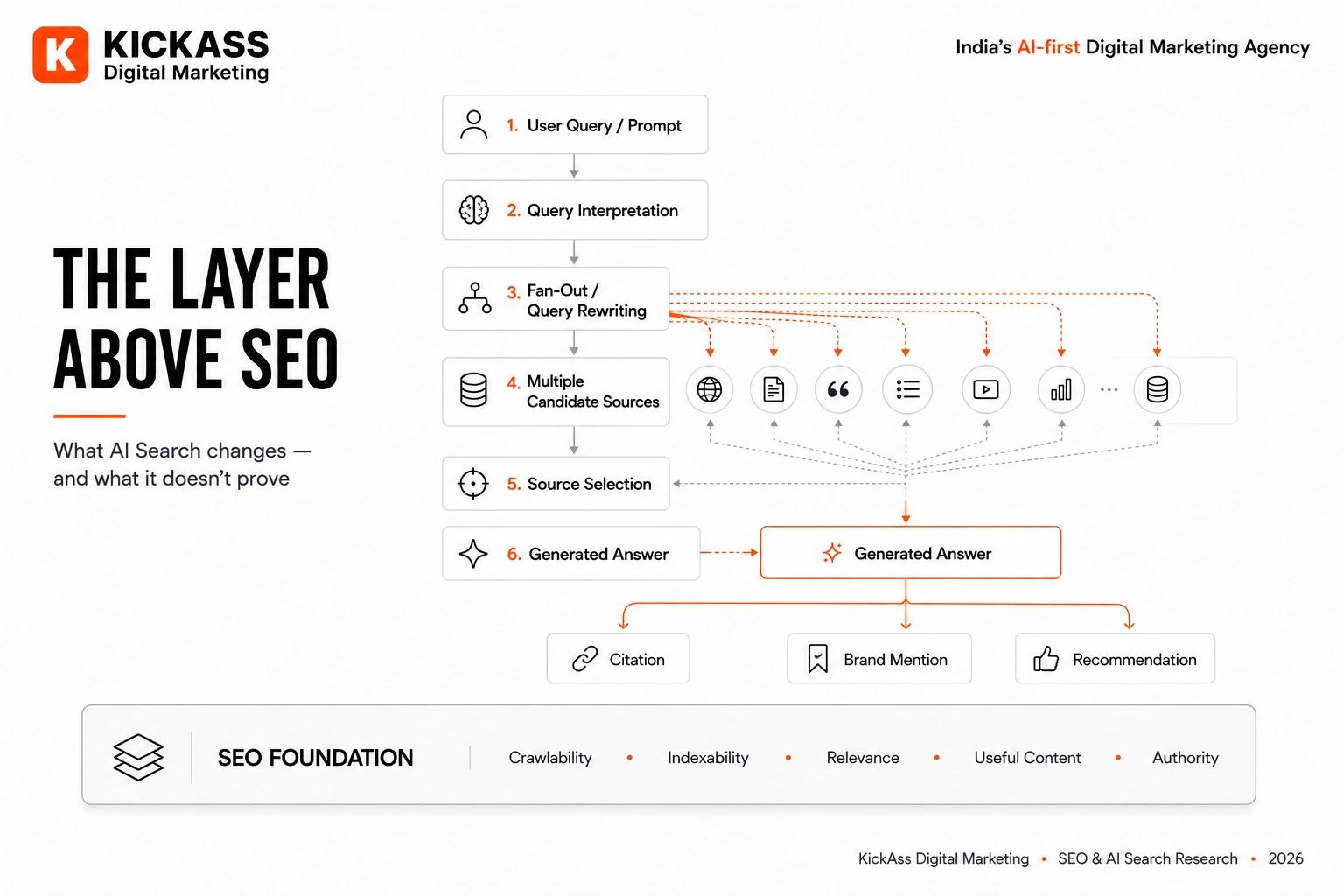
Figure 1 — AI Search expands what happens above the SEO foundation: one prompt can trigger multiple searches, sources and generated outcomes.
Consider a real-estate developer in Goa.
The developer may rank well for:
luxury villas in North Goa
But a buyer asks:
Which villa developments in North Goa would suit an NRI family looking for a reputed developer, quiet surroundings, reasonable airport access and a property that will be easy to manage while they are overseas?
That is not simply a longer keyword.
It contains multiple information needs:
developer credibility, project location, accessibility, property characteristics, maintenance, buyer profile and probably third-party evidence.
An AI system can search across those sub-problems before constructing the answer.
The landing page ranking for the literal head term still matters.
It is no longer the whole evidence environment.
This is one of the most important distinctions in the entire AI visibility discussion.
A business can move through several different states:
Eligible → Retrieved → Used → Cited → Mentioned → Recommended → Commercial Outcome
They are not interchangeable.
Eligibility means the system can potentially access the information.
Retrieval means a source or passage enters the candidate information set for that request.
Use means information from that source contributes to the answer.
Citation means the interface visibly attributes something to the source.
Mention means the actual business or brand appears in the generated answer.
Recommendation is more demanding: the system presents that brand as an appropriate option for the user’s need.
And only after that do we get to what a marketing team ultimately cares about: preference, branded search, a website visit, enquiry, shortlist, booking or sale.
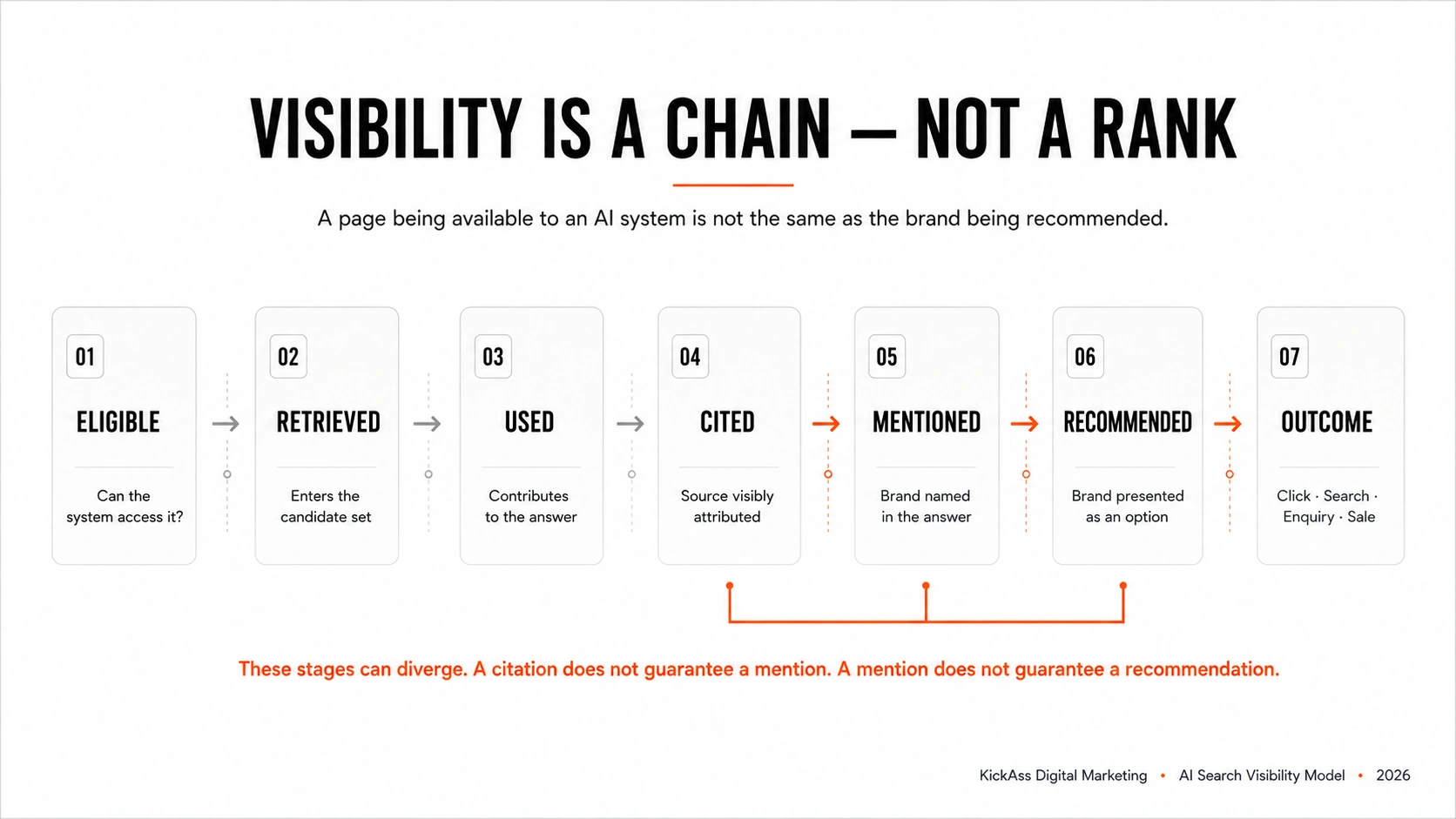
Figure 2 — Citation, mention and recommendation are different visibility states. Measuring them as one metric hides where a brand actually drops out.
This distinction becomes especially important in high-consideration categories.
A hotel may be used as a source for factual information without appearing in the shortlist.
A publication might be cited while the brands it discusses get mentioned.
A real-estate portal may supply project facts while a developer’s own website receives no citation.
And an AI system can recommend a company without producing a click at all.
ShodhDynamics describes this wider structural change through its work on AI Decision Funnels:
“If marketing funnels optimise outcomes, AI decision funnels determine who is even considered.”
That is a more commercially useful way to think about AI visibility than treating every citation as a new version of keyword rank.
The AI Discovery Lexicon deliberately separates concepts such as Prompt-Level Visibility, Source Gravity, Answer Compression and the Shortlist Moment because generated-answer presence is not the same thing as conventional click-based discovery.
Ranking still matters.
What the evidence does not support is treating organic position as a deterministic AI citation position.
In March 2026, Ahrefs analysed 863,000 keyword SERPs and four million AI Overview URLs.4
For conventional blue links:
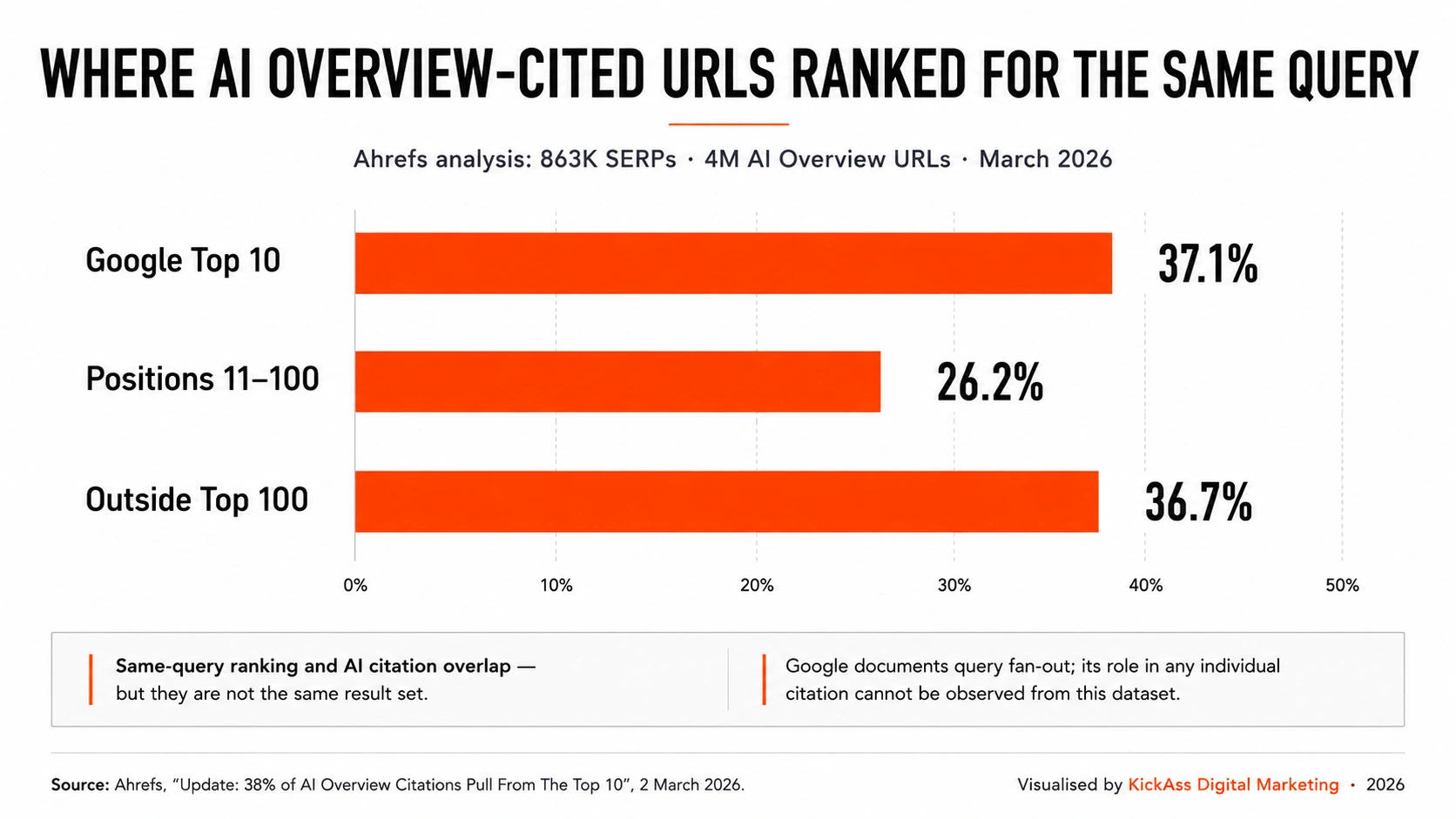
Figure 3 — Only 37.1% of AI Overview-cited URLs in Ahrefs’ March 2026 dataset also ranked in the conventional top 10 for the same query.
Those numbers do not prove rankings are becoming irrelevant.
They establish something narrower:
The user’s literal-query ranking does not fully explain source selection in AI Overviews.
That is a critical distinction.
The same Ahrefs research explicitly points to query fan-out as a plausible explanation for the widening difference between the original SERP and the URLs ultimately cited.4
Google documents that fan-out exists.1
But we cannot see every hidden query.
Therefore we cannot legitimately say:
“This URL was cited because it ranked #3 for fan-out query X.”
unless that query was actually observable.
Nor can we turn fan-out into another content-production formula:
“Publish one page for every sub-query and citations will increase.”
That causal step has not been established.
The mechanism is documented.
The weighting is not.
One of the more revealing parts of this investigation was not a third-party study.
It was what happened when we asked AI systems themselves.
We gave the same underlying question to:
Then we did something that materially changed several answers.
We asked each system to go back through its recommendations and separate:
platform-documented mechanisms, experimental evidence, observational correlation, reasonable inference and common industry claims without strong evidence.
The eventual consensus was much narrower than the first-pass advice.
Across the panel, the strongest common ground was:
llms.txt is not established as a Google AI Search ranking lever;What was more interesting was what changed after pressure testing.
| System | Initial tendency | After evidence challenge |
|---|---|---|
| ChatGPT | Already relatively cautious about causal claims | Became even more explicit about separating retrieval from downstream use and correlation from mechanism |
| Claude | Presented entity establishment and third-party mentions as strong new levers | Later acknowledged confounding and weakened causal language |
| Gemini | Made relatively confident schema/entity and crawler claims | Later separated some documented crawler functions more carefully |
| Perplexity | Prescribed concrete answer/passsage formats and lengths | Later admitted there was no strong controlled evidence for exact formulas, although some formulaic recommendations returned in its final advice |
This is not evidence that one AI system is “better” at SEO.
That was not the test.
The important finding is that evidence pressure changed the advice.
A recommendation that sounds established in a generated answer may become substantially more qualified when the same model is asked:
What exactly proves that?
That matters because marketers are increasingly using AI-generated advice to build AI-search strategy.
We are in a period where the systems summarising the evidence can also amplify the industry’s uncertainty.
After the four-system exercise, we manually searched ten semantic variations of the topic in Google from India on 20 August 2026.
The wording changed.
The underlying intent did not.
Queries included:
SEO for AI searchAI SEOhow to optimize for AI searchdoes SEO still matter for AI searchhow does AI search choose sourcesdoes ranking help AI citationsSEO strategy for Google AI ModeSEO for ChatGPTschema for AI searchis GEO different from SEOThe AI Overviews repeatedly mixed statements with very different levels of evidentiary support.
For SEO for AI search, Google recommended direct summaries, topical clusters, structured data, unique expertise, quarterly freshness and external-platform presence as “Core Optimization Tactics”.
For how to optimize for AI search, the overview became more prescriptive: put 40–60-word answers beneath major headings, turn H2/H3s into questions, implement schema and maintain single-intent pages.
For how does AI search choose sources, the overview described a clean pipeline of query expansion, passage retrieval, trust filtering and grounding, then presented clarity, topical authority, consensus and freshness as source-selection signals.
Some of those practices may be useful.
But the confidence of the presentation exceeds what can currently be verified as a universal causal mechanism.
That is the distinction this article is making.
Not:
“Ignore clarity.”
Not:
“Never use schema.”
Not:
“Freshness does not matter.”
But:
Do not confuse a sensible practice, an observed correlation and a documented ranking mechanism.
Schema is useful.
We use structured data extensively ourselves.
It can represent organisations, people, services, products, offers, authorship and relationships in machine-readable form. It serves established Search functions and can reduce ambiguity in how facts are expressed.
But that is different from saying:
Add schema and AI systems will cite you more.
Ahrefs first examined six million URLs and found that AI-cited pages were almost three times more likely to contain JSON-LD than non-cited pages.5
On its own, that is easy to turn into a LinkedIn carousel:
Schema = AI visibility.
But technically sophisticated websites are also more likely to publish better content, attract links, maintain their sites properly and have stronger authority.
Schema may simply co-exist with all of that.
So Ahrefs ran a second study.
It tracked 1,885 pages that added JSON-LD and matched them against 4,000 control pages. Citation changes in ChatGPT and Google AI Mode were statistically indistinguishable from zero; the authors also cautioned against reading a small relative decline in AI Overview citations as schema causing harm.5
That is a much better example of how SEO evidence should be interpreted.
“AI-cited pages often have schema”
and
“adding schema causes additional AI citations”
are not the same claim.
Google itself says there is no special schema required for AI Overviews or AI Mode.1
Our conclusion is therefore straightforward:
Use structured data when it accurately represents the page, supports Search functionality, improves data clarity or serves an operational purpose. Do not sell generic schema as a proven independent AI-citation lever.
This distinction also matters in our own AI Readiness work. Machine-readable infrastructure can be valuable without pretending that every infrastructure layer is a disclosed ranking factor.
llms.txt is another good example of a promising infrastructure idea being converted too quickly into a visibility claim.
Google explicitly says website owners do not need new machine-readable AI files to appear in AI Overviews or AI Mode.1
Ahrefs subsequently analysed 137,210 domains in May 2026.6
Around 28% published a valid llms.txt.
Of those files, 97% received no request at all during the measured month.
That does not prove llms.txt will never matter.
It does not prove that no current specialised agent uses it.
And it certainly does not tell us what future agentic systems will adopt.
What it does tell us is that the current evidence cannot support:
“Add
llms.txtand your AI rankings will improve.”
We have an existing guide to llms.txt implementation on this site. This newer research gives us reason to be more precise about what the file currently demonstrates versus what remains experimental.
That distinction matters because KickAss does use machine-readable infrastructure.
Our position is not that experimentation should stop.
It is that implementation and proven visibility impact are two different claims.
This is where the discussion needs more nuance.
Clear writing is useful.
Good headings are useful.
Putting the answer before 500 words of generic introduction is usually better for a human reader too.
Tables can make comparisons easier.
Specific facts are more useful than vague marketing copy.
None of those practices needs a secret LLM ranking factor to justify it.
There is also evidence worth studying.
Semrush compared 304,805 AI-cited URLs against 921,614 Google-ranking URLs across 11,882 prompts and found positive associations with qualities including clarity, summarisation, Q&A formatting and section structure.7
But the study examined visible textual features.
It did not prove:
rewriting an existing page into 40-word answer blocks will independently cause the page to be retrieved and cited more often.
That distinction matters.
The original Generative Engine Optimization research accepted at KDD 2024 also demonstrated that certain changes to source material could alter visibility inside the generative environments tested, with results varying by intervention and domain.8
That is meaningful evidence.
But the study does not justify converting:
“some interventions changed visibility within the tested setup”
into:
“do this on your live website and ChatGPT will retrieve you 40% more often.”
The missing step is organic retrieval.
A model using a document differently after that document has already entered its context is not the same thing as proving an edit caused the live search system to retrieve that document.
That remains one of the most important open questions in AI-search optimisation.
AI-generated recommendations make the business’s own website only one part of the evidence environment.
Independent sources can become important.
Pew Research Center analysed 68,879 Google searches in 2025 and found that Wikipedia, YouTube and Reddit collectively accounted for 15% of sources cited in AI summaries.9
That supports a practical conclusion:
the wider information environment around a brand matters.
It does not establish:
“Get more Reddit mentions and ChatGPT will recommend you.”
Those are different claims.
This is where ShodhDynamics’ ESC™ Framework is useful as an analytical model.
ESC™ separates:
Entity Clarity
Can the system establish what the entity actually is?
Semantic Authority
Is there sufficient substantive information connecting the entity to the subject?
Cross-Source Trust
Do independent sources provide enough consistent evidence for the system to reason about the entity confidently?
ESC is not presented as Google’s ranking algorithm or OpenAI’s recommendation formula.
That is exactly how a framework should be used.
It helps structure the problem without pretending to expose hidden model weights.
It is easy for this discussion to become too technical.
For a marketing director, CMO or founder, the practical problem often looks much simpler.
Your business ranks.
Your competitors appear when buyers ask AI for recommendations.
You do not.
Why?
Consider a hotel in Singapore.
The hotel’s website can be technically excellent. Its room pages can rank. Its local information can be accurate. Its structured data can be valid.
Then a traveller asks:
Where should I stay in Singapore for a three-night business trip if I need late check-in, easy access to Marina Bay, restaurants within walking distance and somewhere quiet enough to work in the evening?
The answer may require evidence about:
The problem is no longer simply:
Does the hotel page rank?
It becomes:
Does the wider evidence environment give the answering system enough accessible, relevant and credible information to include that hotel in the shortlist?
The same applies to a real-estate developer in Goa, a travel business in Dubai or a B2B company in Gurugram.
Search visibility still matters.
But discovery and evaluation are beginning to overlap.
That is the business reason to care about AI Search.
Not because SEO has acquired more acronyms.
The easiest way to lose perspective is to put every AI-search recommendation into one bucket.
They do not belong there.
| Claim | Current evidence status | How we would treat it |
|---|---|---|
| Foundational SEO still matters for Google AI features | Documented | Act on it |
| Google uses query fan-out | Documented | Adapt research and content architecture |
| ChatGPT can rewrite prompts into multiple searches | Documented | Adapt query-family research |
| OAI-SearchBot access matters for ChatGPT Search inclusion | Documented | Check technical access |
| Organic ranking and AI citation are related | Observed / correlational | Use ranking as one visibility input, not a guarantee |
| Clear, well-structured content correlates with citations | Observed / correlational | Apply where useful; test impact |
| Third-party sources frequently appear in AI answers | Observed | Analyse source ecology and reputation |
| Adding generic schema increases AI citations | Not established | Use schema for legitimate purposes; test separately |
llms.txt increases AI ranking/citation | Not established | Treat as infrastructure experiment |
| Exact 40–60-word answers improve retrieval | Not established | Do not make it a rule |
| Fixed 130–170-word chunks improve citations | Not established | Do not make it a rule |
| More Reddit mentions cause recommendations | Not established | Do not manufacture mentions |
| #1 Google ranking guarantees AI citation | Contradicted by observed data | Measure both separately |
This is the part most “AI SEO checklists” remove.
Uncertainty.
But uncertainty is not a weakness in strategy.
It tells us what to build, what to measure, and what to test.
After reviewing the evidence, we needed a practical way to prevent two opposite mistakes:
Our working model is BASE™.
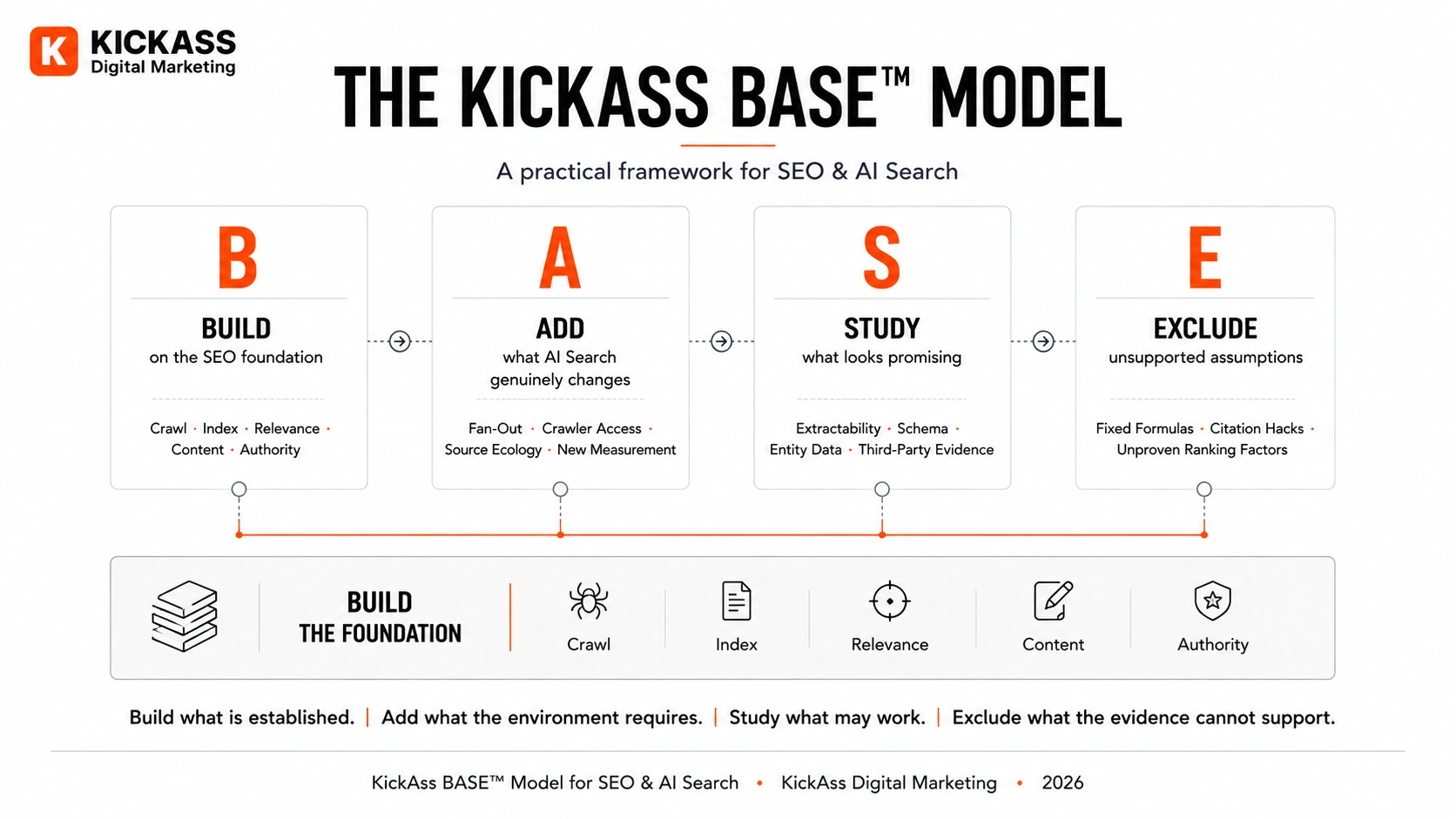
Figure 4 — The KickAss BASE™ Model separates established SEO foundations from genuine AI Search additions, experimental tactics and unsupported assumptions.
Keep investing in what still establishes search eligibility, relevance and competitiveness:
technical SEO, crawlability, indexability, useful content, internal architecture, authority, links, page quality and genuine topical coverage.
For Google, this is explicitly supported by its own guidance.1
Do not try to repair weak SEO with “GEO formatting”.
Some additions are justified by documented changes.
Audit platform-specific crawler access.
Research query families and likely fan-out territory instead of treating a single keyword as the entire demand surface.
Measure citations, mentions and recommendations separately.
Study the source environment beyond your own domain.
And monitor the platforms where your actual buyers are asking questions.
Google itself has begun separating this layer in reporting. In June 2026 it launched dedicated generative-AI visibility reporting in Search Console for a subset of websites, including impressions, pages, countries, devices and dates for AI Search surfaces.10
This is where serious experimentation belongs.
Test whether clearer content changes live retrieval.
Test structured-data interventions without simultaneously rewriting the page.
Test entity-data clean-up.
Test third-party evidence.
Test whether results differ by industry.
Test whether Goa, Singapore, Dubai or Delhi NCR produce different recommendation environments.
Repeat prompts rather than trusting one screenshot.
Most importantly, define the outcome before the test.
Are we measuring:
retrieval? citation? mention? recommendation? traffic? enquiry?
If those are mixed together, the test tells us very little.
Do not build a client strategy around claims such as:
llms.txt is an AI ranking factor;Our research does not support treating those statements as established fact.
A useful pressure test for any new tactic is:
What exactly establishes this?
If the evidence chain ends with an agency blog quoting another agency blog quoting an AI-generated answer, that is not enough.
The SEO agency’s job is widening.
Not because somebody renamed SEO as GEO.
Because the environment in which discovery happens is widening.
If you are choosing an agency, it should be able to explain:
what part of its work strengthens conventional Search;
what is specifically relevant to Google AI Overviews and AI Mode;
what additional crawler or access controls matter for systems such as ChatGPT;
how it researches semantic query families rather than simply matching exact keywords;
how it evaluates the wider evidence environment around the brand;
how it distinguishes citation, mention and recommendation;
how it measures AI visibility without pretending one prompt is a stable rank;
and which parts of its programme are proven practice versus controlled experimentation.
That matters more than whether the proposal says SEO, GEO, AEO or AI SEO on the cover.
The terminology is easy.
Evidence discipline is harder.
The shortest defensible answer is:
The foundation changes less than the discovery and decision layer above it.
SEO still helps determine whether information is crawlable, indexable, relevant, useful and competitive.
AI Search adds additional behaviour above that foundation:
That is a real change.
But it does not follow that every tactic being sold under AI SEO or GEO has therefore become a proven mechanism.
That is the line businesses should hold.
Build what is established.
Add what the new environment clearly requires.
Study what may work.
Exclude what the evidence cannot yet support.
That is the logic behind the KickAss BASE™ Model for SEO & AI Search.
For now, that is a more defensible operating model than pretending anybody has already reverse-engineered the final AI-search playbook.
Frequently Asked Questions related to SEO for AI Search
Yes. SEO remains relevant because AI-powered search still depends on accessible, indexable, relevant and trustworthy web content. Google explicitly says its existing SEO best practices continue to apply to AI Overviews and AI Mode. What changes is that AI systems can retrieve across multiple queries and sources before deciding what to cite, mention or recommend.
Optimising for AI Search starts with strong SEO, then adds attention to query fan-out, AI crawler access, source-level evidence, machine-readable clarity and measurement of citations, mentions and recommendations. Practices such as fixed answer lengths, generic schema for citation gain or llms.txt as a ranking factor should be tested rather than treated as proven requirements.
There is no publicly documented universal formula for how AI Search chooses sources. Major systems can retrieve information through search, query rewriting or fan-out and then select material for a generated answer. Relevance, accessibility and source quality clearly matter, but the exact weighting behind retrieval, citation and recommendation is not publicly disclosed and varies by platform.
Higher Google rankings are associated with AI citations, but they do not guarantee them. In Ahrefs’ March 2026 analysis, only 37.1% of AI Overview-cited URLs also ranked in the conventional top 10 for the same query. Query fan-out means AI systems may retrieve sources through related searches that differ from the user’s literal query.4
GEO and SEO describe different optimisation outcomes, but GEO does not replace SEO. SEO establishes discoverability, relevance and authority in search; GEO focuses more specifically on visibility inside generated answers, including citations and brand representation. In practice, effective GEO usually depends on a strong SEO foundation plus additional work around AI retrieval and source ecosystems.
Not consistently. “AI SEO” is used both for optimising visibility in AI-generated search and for using AI tools to perform conventional SEO work. GEO has a narrower meaning: optimising how content or brands appear in generative answers. Because industry terminology is still fragmented, the underlying objective matters more than the label.
Schema markup is useful for representing facts and entities in machine-readable form, but current evidence does not show that adding generic schema independently causes more AI citations. Google says no special AI-specific structured data is required for its generative Search features. Use schema where it accurately describes the content, not as a guaranteed citation hack.5
No major search platform currently requires llms.txt as a general AI Search ranking mechanism. Google explicitly says it is not required for AI Overviews or AI Mode.1 It can still be used experimentally as machine-readable infrastructure for systems that choose to support it, but its effect on retrieval or citations should not be assumed.
Some platform-specific differences are real. For example, OpenAI says OAI-SearchBot access is relevant to inclusion in ChatGPT Search.11 But that does not mean a completely separate content strategy is required for every LLM.
There is no strong evidence supporting 40–60 words as a universal AI-search optimisation rule. Direct, clear answers can improve readability and extractability, but exact lengths should be treated as a hypothesis rather than a ranking factor.
This investigation was conducted in August 2026.
We deliberately used several evidence layers rather than relying on one SEO tool, one AI system or one SERP snapshot.
We reviewed official platform documentation, academic research and disclosed industry datasets covering:
Google AI Overviews and AI Mode, ChatGPT Search, query fan-out, generative-engine optimisation, schema, llms.txt, crawler access, rankings, citations and AI visibility.
Primary platform documentation was given greater weight than agency or vendor claims.
The same initial research question and three evidence-challenge follow-ups were run through:
ChatGPT, Gemini, Claude and Perplexity.
The prompts asked the systems to distinguish:
The four raw outputs were then analysed together as a closed evidence set.
We examined:
terminology, recurring sources, agreement, disagreement, evidence quality, causal overreach and whether individual systems changed their recommendations after being challenged.
On 20 August 2026, we manually searched Google from an incognito browser session in India across ten semantically related intents.
We recorded:
We did not treat Google AI Mode as part of this manual Stage 4 sample.
This is an evidence audit, not a reverse-engineering study.
AI responses can vary by model version, geography, account state, personalisation and time.
A visible citation does not reveal every source retrieved internally.
A missing citation does not prove a source was never retrieved.
And observational relationships should not be converted into causal ranking factors.
The first-party research package for this investigation contains:
DOWNLOAD – SEO for AI Search Consolidated ZIP
Publishing the raw material is recommended so readers can inspect the AI outputs, source trails and evidence challenges rather than relying only on our interpretation.
Editorial verification date: 20 August 2026
Platform documentation and time-sensitive research findings should be rechecked before major future revisions because AI Search interfaces, models and reporting can change rapidly.