Get Marketing Insights First
Subscribe to receive actionable strategies, growth tips, and industry insights delivered straight to your inbox.

SEO, GEO and AEO are often presented as three distinct optimisation disciplines: rank, answer and get cited. Our live Google Search audit in India found that the distinction becomes much less stable when the questions change. This research separates the shared SEO foundation from genuine platform-specific differences, overlapping terminology and tactics that are still being presented more confidently than the evidence supports.
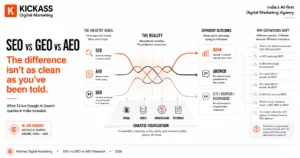
SEO vs GEO vs AEO. We changed the intent:That matters because businesses are increasingly being asked to buy SEO, AEO, GEO and AI SEO as separate services when much of the underlying work overlaps.
What capability are we actually adding, what outcome are we trying to influence, and what evidence shows that the work differs from good modern SEO?
Prefer the practitioner walkthrough? This video explains the research through practical examples — including the difference between ranking, retrieval, citation, brand mention and recommendation; why the optimization unit can change by platform; and how to diagnose the capability your business actually needs.
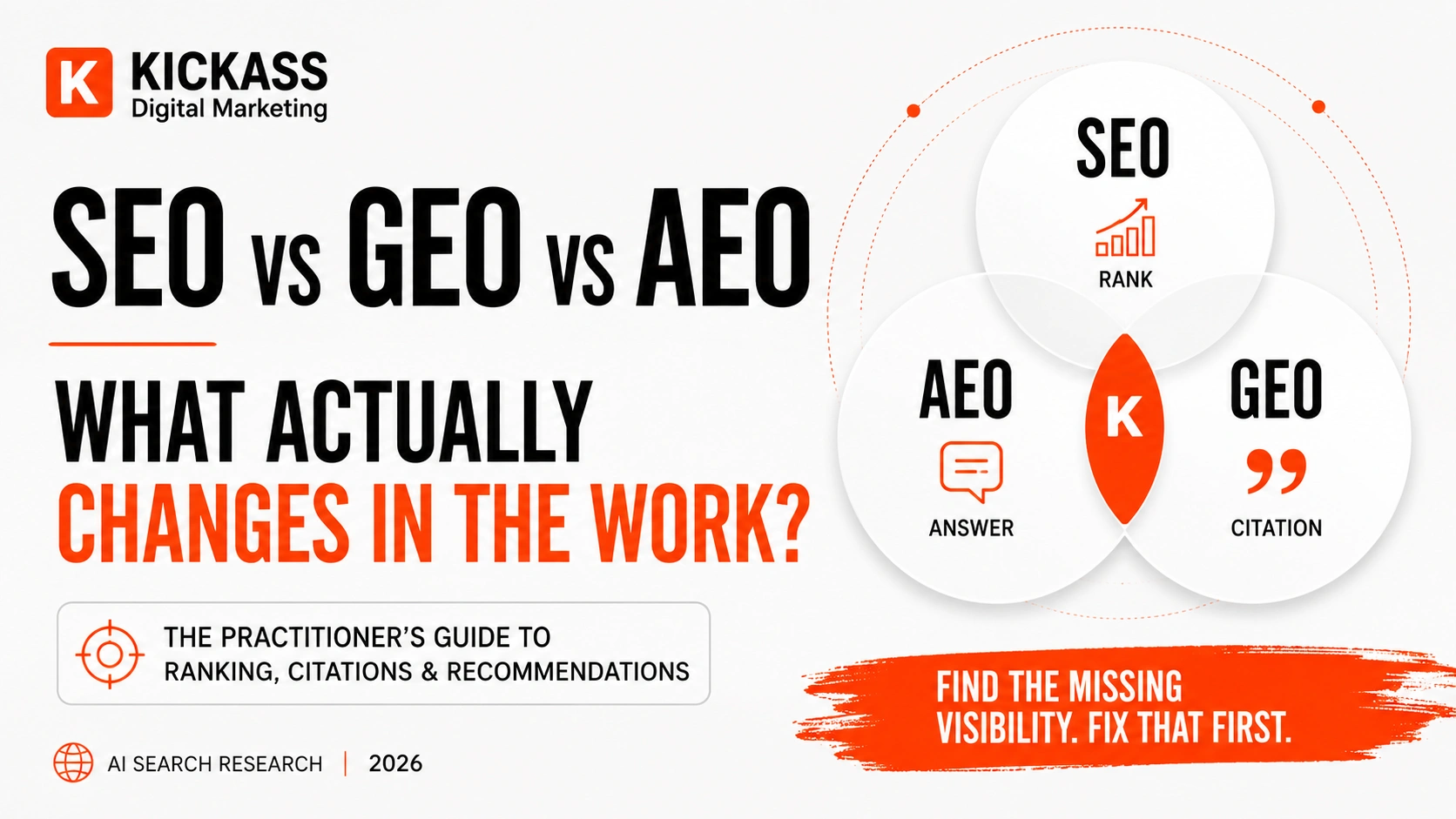
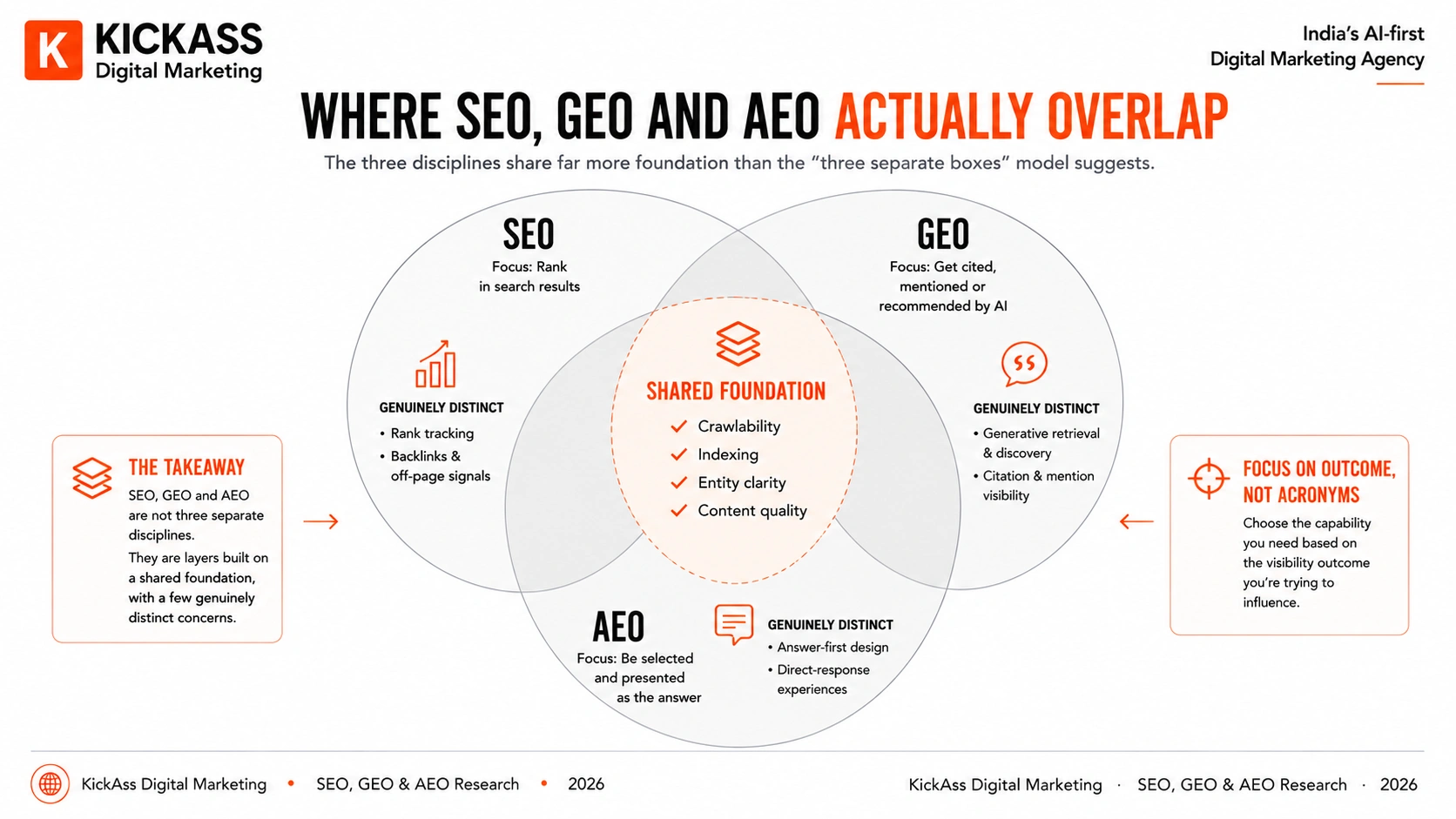
Figure 1: The three disciplines share far more foundation than the “three separate boxes” model suggests.
SEO, GEO and AEO overlap more than their names suggest. SEO provides the foundation for crawling, indexing, relevance and search visibility. GEO focuses on being retrieved, cited, mentioned or recommended in generative AI responses, while Answer Engine Optimization focuses on being selected and presented as an answer. In practice, AEO and GEO increasingly overlap. The meaningful differences emerge less from the acronym and more from the platform, retrieval environment, information sources and visibility outcome being optimised.
For Google Search specifically, this distinction is unusually clear. Google’s official guide says its generative Search features remain rooted in core Search ranking and quality systems, retrieve supporting material from the Search index, and can use query fan-out to generate related searches. Google also says that, from its perspective, work described as AEO or GEO for generative Search is still SEO. See Google Search Central’s guide to optimising for generative AI features.
That does not mean nothing has changed.
It means we need to separate changes in the discovery architecture from changes in the name of the service being sold.
For the head query SEO vs GEO vs AEO, the AI Overview generated a familiar division:
| Label | Broad framing surfaced in the AI Overview |
|---|---|
| SEO | Traditional rankings and clicks |
| AEO | Direct answers, snippets and voice |
| GEO | Citations, mentions and recommendations in generative AI |
It then described the three as complementary layers. The answer was synthesised from third-party sources, including digital-marketing publishers and agencies.
Change the wording to what is the difference between SEO GEO and AEO and the structure remains similar. AEO becomes concise definitions, FAQs and schema; GEO becomes entity authority, original data and conversational depth.
Search AI SEO vs GEO vs AEO and the same clean separation appears again: SEO for rankings, AEO for extraction, GEO for AI synthesis, mentions and recommendations.
If we stopped there, the obvious conclusion would be:
You need three optimisation disciplines.
But that conclusion starts to break when we change the query.
This is the most important observation from our audit.
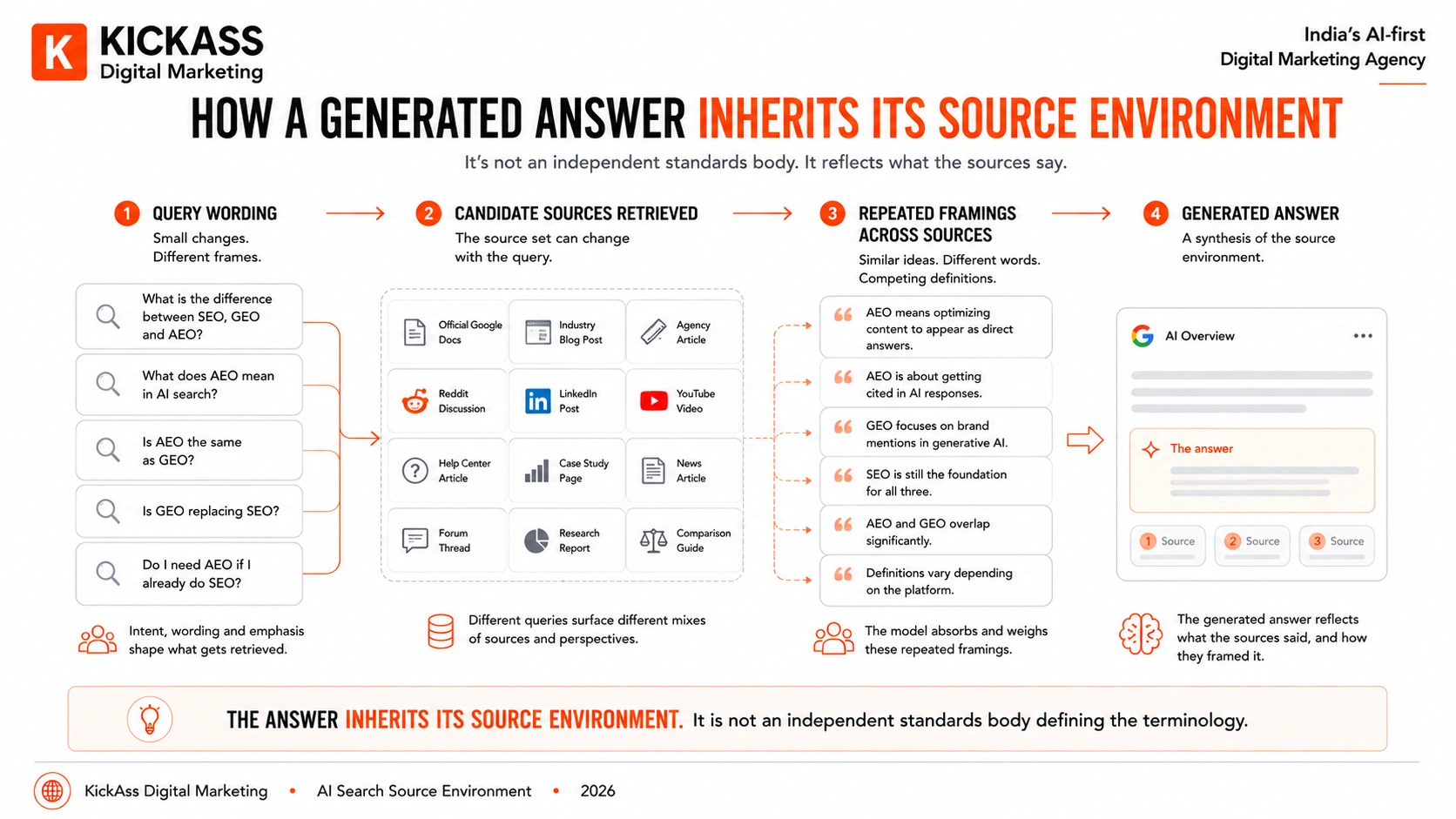
An AI Overview is a generated response. It retrieves information, evaluates candidate material and synthesises an answer. It is not an independent industry standards body publishing canonical definitions.
Google’s own documentation describes retrieval-augmented generation and query fan-out as part of how its generative Search features gather supporting information. In Google’s description, core Search systems retrieve relevant pages and the generative system uses information from those retrieved pages to produce the response. See Google’s generative AI Search documentation.
So when an AI Overview tells us:
SEO ranks, AEO answers, GEO gets cited
the first question should not be:
“Is that Google’s official definition?”
It should be:
“Which sources were available and selected to construct that answer?”
Our audit demonstrates why.
For GEO vs AEO, the generated answer placed AEO around direct snippets and voice results while GEO covered LLM citations and recommendations. It also surfaced the familiar claim that AEO content should use 40-to-60-word definitions.
But when we searched:
AEO suddenly expanded.
The generated answer described Answer Engine Optimization as work intended to make content extractable and citable by ChatGPT, Google AI Overviews, Perplexity and Microsoft Copilot, and associated it with citations, mentions, brand authority and third-party presence.
Those are many of the same outcomes that preceding queries had labelled GEO.
Then:
produced another distinction.
The generated response said the terms were not exactly the same while acknowledging that marketers often use them interchangeably. It again tried to separate AEO around direct answers and GEO around broader LLM sourcing.
The inconsistency is not evidence that Google has three conflicting official definitions.
The web has conflicting definitions. Generated search can inherit that instability from the sources it retrieves.
This is where ShodhDynamics’ concept of Source Gravity is useful as an analytical lens: a topic’s answer environment is not shaped equally by every page that exists. Repeated framings across the sources that are available, relevant and repeatedly surfaced can become disproportionately visible in generated answers.
The opportunity for publishers is therefore straightforward:
do not produce the 101st copy of the dominant definition. Produce a better source.
One reason the three-way comparison becomes misleading is that it often defines SEO far too narrowly.
Modern SEO is already broader than that. It includes crawlability, rendering, indexing, information architecture, semantic relevance, internal relationships, content quality, structured data where appropriate, local and ecommerce information, multimedia and user intent.
Google’s current generative-AI Search guidance explicitly says SEO best practices continue to matter because AI Overviews and AI Mode are rooted in its core Search systems. Pages still need to be eligible for Search, and Google still retrieves content from its Search index. Google’s guide also explicitly treats AEO and GEO as labels people use for AI-search visibility work rather than as separate requirements for Google Search.
This is the foundation we established in our earlier research, SEO for AI Search: What Actually Changes — and What the Evidence Doesn’t Yet Prove.
What changes above that foundation is significant:
one query can fan out into several related searches; candidate sources can differ from the literal-query SERP; generated answers synthesise information; and ranking, retrieval, citation, brand mention and recommendation become separate visibility states.
Calling all of that “traditional blue-link SEO” understates modern SEO.
Calling all of it GEO understates the shared foundation.
The useful distinction lies between the foundation and the additional discovery environments built above it.
GEO — Generative Engine Optimization — remains useful terminology when the objective is specifically visibility inside generative responses.
That can include whether:
Those are not equivalent outcomes.
Our research into how Perplexity selects and cites sources examines a search-and-retrieval environment where citation behaviour can be studied independently from conventional Google rank.
Our study of Claude AI sourcing and off-page entity optimisation shows why the wider public-web source environment can matter when analysing how a brand is represented beyond its own domain.
Neither study establishes a universal “GEO ranking factor”.
They demonstrate why platform-specific retrieval and source-selection analysis can require work beyond conventional rank tracking.
That is where GEO is useful.
Not as a replacement for SEO.
As a name for a newer optimisation objective that SEO historically did not have to measure directly.
ShodhDynamics uses the broader term AI Discovery for the process by which AI systems identify, retrieve, prioritise and include entities within generated responses rather than relying on a ranked result list and subsequent user navigation.
That conceptual distinction is closer to the real change than “SEO writes long pages; GEO writes AI-friendly pages”.
Answer Engine Optimization predates the current generative-AI boom.
Historically, the term was associated with direct-answer environments such as featured snippets, voice assistants, People Also Ask results, structured Q&A and zero-click search experiences.
That explains why many current SEO-vs-AEO-vs-GEO articles still define AEO around short answers, FAQ blocks and schema.
Our India audit surfaced exactly this pattern. For SEO vs GEO vs AEO India, the generated answer described AEO around question headings, FAQ schema and a fixed 40-to-60-word answer length.
There are two problems with treating that as a current optimisation formula.
First, Google says there is no requirement to break content into tiny chunks for AI, no ideal page length, and no need to rewrite content into a special generative-AI style. It also says there is no special structured-data markup required for generative AI Search. See the mythbusting section of Google’s official generative Search guide.
Second, Google stopped showing FAQ rich results in Search starting 7 May 2026, and is retiring the FAQ search-appearance filter, the rich result report and Rich Results Test support through June 2026, with Search Console API support following in August. The FAQPage markup itself remains valid and does not need to be removed — only the visible SERP feature is gone. That change is documented in the Google Search documentation changelog.
That does not make FAQs bad content.
We use question-led answers ourselves because real users ask questions and self-contained answers are easier for people to understand and easier to reuse across search, support and editorial contexts.
But that is an editorial decision.
It should not be converted into an unsupported rule such as:
“Write every answer in 40–60 words because AI systems prefer it.”
This is a good example of why AEO needs to be separated into useful practice and claimed mechanism.
Our Answer Engine Optimization (AEO) agency in India work is therefore best understood as answer-oriented information design operating within a wider SEO and AI-discovery system — not a separate technical universe.
One universal GEO checklist is difficult to defend because AI-mediated discovery does not use one universal retrieval architecture.
Consider three of our recent first-party studies.
For ecommerce and shopping-oriented use cases, product information can enter the discovery environment through structured commercial systems, not only through ordinary webpage text.
Google’s own guidance says Merchant Center feeds can help products and services appear in generative AI responses and other Google Search results. See Google Search Central’s Merchant Center guidance inside the generative AI guide.
Our first-party research on Gemini product recommendations, Merchant Center and SEO examines what that broader structured commercial environment looks like in practice.
That is not simply “GEO content formatting”.
It is platform-specific commercial infrastructure.
Our Claude sourcing research highlighted the need to analyse evidence that exists outside the brand’s own site.
If an AI system constructs an answer using aggregators, specialist publications, community discussions or other third-party sources, rewriting another H2 on your own domain may not solve the visibility gap.
That is an information-environment problem.
Perplexity makes citation behaviour unusually observable.
That lets us study which sources appear, how sourcing varies by query and whether conventional rankings align with cited sources. Our Perplexity AI citation-source analysis focuses on that distinction.
Again, the problem is not adequately described by:
“Write more concise answers.”
These examples are why we resist treating GEO or AEO as a universal set of page-level tactics.
The optimisation unit changes with the platform.
Sometimes it is the webpage.
Sometimes it is a product feed.
Sometimes it is the brand’s third-party evidence.
Sometimes it is crawler access.
Sometimes it is the broader entity.
Sometimes the problem is not discoverability at all — it is what happens after discovery.
This was one of the most useful live queries in our audit.
For is SEO still enough for AI search, the AI Overview generated the conclusion that “traditional SEO” was no longer enough on its own and then expanded into entity authority, machine-readable context, schema and cross-web brand mentions.
The problem is the word traditional.
If traditional SEO means:
rank one webpage for one keyword and measure ten blue links,
then no — that model is incomplete.
If SEO means:
build technically accessible, relevant, authoritative information that search and discovery systems can retrieve, understand and connect to user intent,
then SEO remains the foundation.
The additional work is real.
But it should be defined by the new capability being added, not by a requirement to buy another acronym.
For a fuller evidence review of this exact boundary, see SEO for AI Search: What Actually Changes — and What the Evidence Doesn’t Yet Prove.
No.
Our live result environment overwhelmingly reflected the same broad conclusion: GEO was usually presented as an extension of, or additional layer above, an SEO foundation rather than its replacement.
For Google Search specifically, the official position is clearer still. Google says that optimising for its generative AI Search experiences is still SEO. See Google Search Central’s AEO/GEO guidance.
Where GEO adds value is in forcing teams to ask questions rank tracking alone did not answer:
Did the system retrieve us?
Did it cite us?
Did it name the brand?
Did it recommend us?
Which other sources shaped the answer?
Those are legitimate new questions.
They do not erase SEO.
Our answer is generally no — not as three disconnected programmes.
Interestingly, the business-intent results in our live audit move in that direction too.
For:
the generated answer recommended starting with SEO and treating AEO and GEO as additional layers rather than independent competing channels.
But separate searches for do I need GEO if I already do SEO and do I need AEO if I already do SEO both generated “yes” answers and then prescribed additional tactics.
That illustrates the danger of allowing the acronym in the query to define the strategy.
Ask:
“Do I need GEO?”
and the retrieved source environment explains why GEO is needed.
Ask:
“Do I need AEO?”
and the retrieved source environment explains why AEO is needed.
A marketing director should ask something different:
What visibility outcome are we currently missing, and what capability do we need to add to fix it?
A more useful decision framework looks like this:
| Visibility problem | Capability to add | Useful label, if one is needed |
|---|---|---|
| Pages cannot be crawled, indexed or understood | Technical SEO, architecture, content and entity clarity | SEO |
| Content is weak at directly answering important questions | Answer-first information design and question-led content | AEO / SEO |
| Brand is absent from generative citations or recommendations | AI visibility measurement, source analysis and generative retrieval work | GEO / AI SEO |
| Product information is missing or stale in Google’s commercial ecosystem | Merchant Center, product data and structured commercial infrastructure | Ecommerce SEO / AI commerce |
| AI systems rely on third-party sources that do not corroborate the brand | Off-page evidence and cross-source consistency | GEO / AI Discovery |
| Visibility differs materially by platform | Platform-specific testing and measurement | Platform-specific optimisation |
The label is secondary.
The missing capability is the strategy.
We use the KickAss BASE™ Model for SEO & AI Search to prevent emerging terminology from turning every observation into a new service category.
Maintain the things we already know matter:
crawlability, indexability, useful content, relevance, site architecture, authority, accurate entity information and appropriate structured data.
Add capabilities where the environment actually differs:
AI visibility measurement, platform-specific crawler governance, query-fan-out analysis, source and citation analysis, Merchant Center data, third-party evidence mapping, prompt-level monitoring and recommendation testing.
Study observed patterns without prematurely calling them ranking factors:
citation-source patterns, source-type preferences, passage extraction, recency effects, entity associations and emerging agent behaviour.
Do not build strategy around claims we cannot defend:
fixed answer lengths, generic schema as a guaranteed AI-citation lever, llms.txt as a Google AI ranking factor, artificial mentions, or universal GEO ranking-factor lists.
Google’s current documentation directly rejects several supposed requirements for its own generative Search experiences. It says Google Search does not use llms.txt, that there is no required AI-specific markup, that special structured data is not required, and that content does not need to be artificially “chunked”. See Google’s mythbusting guidance.
The purpose of BASE™ is therefore not to replace SEO with another acronym.
It is to classify change according to evidence.
This was the most commercially revealing query in our audit.
The generated answer said generally no and argued that GEO should normally be integrated with the SEO foundation rather than split across competing providers. It suggested evaluating whether the existing SEO partner actually understands AI visibility before adding another specialist.
We would make the answer slightly more conditional.
You do not automatically need three separate agencies. You need the right capabilities under one coordinated search and AI visibility strategy.
If the primary problem is organic discoverability, technical performance, topical authority and visibility across both conventional search and AI-generated discovery, start with an SEO and AI Search Visibility agency that can work across both layers rather than treating AI visibility as an unrelated add-on.
Where the specific gap is being retrieved, cited, mentioned or recommended inside generative responses, a Generative Engine Optimization (GEO) agency in India should be able to analyse source environments, AI citations, entity signals and platform-specific retrieval behaviour rather than simply repackage conventional on-page SEO.
Where the requirement is specifically around direct-answer visibility, question-led information architecture and answer-oriented search experiences, an Answer Engine Optimization (AEO) agency in India can address that layer — although, as this research shows, AEO and GEO increasingly overlap in practical AI-search implementation.
The decision should therefore follow the visibility problem, not the acronym on the agency proposal.
The same distinction applies locally. A business in Goa evaluating a specialist should examine whether the provider can solve the actual visibility gap rather than choosing one because it uses the newest label. Our GEO agency services in Goa focus on generative discovery, citation and recommendation visibility, while our AEO agency services in Goa focus on answer-oriented visibility within the same broader search and AI-discovery system.
Google itself recommends evaluating third-party SEO, AEO and GEO advice critically rather than assuming a tool or service has access to proprietary ranking information or can guarantee performance. See Google Search Central’s guidance on third-party SEO tools and advice.
The acronym itself is becoming unstable.
Search Answer Engine Optimization vs Agentic Engine Optimization and the result environment now recognises both meanings of AEO.
Addy Osmani, a Director of Engineering at Google Cloud AI, uses Agentic Engine Optimization to describe structuring and serving technical information so autonomous AI agents can fetch, parse and act on it. He’s explicit that this is his own practitioner view for a developer audience, not Google Search policy — Google’s separate Search Central guidance does not endorse llms.txt as a ranking input: Agentic Engine Optimization (AEO).
That is materially different from Answer Engine Optimization.
One concerns visibility and answers.
The other concerns machine action.
For commerce, booking and transaction environments, this distinction becomes increasingly important. We explore that wider movement from discovery toward referral, transaction and trust verification in The 5-Layer AI Commerce Engine.
The acronym collision reinforces the broader conclusion:
strategy should be defined by the system and desired outcome, not by whichever three-letter label wins the quarter.
Do not divide the budget into SEO, AEO and GEO because a comparison graphic told you they are three separate boxes.
Prioritise the sequence of problems.
That is the foundation.
That requires measurement.
Ranking? Retrieval? Citation? Brand mention? Recommendation?
Sometimes another content page is the answer.
Sometimes the missing evidence sits in Merchant Center, a knowledge source, an industry publisher, an aggregator or inconsistent information across the web.
Gemini commerce is not Claude sourcing.
Claude is not Perplexity.
Google AI Overviews are not ChatGPT.
That is where implementation should diverge.
Not because the acronym says so.
Because the system does.
There is another reason this distinction matters.
When we ran these searches, the generated answers repeatedly drew from agencies, publishers, LinkedIn posts, Reddit discussions, videos and other available sources.
Those sources are helping shape what SEO, GEO and AEO mean inside generated search.
That creates an opportunity for any publisher working seriously in this field.
If the available web repeatedly says:
SEO ranks. AEO answers. GEO cites.
generated search has ample material from which to reproduce that model.
The response should not be to complain that the model is simplistic.
It is to publish something more useful:
a source grounded in official documentation, live retrieval observations, first-party platform research and explicit evidence boundaries.
Publishing one article does not guarantee retrieval or citation. Our earlier SEO for AI Search evidence review explains why eligibility, retrieval, citation, mention and recommendation need to be treated separately.
But becoming a consistently useful source is the part publishers can influence.
ShodhDynamics uses Inference Authority as a conceptual term for authority that emerges through consistent, corroborated associations rather than self-declaration alone. Its broader AI Discovery Lexicon exists precisely because legacy ranking vocabulary does not describe every stage of generated-answer visibility well.
The aim is not to own another acronym.
It is to become difficult to answer the underlying question well without encountering the evidence you publish.
SEO, GEO and AEO are useful labels only up to the point that they help a team describe a real problem.
SEO remains the foundation.
GEO is useful when the problem is generative retrieval, citation, brand mention or recommendation.
AEO is useful when the problem is answer-oriented information design — but its boundary with GEO is increasingly unstable, and the acronym now has a second emerging meaning in agentic systems.
The live Google audit makes one thing especially clear: the neat three-box model is a product of the current source environment, not a settled technical standard.
For businesses, the practical response is not to buy three strategies.
It is to identify the missing visibility outcome, add the capability that solves it, test what remains uncertain, and reject what cannot yet be supported.
That is a more durable way to operate than chasing the newest acronym.
Frequently Asked Questions related to SEO vs GEO vs AEO
No. GEO is better understood as an additional optimisation objective around visibility in generative AI responses rather than a replacement for SEO. SEO still provides the technical and information foundation required for discovery. GEO adds measurement and optimisation around retrieval, citation, brand mention and recommendation in AI-generated environments.
SEO remains the foundation, but conventional rank tracking alone is no longer enough to measure AI visibility. Businesses may also need to monitor whether their content is retrieved, cited or used in generated answers, whether their brand is mentioned or recommended, and whether platform-specific sources such as product feeds or third-party evidence influence those outcomes.
Not necessarily as a separate programme. If your SEO strategy already covers AI visibility measurement, generative retrieval, citation analysis, crawler access, entity clarity and relevant off-site evidence, much of the required capability may already exist. Add GEO-specific work where the target AI platform or visibility outcome genuinely requires something different.
You do not automatically need a separate AEO programme. Clear question-led information and extractable answers are useful, but they should sit within a strong SEO and AI-discovery foundation. For Google Search specifically, there is no special AEO technical requirement or prescribed answer length for appearing in AI Overviews or AI Mode. See Google’s official generative Search guidance.
Not exactly, but the terms overlap considerably in current industry usage. Answer Engine Optimization traditionally focuses on being selected as a direct answer, while Generative Engine Optimization focuses on visibility within synthesised generative responses. In practice, both are now frequently used to describe optimisation for citations, mentions and visibility in AI-powered search.
Start with the SEO foundation, then add the capabilities required by the discovery environments your customers actually use. Do not fund three isolated strategies simply because SEO, GEO and AEO have different names. Invest in the missing capability: technical discoverability, answer visibility, AI citation measurement, source authority, structured commercial data or platform-specific optimisation.
AEO most commonly means Answer Engine Optimization: structuring information so it can be understood and selected when a system generates a direct answer. However, the term increasingly overlaps with GEO and AI SEO, and AEO is also now being used separately to mean Agentic Engine Optimization in autonomous-agent contexts.
Usually not if your existing SEO agency has genuine AI-search capabilities. Evaluate whether it can measure AI visibility, analyse citation and source environments, handle platform-specific technical requirements and distinguish documented mechanisms from experimental tactics. A separate specialist is useful when those capabilities are missing, not merely because GEO has a different acronym.
This article uses a manual Google Search audit conducted on 23 August 2026 from an incognito desktop session in Indore, Madhya Pradesh, India.
Sixteen deliberate query tests were used across definition, replacement, investment, agency-selection and terminology intents:
SEO vs GEO vs AEOwhat is the difference between SEO GEO and AEOAI SEO vs GEO vs AEOGEO vs SEOAEO vs SEOGEO vs AEOis GEO replacing SEOis SEO still enough for AI searchdo I need GEO if I already do SEOdo I need AEO if I already do SEOis AEO the same as GEOwhich should a business invest in SEO GEO or AEOwhat does AEO mean in AI searchAnswer Engine Optimization vs Agentic Engine OptimizationSEO vs GEO vs AEO Indiado I need a separate GEO agency if I already have an SEO agencyPeople Also Ask, related searches and adjacent commercial follow-up intents were also recorded from the same result pages; these were treated as SERP observations rather than additional deliberate queries.
For each query, we recorded the generated AI Overview where present, surfaced sources, conventional organic results, People Also Ask and related-search patterns.
The AI Overview was treated as an observed generated output, not as official Google guidance.
Claims about how Google Search itself works were checked separately against Google Search Central’s official generative AI documentation and Google Search documentation updates.
Our platform-specific KickAss studies are used as first-party observational examples. They are not presented as universal causal evidence for how every AI system selects or recommends sources.