Get Marketing Insights First
Subscribe to receive actionable strategies, growth tips, and industry insights delivered straight to your inbox.

Perplexity doesn't care how well you rank on Google — it cares whether your page can be cleanly extracted, cross-verified, and cited without ambiguity. Here's how its citation pipeline actually works, and why your best Google ranking may mean nothing here.
Perplexity runs retrieved pages through a multi-stage pipeline — relevance matching, freshness, structural clarity, and a layered reranking pass — before selecting citations. Across AI platforms broadly, one large study found only around 12% overlap between AI-cited URLs and Google’s top-10 results for the same queries — meaning classical Google ranking is a weak predictor of an AI citation generally, Perplexity included.
Yes, consistently. Independent research analyzing over 230,000 prompts found Reddit and LinkedIn among Perplexity’s most-cited domains, alongside our own testing which found the same pattern in Indian commerce categories.
No. Perplexity states advertisers cannot pay for placement in its “related products” section, and its core revenue comes from Pro and enterprise subscriptions rather than sponsored citations.
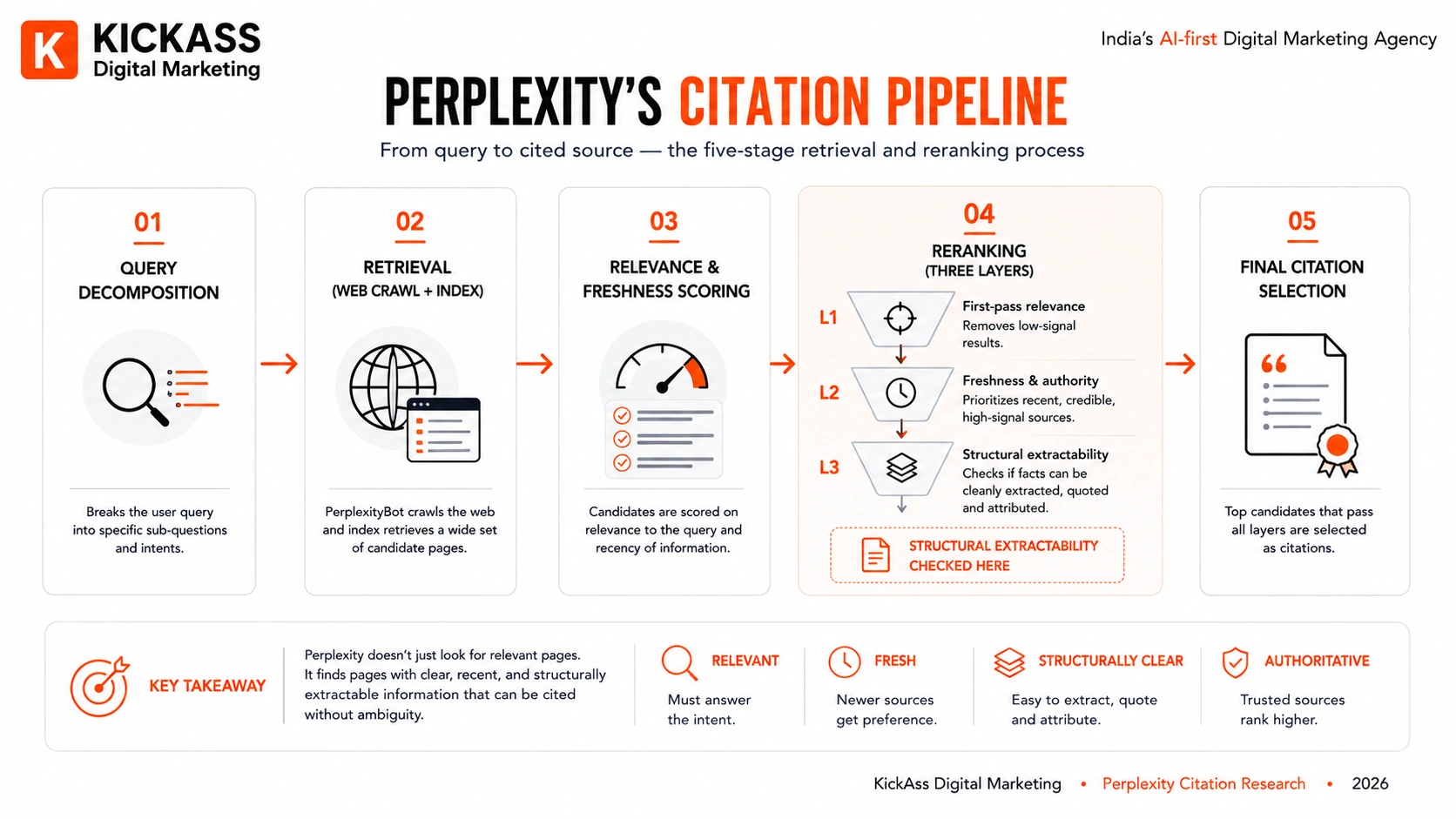
Figure 1: How Perplexity moves from a raw query to a final cited source — decomposition, retrieval, scoring, layered reranking, and selection.
The instinct for most SEO teams is to assume that whatever ranks on Google will eventually surface on Perplexity too. Independent research doesn’t support that. One large-scale study analyzing 15,000 queries found only around 12% overlap between URLs cited by AI platforms generally and the same query’s Google top-10 results — meaning the vast majority of what gets cited across AI tools never appears on page one of classical search at all. This isn’t a Perplexity-specific finding, but it applies directly here: Perplexity’s own retrieval infrastructure has, by 2026, moved well beyond simply mirroring Bing or Google results.
It’s worth being precise about what Perplexity actually queries, since this gets misreported often. In its early years, Perplexity leaned heavily on Bing’s index for retrieval. By 2026, it runs its own crawler and index — PerplexityBot — built specifically for this purpose, with Bing serving as a supplementary real-time source rather than the primary engine. That distinction matters for optimization: submitting to Google and Bing alone doesn’t guarantee PerplexityBot discovers you, and vice versa.
The reason ranking elsewhere doesn’t reliably predict citation here is structural, not a ranking quirk. Perplexity’s retrieval step pulls candidates broadly from its own index, but the reranking pass that decides what actually gets cited weighs relevance, freshness, and — critically — whether a specific claim can be cleanly extracted and attributed without the meaning shifting between source and quote. A page can have excellent domain authority and still be invisible to Perplexity if its useful facts are buried in dense prose rather than structured, citable statements.
Perplexity’s process runs through several distinct stages before a citation is chosen. First, the query is decomposed into more specific sub-questions. Next, a retrieval step pulls a wide set of candidate pages from a live web index. Those candidates then pass through layered reranking — filtering progressively on relevance, recency, and structural quality — before a final selection stage chooses which sources actually get cited in the response.
Two things stand out from our own testing that align with this mechanism. First, Perplexity showed the strongest recency bias of the four platforms we tested — it consistently favored newer content over older, higher-authority pages when both addressed the same claim. Second, it maintained this same search-first behavior regardless of category: unlike Claude, which leaned on training memory for low-consideration queries, Perplexity ran a live retrieval pass every time, from moisturizers to health insurance.
This distinction is important in how we apply the KickAss BASE™ Model for SEO & AI Search. Perplexity’s separate crawler, retrieval and citation environment belongs under Add: it is a genuine platform difference that SEO teams need to account for. The relative influence of recency, extractability and individual source types belongs under Study: we can observe those patterns, but should not turn them into universal Perplexity ranking factors without stronger causal evidence.
Our own testing flagged something we called the Reddit Node — Perplexity’s tendency to weight forum and community sentiment heavily as a trust signal, treating it as more authentic than polished marketing copy. Independent research now backs this at a much larger scale: an analysis of more than 230,000 prompts found Reddit and LinkedIn among Perplexity’s most-cited domains overall, with Wikipedia, Microsoft, and Forbes showing the fastest citation growth.
For brands, this means community presence isn’t a soft, unmeasurable “brand awareness” play on Perplexity — it’s a direct citation input. A well-argued, organic thread discussing your product carries real weight in what Perplexity ultimately tells a user, independent of anything on your own domain.
As category risk increases, Perplexity’s behavior shifts the same way it does across the other platforms we tested — a pattern documented in our foundational research, The 5-Layer AI Commerce Engine. For Bangalore real estate queries, Perplexity refused to name a single “best” project, describing its picks instead as “area-level and criteria-level recommendations, not endorsements of specific projects or builders.” For health insurance, it abandoned marketing snippets entirely in favor of IRDAI master circulars and Form NL-25 disclosures to verify room-rent caps and claim-settlement records.
In both regulated categories, its top picks also mirrored existing aggregator rankings — Policybazaar, Ditto, and Beshak for insurance; MagicBricks, Housing.com, and PropTiger for real estate — rather than an independent evaluation. Standard transactional SEO carries little weight here; what matters is whether your compliance documentation is publicly discoverable and consistent with what the aggregators already say about you.
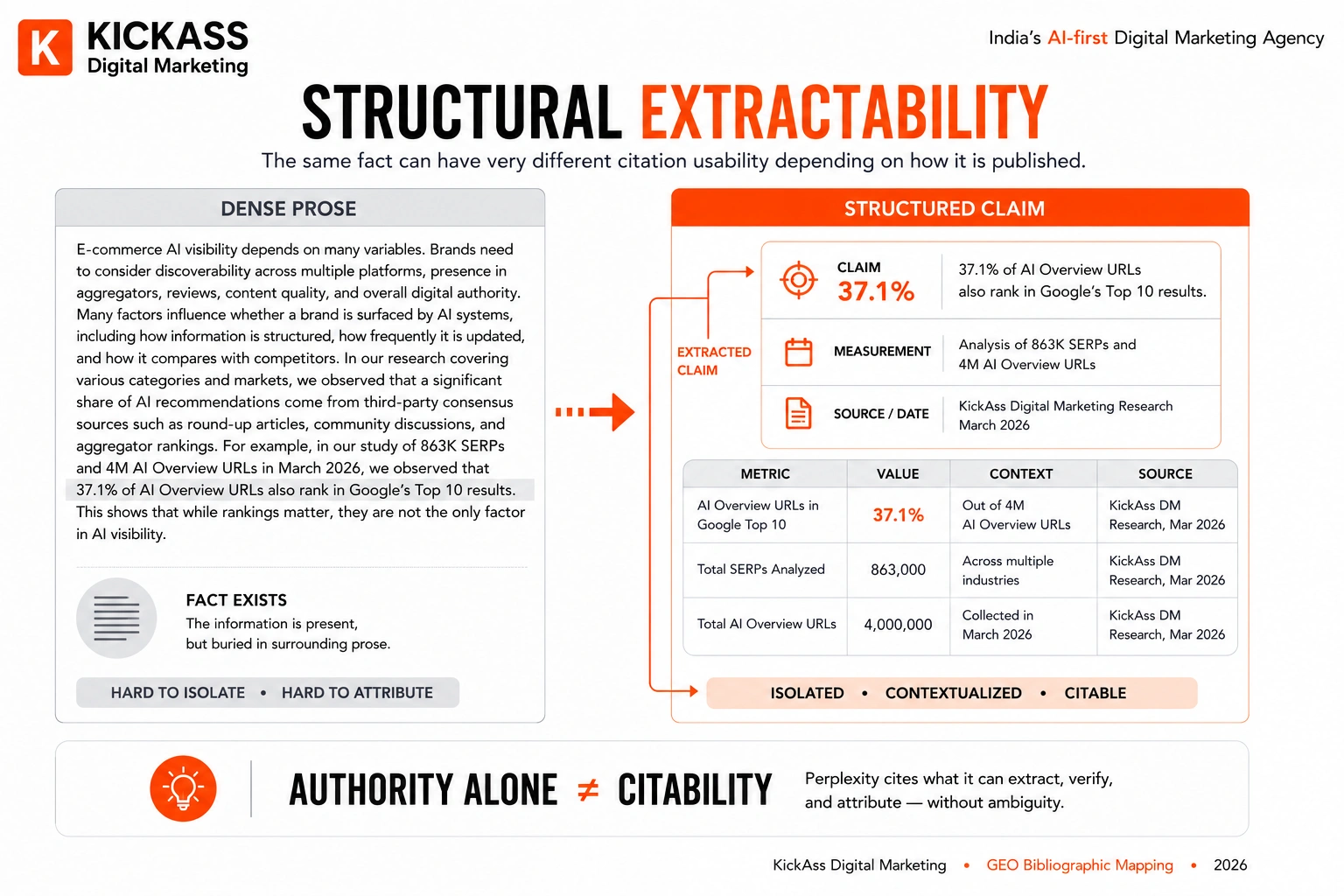
Figure 2: A true, well-sourced fact buried in dense prose is often invisible to Perplexity’s reranker; the same fact as a structured, standalone claim is citable.
This is the same entity-clarity and cross-source-consistency work ShodhDynamics’ ESC™ Framework is built around — worth reading if you want the underlying strategy behind this checklist rather than just the checklist itself. If you want this built out as a full program rather than a self-run checklist, this is exactly what our GEO services work covers.
Frequently Asked Questions on How Perplexity AI Chooses Sources and Citations
Neither, primarily, as of 2026. Perplexity relied heavily on Bing’s index in its early years, but has since built its own crawler and index — PerplexityBot — using Bing only as a supplementary real-time source. It explicitly denies scraping Google AI Overviews or SERPs directly. PerplexityBot respects standard robots.txt rules, and — separately — a well-structured llms.txt file gives it a cleaner, pre-parsed entity summary to work from rather than forcing it to infer your business from raw HTML.
ChatGPT and Gemini both connect to structured commercial data — the Shopify Catalog and ACP for ChatGPT, the Shopping Graph for Gemini (see our Gemini deep dive for the mechanics). Perplexity has no equivalent structured commerce pipeline; its entire model runs on web-synthesized bibliographic consensus, which makes extractability and community sentiment far more decisive here than on either of those platforms.
No. It’s currently restricted to the U.S. market. Indian users are redirected to the merchant’s site via a standard, untracked link — consistent with the Transaction Gap we’ve documented across all four platforms tested.
Want to see how extractable and citation-ready your own content actually is? Run a check with our AI Discovery Readiness assessment.