Get Marketing Insights First
Subscribe to receive actionable strategies, growth tips, and industry insights delivered straight to your inbox.

A practitioner blueprint for real estate ChatGPT Ads in India — buyer-intent ad groups, current creative limits, negative phrases, OAI-AdsBot-ready micro landing pages, tracking, CRM attribution and qualified-lead performance.
Real estate businesses should build ChatGPT Ads around buyer intent, not a transplanted Google Ads keyword list. Separate second-home, investment, first-home and location-led needs; give each ad group focused context hints and multiple concise creatives; send the click to a destination that continues the same intent; and measure the journey from click to qualified lead, site visit and booking.
For a developer, brokerage, property agency or listing platform, that is the operating model.
The ad unit is new. The discipline is not:
buyer situation → context hint → ad → landing destination → lead → CRM → site visit → booking
This article applies ChatGPT Ads mechanics specifically to property marketing. For the broader platform-level setup — including campaign objectives, context hints, creative requirements, budgeting, eligibility and measurement — see our ChatGPT Ads in India practitioner guide.
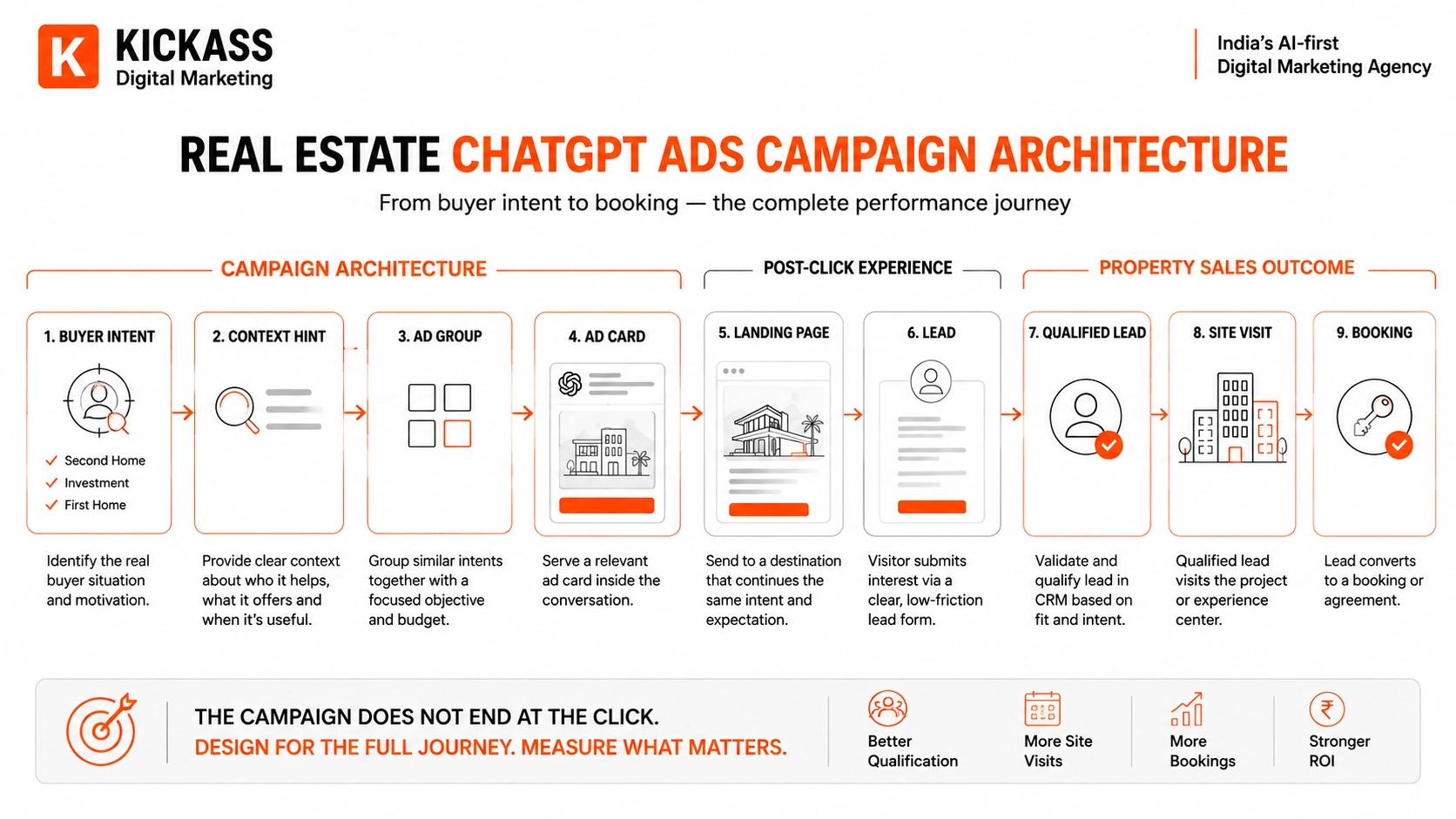
Figure 1: The campaign does not end at the click: real estate ChatGPT Ads should connect buyer intent and ad delivery to lead qualification, site visits and bookings.
If you need the commercial execution layer, see our ChatGPT Ads Services for Real Estate and broader ChatGPT Ads Agency in India services.
OpenAI’s current ad policy prohibits ads for individual housing rentals or sales. It says platforms containing housing listings may advertise provided the ad and landing page do not reference a specific listing. For developers, brokerages, agencies and property platforms, final eligibility depends on the advertiser, campaign, creative and destination reviewed by OpenAI.
The examples below are therefore campaign-architecture examples, subject to platform approval. Policies are changing quickly; check the current OpenAI Ad Policies before launch.
That policy boundary is important. It should not stop a real estate marketer from understanding how the channel should be structured.
A real estate ad group should represent one coherent buyer need. City, property type and budget can support that need, but they should not substitute for it.
OpenAI’s current guidance says context hints should describe what the offer does, who it helps and when it may be useful. They are not exact-match keywords and do not guarantee delivery for a specific phrase.
That means this:
Goa villa, property Goa, investment Goa
is not a strong strategy simply because it resembles a familiar Google Ads keyword cluster.
A better starting point is the buyer situation.
| Market / intent | Weak keyword-shaped hint | Better context hint |
|---|---|---|
| Goa — second home | villa Goa, second home Goa | Buyer comparing premium second-home options in Goa for personal use, holidays or a lifestyle move away from a metro city |
| Goa — investment / rental return | Goa property investment | Investor comparing residential property markets in Goa for capital appreciation and rental-return potential |
| Pune — first home | 2 bhk Pune, Hinjewadi flat | First-time home buyer comparing RERA-registered residential options near Pune employment corridors, with attention to price and commute |
| Bengaluru — work-location fit | Whitefield flats | Professional or family comparing homes around Bengaluru technology corridors based on commute, neighbourhood quality and budget |
| Gurugram — premium upgrade | luxury apartments Gurgaon | Buyer evaluating premium residential locations in Gurugram based on connectivity, amenities, developer credibility and long-term value |
| Mumbai — connectivity-led | Mumbai property near metro | Home buyer comparing Mumbai or Navi Mumbai residential locations around rail, metro and major employment connections |
The context hint should add information that is not already obvious from the ad.
If your ad already says “Explore Goa Homes”, the hint can explain that the intended use case is second-home research or investment comparison.
Create separate ad groups when the buyer need would require different creative or a different landing-page emphasis.
For one Goa portfolio, for example:
Ad group A — Second Home / Lifestyle
The buyer cares about location, beach access, privacy, amenities, usage and quality of life.
Ad group B — Investment / Rental Return
The buyer cares about acquisition price, demand, rental-return potential, appreciation, liquidity and project fundamentals.
Same geography.
Possibly the same property inventory.
Different reason to care.
That is enough to justify separate ad groups.
For the broader real-estate buyer journey before the enquiry, see How Real Estate Developers and Agents Can Use AI to Win Buyer Decisions Before the First Enquiry.
OpenAI supports country targeting and, where available, states or regions, cities, DMAs and postal codes. Use location to control eligibility, then use context hints and creative to express the actual property-buying intent.
Do not assume every Google Ads geography control exists in the same way.
OpenAI’s current campaign documentation says more granular locations are available where supported, so the exact India options should be checked inside Ads Manager when self-service access becomes available.
For a Goa second-home campaign, a reasonable test may include supported locations such as Mumbai, Delhi NCR, Bengaluru or Pune if those are markets from which the developer genuinely attracts buyers.
But do not hard-code a media theory such as:
“Never target people already in Goa.”
A local resident, returning Goan, NRI family member or existing investor can still be a legitimate buyer.
The rule is simpler:
Use geography to remove impossible or low-value markets. Use intent to define why the ad is relevant.
For a Goa-led execution, see our ChatGPT Ads Agency in Goa. For Pune and Gurugram examples, see ChatGPT Ads Agency in Pune and ChatGPT Ads Agency in Gurugram.
OpenAI also supports customer-list custom audiences, but this is not automatically useful for every developer.
A custom audience currently needs at least 25,000 matched users before it can be used, and OpenAI recommends audiences of at least 100,000 users.
Most individual projects will not have a CRM audience of that size.
So for many real estate advertisers, the first useful controls are likely to be:
location + buyer-intent ad group + context hints + creative + landing-page relevance
—not an elaborate audience stack imported from Meta.
Context hints tell the system where the ad may be useful. Negative phrases, where available, can help stop delivery around clearly unwanted wording. They solve different problems.
As of 28 August 2026, OpenAI’s public Help Center documents context hints but does not yet document a negative-phrases control.
However, Adthena reported seeing a Negative phrases field in a live UK Ads Manager account on 21 August. Its observation showed up to 100 words or phrases, each up to 100 characters, used as hard exclusions when the user message contains the specified wording.
Treat that as a live-interface observation, not a universal documented feature. Check whether the field exists in your India account before designing the campaign around it.
If it is available, use exclusions in blocks.
Useful for residential-sale or investment campaigns where the advertiser does not want short-term accommodation demand:
cheap rent
PG accommodation
paying guest
roommate
flatmate
hostel
room for rent
tenant rights
rental agreementUseful for Goa property campaigns where travel planning is adjacent to the same geographic language:
Goa itinerary
scooter rental
hotel booking
beach shack
nightlife
water sports
flight to Goa
weekend trip
Goa packageUseful when you are trying to reach buyers rather than people learning the profession:
real estate agent exam
how to become a broker
real estate internship
broker licence
real estate course
architecture thesis
civil engineering courseUseful where legal-research conversations are clearly outside the campaign goal:
property dispute
tenant dispute
RERA complaint
land encroachment
property court case
legal notice property
Do not blindly add every “negative” sounding phrase.
For a Goa rental-return campaign, the word rental may be commercially useful because the buyer is researching rental-return potential. Blocking it broadly would remove part of the intended demand.
The useful model is:
positive context = describe the buyer situation
negative phrase = block clearly disqualifying literal language
OpenAI currently recommends ad titles of 16–24 characters and copy of 32–48 characters. The maximums are 50 characters for a title and 100 characters for copy. Build several distinct messages per intent rather than stretching one Google or Meta ad into the format.
OpenAI’s own guidance says to build for coverage, not one message.
For real estate, that means each ad variation should introduce a different reason to click.
The examples below are deliberately inside OpenAI’s recommended, not merely maximum, character ranges.
| Intent | Proposed title | Title chars | Proposed copy | Copy chars |
|---|---|---|---|---|
| Goa — second home | Explore Goa Homes | 17 | Compare coastal homes for second-home buyers. | 45 |
| Goa — investment | Goa Property Returns | 20 | Compare areas by yield and appreciation. | 40 |
| Pune — first home | Homes Near Hinjewadi | 20 | Compare RERA homes, prices and commute. | 39 |
| Bengaluru — tech corridor | Homes Near Whitefield | 21 | Compare homes for commute, price and lifestyle. | 47 |
| Gurugram — premium | Premium Homes Gurugram | 22 | Compare locations, amenities and access. | 40 |
| Mumbai — connectivity | Mumbai Homes by Metro | 21 | Explore homes around key rail and metro links. | 46 |
These are not “winning ads”.
There are no India-wide ChatGPT Ads performance benchmarks yet, and OpenAI explicitly says the platform does not yet have benchmarks across advertisers, industries or campaign types.
They are structurally correct starting points.
A weak real-estate card tries to squeeze this into 48 characters:
beach location + RERA + 3 BHK + price + ROI + possession + amenities + CTA
That is not useful.
Use different ads:
Lifestyle angleExplore Goa HomesCompare coastal homes for second-home buyers.
Investment angleGoa Property ReturnsCompare areas by yield and appreciation.
Location angleHomes Near HinjewadiCompare RERA homes, prices and commute.
The landing page can carry the proof.
The card only needs to establish a relevant reason to continue.
OpenAI’s current standard ad schema documents:
It does not currently document a separate advertiser-written CTA-button field in the standard ad creation guidance.
So do not design your copy framework around invented buttons such as “Get ROI Details” unless that control is actually present in your account.
Use the title + copy to create intent.
Use the landing page CTA to convert it.
The landing page has two jobs in ChatGPT Ads: reinforce relevance before the click and convert the buyer after the click.
OpenAI explicitly says its ads system can consider the landing page, along with the conversation context, title, copy, context hints and targeting selections, when deciding which ad may be relevant. OpenAI also says the destination should be the most relevant page for the offer rather than defaulting to a generic homepage.
That makes the landing page more than the place where the form lives.
For real estate, the practical chain is:
buyer intent → context hint → ad message → landing-page message → property evidence → conversion
If those pieces disagree, the user has to reconstruct the campaign logic after clicking.
No. OpenAI does not require one landing page per intent. But when two buyer intents require materially different messages, proof or calls to action, a focused micro landing page can be a better campaign destination.
Consider one when:
Do not create extra pages merely because your ad groups have different names.
The test is:
Would the buyer immediately recognise the same promise after the click?
The same developer or brokerage may want to reach:
The underlying inventory may be identical.
The first screen should not necessarily be.
Ad:Explore Goa HomesCompare coastal homes for second-home buyers.
Landing-page hero:
Headline:Premium Homes in Goa for a Second Life, Not Just a Second Address
Subheadline:Compare coastal residential options by location, privacy, amenities, beach access and everyday liveability.
Primary CTA:Explore Available Options
First supporting modules:
Ad:Goa Property ReturnsCompare areas by yield and appreciation.
Landing-page hero:
Headline:Compare Goa Property by Capital Appreciation and Rental-Return Potential
Subheadline:Evaluate coastal locations, acquisition price, demand drivers and project fundamentals before shortlisting an investment.
Primary CTA:Request Investment Details
First supporting modules:
The lower part of the page can still reuse the same project or inventory facts.
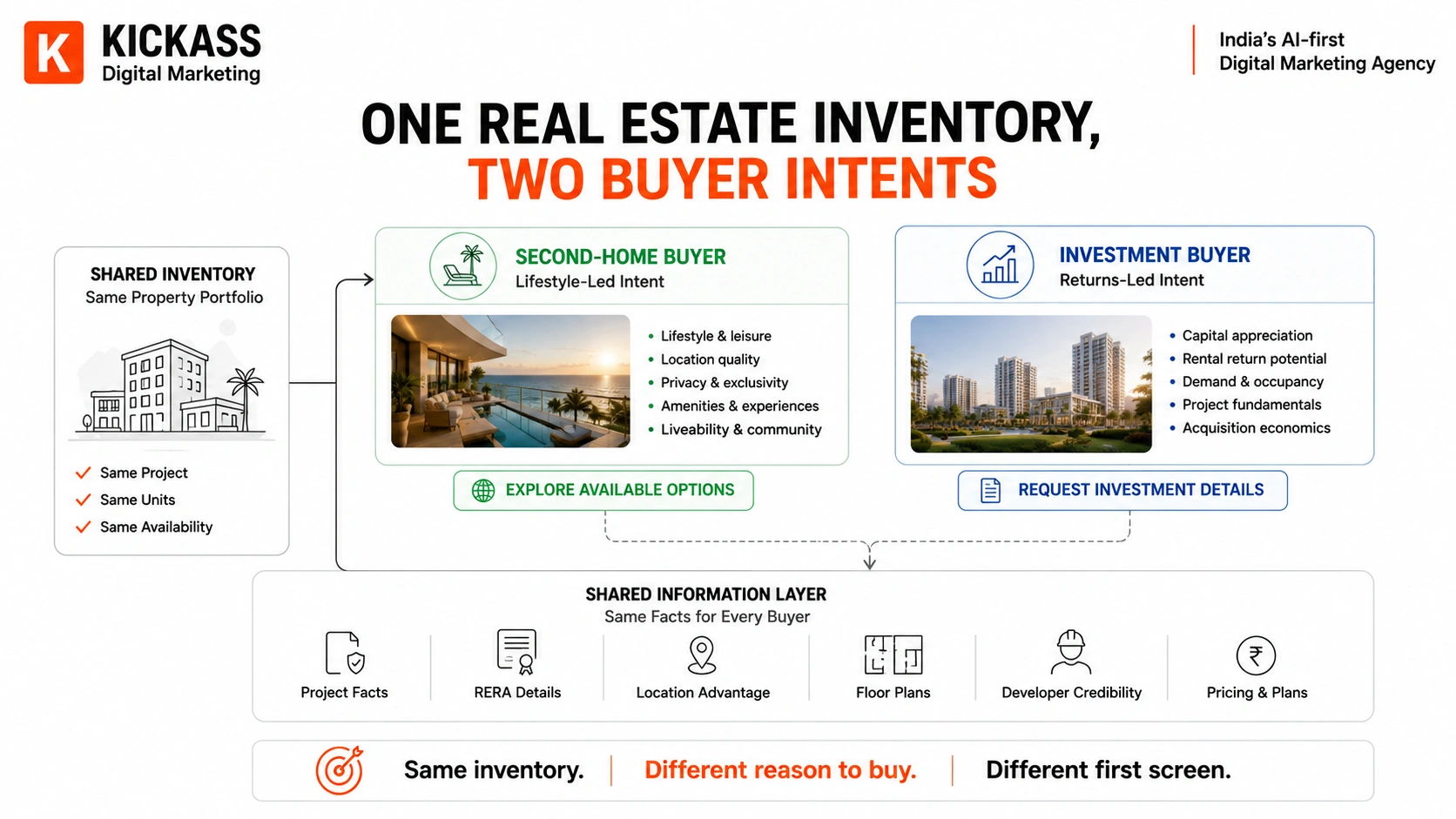
Figure 2: The same property inventory can require a different first screen: lifestyle-led framing for second-home buyers and returns-led framing for investment buyers, supported by the same underlying project facts.
Prefer a fast, directly reachable and easily crawlable destination over unnecessary technical complexity.
That does not mean OpenAI has said “use plain HTML” or that WordPress, Elementor or a block editor is inherently unsuitable.
It means the page should not make either the crawler or the buyer work harder than necessary.
A focused campaign micro page can therefore be useful because it can:
If a lightweight HTML page achieves that more reliably than a heavily layered template, it can be the better implementation. The objective is clarity, accessibility and conversion, not a particular CMS or front-end technology.
A persuasive landing page can still fail review if OpenAI cannot access it.
OpenAI says OAI-AdsBot is required for ChatGPT Ads landing-page validation and review, and recommends allowing both OAI-AdsBot and OAI-SearchBot. OpenAI may visit the destination to validate policy compliance and may also use landing-page content to help determine when the ad is relevant.
Before submitting a real-estate campaign, check that:
robots.txt allows OAI-AdsBot to access the landing-page path;403;429 Too Many Requests.A simple robots.txt allowance, where appropriate, looks like:
User-agent: OAI-AdsBot
Allow: /

User-agent: OAI-SearchBot
Allow: /
Do not wait for a rejected ad to discover that the landing page is inaccessible.
Add OAI-AdsBot accessibility to campaign QA alongside the copy, image, destination URL, tracking, Pixel/CAPI and CRM attribution.
Do not make the buyer fight the landing page before they can verify that they clicked the right ad.
A common real-estate landing-page pattern is:
page loads → 10–20 seconds pass → full-screen lead form appears → user must submit or close it
That can interrupt the evaluation process before the buyer has seen the project, location, investment logic or pricing context that justified the click.
For a ChatGPT Ads landing page, use a cleaner sequence:
Ad → clear landing-page answer → relevant proof → visible CTA → lead form
not:
Ad → landing page → forced pop-up → close button → content
Practical rules:
This is not a claim that OpenAI “penalises pop-ups”. The operational point is simpler:
technical interstitials can obstruct crawler access, while intrusive lead capture can create post-click conversion friction.
A practitioner guide is more useful when the execution can be inspected, not just described.
To show how the campaign architecture works in practice, we created a fictional real-estate demonstration covering the full path from campaign intent to landing-page experience and supporting technical implementation.
See the working implementation:
Open the conversion landing page
Inspect the metadata and JSON-LD
View the demo llms.txt
The demonstration uses a fictional Goa residential project so the campaign structure, landing-page copy, metadata, structured data and machine-readable site context can be shown without representing a live property listing.
Project: Aurelia Coast Residences, North Goa — fictional demonstration only.
Intent: Goa residential investment / rental-return potential.
Advertiser: Developer, brokerage or property platform, subject to OpenAI campaign approval.
Context hint
Investor comparing premium residential property in Goa for capital appreciation and rental-return potential, with interest in coastal locations, acquisition economics and long-term demand.Proposed ad
Goa Property Returns — 20 charactersCompare areas by yield and appreciation. — 40 characters
The ad stays concise. The landing page carries the deeper investment case, location context, project fundamentals and conversion path.
The demonstration landing page continues the same investment intent introduced in the ad.
EyebrowNORTH GOA · INVESTMENT-LED RESIDENTIAL
H1A North Goa Home Designed Around Long-Term Value
Supporting copyExplore a fictional premium residential project created to demonstrate how a ChatGPT Ads investment campaign can continue the same buyer intent after the click — location demand, acquisition economics, project fundamentals and rental-return potential.
Primary CTA: View Investment Snapshot
Secondary CTA: See Project Fundamentals
DisclosureDemonstration project only. Figures and project details are illustrative and not an investment promise.
The first substantive section moves from proposition to evidence:
Why This Location Could Matter to an Investor
It focuses on four areas:
The first conversion point appears only after that evidence:
Heading: Want the Numbers Behind the Project?
Copy: Review the illustrative cost sheet, location assumptions and investment comparison used in this demonstration.
CTA: View Investment Snapshot
The important design principle is that the visitor sees the property proposition and supporting evidence before being interrupted by a lead form.
Track ChatGPT Ads with both your own campaign taxonomy and OpenAI’s click/measurement signals. UTMs tell your analytics and CRM what you intended to run; OpenAI’s oppref and conversion tools help Ads Manager attribute eligible conversions.
This is where the campaign becomes operational rather than theoretical.
For a Goa second-home campaign:
utm_source=chatgpt
utm_medium=paid
utm_campaign=goa_second_home
utm_content=lifestyle_v1
For a Goa investment campaign:
utm_source=chatgpt
utm_medium=paid
utm_campaign=goa_investment
utm_content=returns_v1
For Pune:
utm_source=chatgpt
utm_medium=paid
utm_campaign=pune_first_home
utm_content=hinjewadi_v1OpenAI currently supports dynamic landing-page query parameters using macros including:
{campaign_id}
{ad_group_id}
{ad_id}
{ad_account_id}
A practical URL could therefore preserve both your human taxonomy and platform IDs:
?utm_source=chatgpt
&utm_medium=paid
&utm_campaign=goa_investment
&utm_content=returns_v1
&oa_campaign={campaign_id}
&oa_adgroup={ad_group_id}
&oa_ad={ad_id}opprefOpenAI appends a click reference called oppref to landing-page URLs.
Its Pixel can preserve that value in a first-party cookie, and the same reference can be passed with Conversions API events when available.
If your landing-page redirect, URL cleaner or CRM handoff strips oppref, you may weaken OpenAI-side attribution.
That is a more important implementation detail than inventing another UTM field.
For real estate, the primary performance metric should not stop at form submissions. The campaign has to be connected to qualified lead, site visit and booking outcomes.
A useful CRM record should retain:
Source: ChatGPT Ads
Market: Goa
Intent: Investment / Rental Return
Campaign: goa_investment
Creative: returns_v1
Project / Portfolio: Goa Residential
Lead Status: Qualified
Site Visit: Booked
Booking: No
For a Pune campaign:
Source: ChatGPT Ads
Market: Pune
Intent: First Home / IT Corridor
Campaign: pune_first_home
Creative: hinjewadi_v1
Lead Status: Qualified
Site Visit: Completed
Booking: Yes
This matters because real estate lead economics are distorted when every enquiry is treated equally.
A campaign generating:
may be worse than one generating:
CTR will not tell you that.
CPL will not tell you that.
Your CRM will.
If lead response and follow-up are weak after the click, see Why Real Estate Leads Stop Converting — And How a Proper AI Lead Management System Changes That.
ChatGPT Ads currently supports CPM, CPC and conversion-optimised CPC (oCPC). A real estate advertiser should choose the objective based on the strongest conversion signal it can send reliably, not on which bidding label sounds most advanced.
For an early real-estate account:
Use when the immediate purpose is controlled reach or awareness.
Not our first choice for a performance-led property campaign unless reach itself is the goal.
Use when the account needs to learn:
Use when conversion tracking is correctly installed and the account has a supported conversion event worth optimizing toward.
OpenAI currently requires a supported standard conversion event for oCPC; custom conversion events are not supported as the optimization event.
For most developers or brokerages, the first usable optimization event is likely to be a lead submission rather than a site visit or final booking.
That means:
Ads Manager optimizes toward lead submission
while
CRM reporting judges qualified lead → site visit → booking
Do not confuse the optimization event with the final business KPI.
There is no responsible universal CTR, CPC or CPL target for ChatGPT Ads in Indian real estate yet. OpenAI explicitly says it does not have platform-wide performance benchmarks across industries or campaign types. Use your own account as the first benchmark.
This is where many early guides become less useful.
A number such as:
“Target 2% CTR”
looks actionable.
It is not evidence if the platform itself says mature benchmarks do not yet exist.
Use patterns instead.
| What you see | Likely question to investigate | First action |
|---|---|---|
| Low delivery / impressions | Is the campaign eligible, geography too narrow, budget constrained, or context too limited? | Check review status, location availability, dates, budget and ad-group scope |
| Impressions but weak CTR | Does the ad give a useful property-specific reason to click? | Test a different buyer angle, not just a synonym |
| Good CTR, weak landing engagement | Did the ad promise investment/lifestyle/location information the page does not show immediately? | Change hero, proof order and CTA |
| Good page engagement, few leads | Is the CTA too high-friction, or are price/project fundamentals unclear? | Test cost sheet, shortlist, brochure or site-visit CTA based on intent |
| Many leads, few qualified buyers | Is the context too broad or qualification too weak? | Tighten intent structure and lead form / CRM qualification |
| Qualified leads, few site visits | Is follow-up slow or inconsistent? | Audit sales response and nurturing |
| Site visits, few bookings | Is the real issue price, inventory, financing or product-market fit? | Feed findings to sales/developer; do not blame media automatically |
| Ads Manager conversions below CRM | Is the event configured correctly, oppref preserved and attribution given time to settle? | Audit Pixel/CAPI/event mapping; allow 24–48 hours for reporting |
| One intent consistently produces better qualified buyers | Can budget be shifted without changing the business objective? | Scale that intent while holding creative/landing quality constant |
This is the performance matrix that matters in real estate.
Not:
CPM → CTR → CPL
but:
Impression → Click → Engaged Visit → Lead → Qualified Lead → Site Visit → Booking
Start with a small number of clear campaigns and intent-led ad groups. Do not launch every city, project and buyer type at once.
Example:
Objective: CPC initially; oCPC after conversion tracking is stable.
Locations: supported India locations where your historical buyer data shows demand; for example Mumbai, Delhi NCR, Bengaluru, Pune and/or Goa where available.
Ad Group A: Goa Second Home
Context: lifestyle, second-home, holiday-home research.
Ads: lifestyle, location, privacy/amenity angles.
Landing emphasis: coastal location, usage, amenities, project quality.
Ad Group B: Goa Investment
Context: capital appreciation, property diversification, rental-return potential.
Ads: location economics, demand, investment-comparison angles.
Landing emphasis: acquisition economics, demand drivers, rental-return potential, cost sheet.
If the Goa market is strategically important, connect this with the location-specific capabilities on our ChatGPT Ads Agency in Goa page.
Objective: CPC.
Ad Group A: First Home / Hinjewadi
Context: first purchase, RERA, commute, price.
Ad: Homes Near Hinjewadi / Compare RERA homes, prices and commute.
Landing emphasis: location, starting range, RERA, commute, financing information.
Ad Group B: Upgrade / Family
Context: larger home, schools, neighbourhood, amenities, commute.
Creative: different from first-buyer messaging even if inventory overlaps.
Objective: CPC or oCPC once measurement is ready.
Ad Group: Premium Upgrade / Location Comparison
Context: premium residential market, connectivity, amenities, developer credibility.
Ad: Premium Homes Gurugram / Compare locations, amenities and access.
The city is not the strategy.
The city tells ChatGPT where the campaign can deliver.
The context hint and creative explain why this particular property proposition is useful now.
A ChatGPT Ads campaign is not complete when the ad is approved. The landing experience and lead-management process determine whether conversational intent becomes commercial intent.
Before launch:
oppref;Real estate has a long enough decision cycle that media and sales cannot be measured separately.
A campaign can be doing its job and still look “bad” if leads sit untouched for four hours.
A campaign can look good at CPL and still be poor if nobody reaches a site visit.
The final report should therefore show both.
That is how an early adopter learns whether ChatGPT Ads is generating property demand, not just curiosity.
| Do | Don’t |
|---|---|
| Segment by buyer intent | Copy a Google Ads keyword structure |
| Use city/state/postal targeting where supported | Assume every Google geo control exists |
| Write natural, descriptive context hints | Treat hints as exact-match keywords |
| Use negative phrases if the field exists in your account | Assume an observed beta control is universally available |
| Keep titles around 16–24 characters | Treat the recommendation as an absolute 24-character maximum |
| Keep copy around 32–48 characters | Stuff project specifications into the ad |
| Produce multiple distinct ads per intent | Rewrite the same headline six times |
| Continue the same intent on the landing page | Send every buyer to a generic homepage |
| Consider a focused micro landing page when the intent materially changes | Build extra pages simply because ad-group names differ |
| Allow OAI-AdsBot to reach the destination | Discover crawler blocks only after ad rejection |
| Keep the first screen clear and unobstructed | Cover the page with a timed lead popup before the buyer sees the offer |
Preserve oppref, UTMs and Ads Manager IDs | Strip tracking parameters during redirects |
| Optimize Ads Manager toward a reliable conversion event | Pretend a form fill is the final real-estate KPI |
| Report qualified lead → site visit → booking | Stop at CTR and CPL |
| Check current housing policy before submission | Assume a property campaign is eligible because another platform allows it |
Potentially, but campaign approval depends on OpenAI’s current housing policy and the specific advertiser, creative and landing page. As of 28 August 2026, OpenAI prohibits ads for individual housing rentals or sales and allows housing-listing platforms only where the ad and landing page do not reference a specific listing. Check the current policy before building project-level creative.
A property platform may be eligible under OpenAI’s current housing policy when the ad and destination do not reference a specific housing listing. A brokerage or agency should still treat approval as campaign-specific and verify its proposed offer with the current policy and Ads Manager review.
OpenAI currently recommends titles of 16–24 characters and copy of 32–48 characters. The maximums are 50 characters for a title and 100 characters for copy.
No. Context hints describe relevant products, needs, situations and conversation types, but OpenAI says they are not exact-match controls and do not guarantee delivery for particular words or conversations.
A negative-phrases field has been observed in live Ads Manager accounts, but OpenAI had not documented it in its public Help Center as of 28 August 2026. If the field appears in your account, use it as a literal exclusion layer while continuing to use context hints for semantic relevance.
OpenAI says Ads Manager supports states or regions, cities, DMAs and postal codes where available. Exact India location availability should be checked during campaign setup rather than assumed.
OpenAI currently lists ₹725 as India’s minimum daily campaign budget. It is a budget floor, not a recommended real-estate test budget or performance benchmark.
Usually no. If second-home and investment buyers require different messaging or landing-page emphasis, OpenAI’s own ad-group guidance supports separating those use cases.
No. You need a destination that continues the ad’s intent. A strong project or portfolio page can support multiple campaigns if the first screen and evidence are aligned; use a separate URL or intent-aware variant when the message, CTA or proof needs to change materially.
No. OpenAI does not say advertisers must use plain HTML or avoid WordPress/page builders. It does require the destination to be valid, reachable and accessible to OAI-AdsBot. A lightweight micro landing page can still be a strong practical choice when it improves crawlability, speed, message clarity and conversion.
Not by default. Let the buyer first see the information promised by the ad. A visible CTA and inline or user-triggered form usually create a cleaner path than covering the page with a timed interstitial before the visitor has evaluated the property proposition.
Report both media and property outcomes: impressions, clicks, spend, CTR, CPC and attributed conversions, then leads, qualified leads, cost per qualified lead, site visits and bookings from the CRM. A real estate campaign should not be judged from CTR or CPL alone.
The early-adopter advantage in ChatGPT Ads will not come from copying the first campaign structure that worked on Google or Meta.
It will come from learning faster:
That is the operating advantage.
For developers, brokerages and property platforms building that system now, see ChatGPT Ads Services for Real Estate.
For a broader paid-media programme across ChatGPT, Google and Meta, see Paid Advertising.
For India-wide ChatGPT Ads execution, see ChatGPT Ads Agency in India.