Get Marketing Insights First
Subscribe to receive actionable strategies, growth tips, and industry insights delivered straight to your inbox.

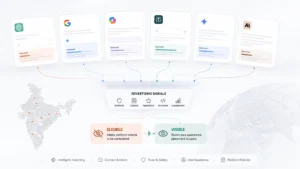
ChatGPT isn't the only AI platform moving into advertising. Google AI Overviews, Microsoft Copilot, Perplexity, Gemini and Claude are taking very different approaches. We checked the current landscape from India, including a 20–25-query test of Google AI Overview, to separate what is officially eligible from what is actually visible.
No. ChatGPT is one of several major AI/search platforms moving into advertising. Microsoft has been developing advertising formats for its AI-powered search and Copilot experiences since the Bing Chat era. Google serves ads in and around AI Overviews on Search. Perplexity tested sponsored placements and subsequently moved away from advertising. The standalone Gemini app and Claude remain separate from these advertising surfaces.
The answer depends on what “available” means.
Google officially lists ads within AI Overviews as available in English on mobile and desktop in India. ChatGPT Ads are not currently available to advertisers in India through OpenAI’s self-serve Ads Manager. Microsoft has an established advertising ecosystem and AI advertising surfaces, but the availability of specific conversational Copilot ad units to Indian advertisers remains less clearly documented. Perplexity has moved away from advertising.
Google officially confirms that ads in AI Overviews are available in India. Our own August 2026 test, however, found no live “Sponsored” placements across roughly 20–25 queries from India.
That is the important distinction:
Eligible does not necessarily mean visible.
Our test is a single-session observation, not a comprehensive audit, and results can vary by query, account, device, language, campaign and rollout status.
Ask most Indian business owners which AI platform sells ads, and they’ll probably say ChatGPT.
Understandable.
ChatGPT is the platform dominating the AI advertising conversation. But that answer is incomplete — and the gap matters if you’re deciding where to invest over the next twelve months.
Microsoft has been developing advertising formats around AI-powered search and Copilot since the Bing Chat era. Google has introduced ads into AI Overviews on Search and now lists India among the countries where ads within AI Overviews are available. Perplexity experimented with advertising and then moved away from it. The standalone Gemini app and Claude are taking different approaches altogether.
So rather than write another article based entirely on announcements and headlines, we looked across the major platforms and tested what was actually visible from India.
The result is more fragmented — and more interesting — than “ChatGPT Ads are coming.”
| Platform | Advertising status | India status | What we know |
|---|---|---|---|
| ChatGPT Ads | Self-serve advertising has been rolled out across a limited set of markets; our dated research recorded availability across 9 markets at the time of that observation. | Not currently available to Indian advertisers | OpenAI’s current Ads Manager documentation does not list India. Availability is evolving as testing expands. |
| Google AI Overview | Ads available within AI Overviews | Available / eligible | Google officially lists India among the countries where ads in AI Overviews are currently available. |
| Google AI Mode | Separate AI Search surface with its own advertising developments | Do not conflate with AI Overview | AI Mode and AI Overview are different Search experiences. Availability of specific ad formats varies by rollout. |
| Microsoft Copilot | AI advertising formats and Copilot-related ad experiences are active | Specific conversational inventory remains less clear | Microsoft has been building advertising into AI-powered search and Copilot, but the India-specific availability of every Copilot conversational unit should not be assumed. |
| Perplexity | Advertising tested, then discontinued / moved away from | No active advertising product | Perplexity’s 2026 strategy moved away from ads, citing trust concerns. |
| Gemini / Claude | No comparable ad product in the standalone assistant experience | No standalone assistant ad product | Do not confuse the Gemini app with Google’s advertising surfaces inside Search, including AI Overviews. |
The first lesson is simple:
“Does this AI platform have ads?” is no longer a useful yes-or-no question.
You have to ask:
That distinction becomes especially important in India.
Google’s AI Overview is the most important example because it is easy to misunderstand.
It does not look like a new advertising platform.
It looks like Google Search.
But Google now treats ads within AI Overviews as a distinct advertising surface. Its current documentation says ads in AI Overviews are available in English on mobile and desktop in Australia, Canada, India, Indonesia, Kenya, Malaysia, New Zealand, Nigeria, Pakistan, the Philippines, Singapore and the United States.
Existing Search, Shopping and Performance Max campaigns can be eligible to show within AI Overviews. Google also says that the user’s query and the content of the AI Overview are considered when determining which ads may be served.
Source: Google Ads Help — https://support.google.com/google-ads/answer/16297775?hl=en
That creates an important distinction for Indian advertisers:
Google has made the advertising surface available. That does not mean every eligible advertiser will see an ad there.
And that is exactly what we wanted to test.
On August 11, 2026, we ran roughly 20–25 commercial and informational queries from India.
We were specifically looking for the AI Overview box in regular Google Search, rather than treating the separate AI Mode experience as the same thing.
The test set covered:
We were looking specifically for visible, “Sponsored”-labelled placements associated with the AI Overview experience.
Zero live placements in our test session.
That does not mean Google AI Overview advertising is unavailable in India.
Google’s own documentation says it is available.
It means something more useful:
Eligibility and visibility are two different things.
The infrastructure and eligibility can exist before a particular advertiser, query or account context consistently produces an observable ad impression.
We even tested a query specifically asking Google about an “AI Overview ads example in India.” The resulting AI Overview described what such advertising looks like, but did not surface a live example for us.
That is a useful distinction for businesses trying to understand where the market actually is.
This was a first-party observation from one test session, one account context and one query set.
It is not a comprehensive audit of Google AI Overview advertising in India.
Results can vary by:
So the correct conclusion is not:
“Google AI Overview has no ads in India.”
The correct conclusion is:
“Google officially makes ads in AI Overviews available in India, but in our August 11, 2026 test we did not observe a live Sponsored placement.”
That is a much more useful statement.
ChatGPT is still the platform most businesses associate with AI advertising.
But Indian advertisers need to separate the global conversation from local availability.
OpenAI’s Ads Manager is a beta platform for creating, launching and managing ChatGPT advertising campaigns. OpenAI’s current country-availability documentation lists a limited set of supported markets and says availability may continue to evolve as testing expands.
Source: OpenAI Ads Manager Availability — https://help.openai.com/en/articles/20001245-ads-manager-availability
Our broader research has tracked ChatGPT Ads across nine markets in dated evidence collected during the rollout. Because OpenAI’s availability list is explicitly subject to change, the dated evidence should be read as a snapshot of the rollout rather than a permanent country list.
For an Indian business, however, the practical question is simpler:
India is not currently listed among the countries where OpenAI’s self-serve Ads Manager is available.
Source: OpenAI Ads Manager Beta — https://help.openai.com/en/articles/20001206-ads-manager-beta-overview
That means an Indian advertiser should not confuse:
Those are different stages.
And that is why the preparation window matters even before direct inventory becomes available.
Microsoft’s AI advertising story actually predates ChatGPT Ads.
In 2023, Microsoft Advertising was already discussing conversational advertising in Bing Chat and its broader plans for generative AI and advertising.
Source: Microsoft Advertising — https://about.ads.microsoft.com/en/blog/post/september-2023/transforming-search-and-advertising-with-generative-ai
That makes Microsoft an important part of the landscape — especially because businesses can mistakenly treat ChatGPT as the beginning of AI advertising.
It wasn’t.
Microsoft has continued expanding its advertising approach around AI-powered search and Copilot. In 2026, Microsoft described AI Max as a way to help advertisers capture intent on AI surfaces such as Copilot Search and Copilot Answers, while also introducing new advertising experiences designed specifically for Copilot conversations.
Source: Microsoft Advertising — https://about.ads.microsoft.com/en/blog/post/april-2026/win-across-all-three-eras-of-the-web
But there is a critical India-specific distinction.
Microsoft Advertising availability is not the same thing as proof that every Copilot conversational ad unit is available to Indian advertisers.
That is where we would rather be precise than manufacture certainty.
The specific availability of a particular Copilot in-chat advertising experience for Indian advertisers remains something to verify against Microsoft’s current product and account-level rollout.
So for now:
Microsoft Copilot: advertising exists. India-specific conversational inventory: do not assume it. Test and verify.
That is a more defensible position than either “yes” or “no.”
Perplexity is the platform that most clearly demonstrates why the AI advertising market cannot be treated as a simple race toward “every AI assistant becomes Google.”
Perplexity tested sponsored placements in 2024 and subsequently moved away from advertising.
By February 2026, the company had decided not to pursue advertising as a core monetization strategy, with concerns around trust and the credibility of AI answers becoming a major part of the discussion.
Source: Financial Times — https://www.ft.com/content/6eec07a5-34a8-4f78-a9ed-93ab4263d43c
The important point is not:
“Perplexity tried ads and failed.”
That is too simplistic.
The more useful interpretation is:
Perplexity decided that advertising could conflict with the trust model it wants its answer engine to maintain.
That is a fundamentally different monetization decision.
The broader AI market is therefore experimenting with several economic models at once:
That matters to advertisers because there is no guarantee that every AI platform will eventually expose the same kind of paid inventory.
This distinction deserves its own section because it is one of the easiest things to get wrong.
When someone says:
“Does Google Gemini have ads?”
they may actually mean one of three different things:
Those are not interchangeable products.
Google’s current advertising documentation specifically discusses ads in AI Overviews on Search.
That does not mean the standalone Gemini app should be described as though it were the same advertising surface.
For Indian businesses, the distinction is important because:
Google can have advertising in AI-powered Search experiences without the standalone Gemini assistant becoming an ad-supported product.
This is another example of why platform-level labels such as “Google has AI ads” are not precise enough.
The surface matters.
The wrong conclusion from all this would be:
“ChatGPT Ads isn’t in India yet, so wait.”
The evidence points in the opposite direction.
AI advertising is already becoming a multi-surface discovery problem.
A business may encounter advertising opportunities through:
The exact inventory will change.
The underlying business information will not change nearly as quickly.
That means the preparation work should not be built around one platform name.
It should make the business:
Those are not guarantees of ad placement.
They are the foundation that helps AI systems understand and evaluate a business across changing discovery surfaces.
That is a much safer strategic investment than betting everything on a single platform launch date.
Our research into the ChatGPT Ads India window makes a related point:
The preparation window does not necessarily close when a platform announces a launch.
It can close gradually as:
The same logic applies beyond ChatGPT.
If AI-powered discovery is changing how users research and decide, the business that waits for the exact advertising button to appear is starting later than the business that prepares its underlying information ecosystem now.
This is also why a single-platform budget strategy can be misleading.
Our research on small-business ChatGPT Ads makes the related point that budget alone does not determine placement:
And the broader framework behind this approach is the ESC™ Framework:
The practical question is no longer:
“Which AI platform should we advertise on?”
It is:
“Is our business ready to be understood consistently when AI platforms start deciding what to show, recommend or place next?”
That preparation has several layers.
Your business name, services, locations, people, products and relationships should not contradict each other across your website and important third-party sources.
AI systems need machine-readable context as well as human-readable content.
That means appropriate structured data, clear page architecture, consistent entity relationships and technically accessible information.
Your website is not the only place an AI system can learn about you.
Reviews, directories, publications, partners, industry references, citations and other third-party sources can contribute to how confidently a platform can understand your entity.
A business that claims expertise without demonstrating it through useful, specific content has a weaker information footprint than a business whose expertise is consistently documented.
Important business information should be discoverable, crawlable, understandable and presented in ways that modern search and AI systems can process.
None of these guarantees a ChatGPT ad impression.
None guarantees a Google AI Overview placement.
None guarantees a Copilot recommendation.
But together they improve the foundation from which those systems can understand and evaluate the business.
That foundation is useful regardless of which platform wins the next phase of AI discovery.
Microsoft has an established advertising ecosystem and has been developing advertising experiences for AI-powered search and Copilot since the Bing Chat era. The specific availability of every conversational Copilot ad unit to Indian advertisers is less clearly documented than Google’s explicit India availability for ads in AI Overviews. Treat the specific inventory as something to verify rather than assuming a blanket yes.
Perplexity moved away from advertising because of concerns that ads could undermine the trust and credibility users place in AI-generated answers. The move is better understood as a monetization-strategy decision than as evidence that AI advertising itself cannot work.
The standalone Gemini app should not be conflated with Google Search advertising surfaces. Google officially documents ads in AI Overviews on Search, including in India. That is a different product surface from simply saying that “Gemini has ads.”
No.
The useful preparation work is broader than one advertising platform. Entity consistency, structured information, cross-source trust, topical content and technical accessibility can help a business build a stronger information foundation across AI and search surfaces.
It is part of the Google Ads ecosystem, but it is not the same user experience as a conventional Search ad placement.
Google says existing Search, Shopping and Performance Max campaigns can be eligible to show ads within AI Overviews. It also says advertisers cannot directly target AI Overview placements only, and reporting does not currently provide a separate segmented view for ads shown within AI Overviews.
Source: Google Ads Help — https://support.google.com/google-ads/answer/16297775?hl=en
No.
The availability of an advertising surface does not mean an advertiser can force a placement.
For Google AI Overviews specifically, Google says ads are matched using the query and AI Overview context and that advertisers cannot directly target only the AI Overview placement.
The same principle is important when thinking about emerging AI advertising platforms generally: availability is not the same as guaranteed delivery.
The AI advertising market is moving quickly, but the most useful conclusion is not “ChatGPT will beat Google” or “Google will beat ChatGPT.”
The more important development is that the discovery layer itself is changing.
Google is putting ads into AI-generated Search experiences.
Microsoft is adapting advertising for Copilot and AI-powered search.
OpenAI is building a new advertising system around ChatGPT.
Perplexity has experimented with advertising and then chosen a different monetization path.
Other AI assistants are still making different choices.
The platforms are not converging on one model.
So businesses should not build their strategy around a single platform assumption.
Build the foundation first.
Then adapt the paid strategy as the inventory becomes real, measurable and commercially useful.
That is the difference between:
waiting for AI advertising to arrive
and
being ready when the right AI advertising opportunity arrives.
Start with an AI Readiness Audit — evaluate whether your business is structured, discoverable and understandable across the AI-driven discovery environment before you start betting budget on a particular platform.
Or see the full ChatGPT Ads Agency & Consultant readiness process — the specific account, entity, landing-page and creative preparation sits inside the broader foundation described in this article.
This article deliberately separates official platform documentation from KickAss first-party testing.
Current Ads Manager country availability:
https://help.openai.com/en/articles/20001245-ads-manager-availability
Ads Manager Beta overview:
https://help.openai.com/en/articles/20001206-ads-manager-beta-overview
Ads in ChatGPT FAQ:
https://help.openai.com/en/articles/20001047-ads-in-chatgpt
Editorial note: The article’s reference to nine markets reflects dated research/evidence collected during the rollout. OpenAI’s availability documentation is dynamic and can change as testing expands. The current page should therefore be treated as the live availability reference, while dated research should retain its original timestamp/context.
Current Google Ads documentation on AI Overviews:
https://support.google.com/google-ads/answer/16297775?hl=en
Google Marketing Live India 2025 announcement:
https://blog.google/intl/en-in/google-marketing-live-2025-driving-growth-with-search-youtube-ai/
Google’s current documentation confirms that ads in AI Overviews are available in English on mobile and desktop in India.
Microsoft’s 2023 generative-AI advertising announcement:
https://about.ads.microsoft.com/en/blog/post/september-2023/transforming-search-and-advertising-with-generative-ai
Microsoft’s 2026 AI advertising developments:
https://about.ads.microsoft.com/en/blog/post/april-2026/win-across-all-three-eras-of-the-web
Financial Times reporting on Perplexity’s retreat from advertising:
https://www.ft.com/content/6eec07a5-34a8-4f78-a9ed-93ab4263d43c