Get Marketing Insights First
Subscribe to receive actionable strategies, growth tips, and industry insights delivered straight to your inbox.

Most advice about AI advertising in India treats it as entirely hypothetical. It isn't — Google confirmed AI Overview ads are eligible in India since December 2025. We tested this ourselves in August 2026 and found no live placements yet. This 28-point, 6-pillar checklist — free to download as an auto-scoring Excel template — shows exactly where your business stands before that changes.
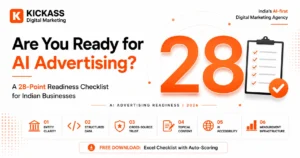
An AI advertising readiness checklist is a self-assessment tool that scores a business across the entity signals AI systems evaluate before showing or ranking a paid ad — entity consistency, structured data, cross-source trust, topical content, technical AI-accessibility, and measurement infrastructure. It identifies exactly where a business’s foundation is weak before spend is committed to any AI advertising platform.
Partially. Google confirmed AI Overview ads are eligible in India since December 2025, automatically extending to businesses already running Search, Shopping, or Performance Max campaigns. ChatGPT Ads is not yet live in India. We tested both Google (AI Overview) and Microsoft Copilot from India in August 2026 across 20-25 queries and found no live sponsored placements in either — suggesting eligibility has not yet translated into visible ad volume here.
A score of 45 or above out of 56 suggests strong readiness — the entity signals are largely in place. 28-44 indicates a business should close specific gaps before increasing any AI ad spend. Below 28 suggests foundational work is needed first, since weak entity signals will undermine performance regardless of budget once these platforms scale in India.
Yes. The full 28-item checklist is available as a free, downloadable Excel template with automatic scoring — enter a score for each item and the pillar subtotals, overall score, and readiness band calculate instantly. No sign-up required.
Most advice about AI advertising in India treats it as entirely hypothetical — something to prepare for, eventually, when it arrives.
That’s only half true.
Google confirmed in December 2025 that AI Overview ads — sponsored placements inside the AI-generated summary box in regular Google Search — are eligible in India, automatically, for any business already running Search, Shopping, or Performance Max campaigns. Not “coming soon.” Eligible now.
So before writing this checklist, we tested it ourselves.
The landscape is more fragmented than most coverage suggests, and the differences matter for how urgently a business should act.
| Platform | Status in India |
|---|---|
| Google AI Overviews | Officially eligible since December 2025 — English, mobile and desktop, no separate signup required for existing Search/Shopping/Performance Max advertisers |
| Google AI Mode (dedicated tab) | Ad rollout confirmed only in the US as of late 2025; no India confirmation found — a genuinely different surface from AI Overviews, easy to conflate |
| Microsoft Copilot | Microsoft Advertising has full India market support as a platform; independent reporting describes Indian advertisers getting early access to AI-search placements, though we found no clean official country list for the specific in-chat ad unit |
| ChatGPT Ads | Not live in India. Confirmed in seven markets — US, Canada, Australia, New Zealand, UK, Japan, South Korea — with no official India launch date |
| Perplexity | No longer runs ads anywhere. Was always US-only from its November 2024 launch, paused new advertisers in October 2025, and shut down advertising entirely in February 2026 |
The practical takeaway: the entity signals that determine AI ad performance are not purely future-proofing exercises. Part of the infrastructure they feed into is already switched on in India.
We didn’t want to publish a readiness checklist built on assumptions, so before writing it, we ran our own test.
On August 11, 2026, from India, we ran roughly 20-25 commercial and informational search queries — about 70% through regular Google Search, specifically watching for the AI Overview box rather than the separate AI Mode tab, and about 30% through Microsoft Copilot’s web interface. The queries spanned product categories, local service searches (“best AC repair service in Indore,” “top coworking spaces in Bangalore” style queries), and informational-but-commercial questions — the categories Google itself and industry reporting associate with AI ad placements.
We found no live, “Sponsored”-labeled ad placements on either platform.
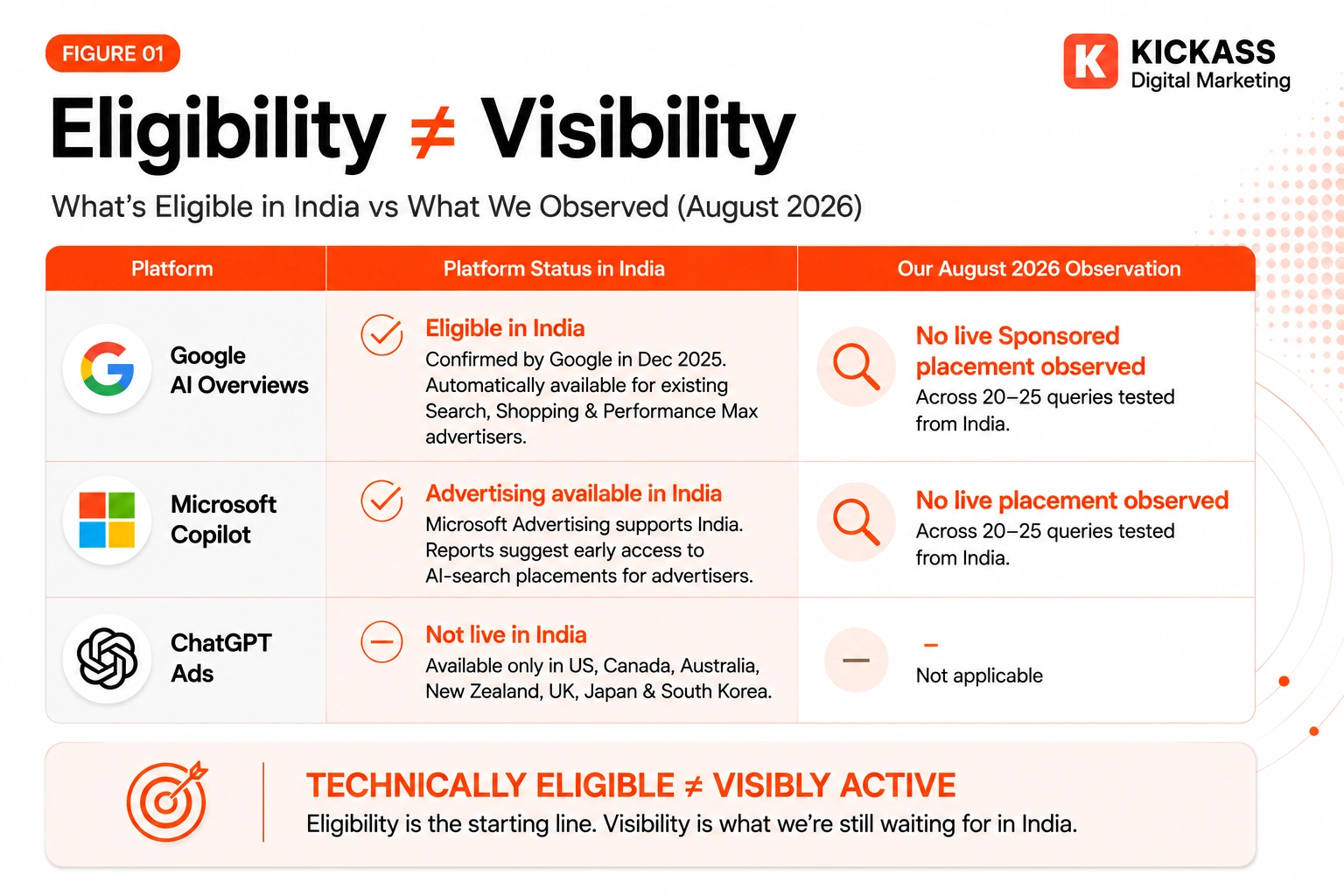
Figure 01. Eligibility ≠ Visibility — platform availability and actual sponsored-placement visibility are not the same thing in India.
Credit: Figure 01. Eligibility ≠ Visibility (Source: platform documentation and KickAss Digital Marketing observation, August 2026).
We went a step further and asked Google directly: “google ai overview ads example in India.” Google’s own AI Overview answered — describing what these ads are and where they’re expected to trigger — but the answer cited third-party marketing blogs and PPC agencies rather than pointing to a confirmed live example. Even a query built specifically to surface one didn’t produce an actual ad.
That’s a more precise finding than a simple “nothing’s happening yet.” Eligibility and observable presence are two different things. Google’s own documentation confirms Indian advertisers have been technically eligible for AI Overview ad placements since December 2025. What our testing suggests is that eligibility has not yet translated into meaningful, visible ad volume in the Indian market as of mid-August 2026 — at least not for the query set and account context we tested from.
For a business trying to decide how urgently to act, this is evidence the window is still genuinely open — not evidence the shift isn’t coming. The infrastructure is confirmed live. The auction volume, in India specifically, has not caught up yet. That’s exactly the kind of gap that closes without warning once a handful of large advertisers start bidding into it.
(Results reflect one test session, one account context, and one query set — not a comprehensive audit. Ad serving is known to vary by account history, device, and session. Testing this yourself may produce different results, and we’d genuinely like to hear if it does.)
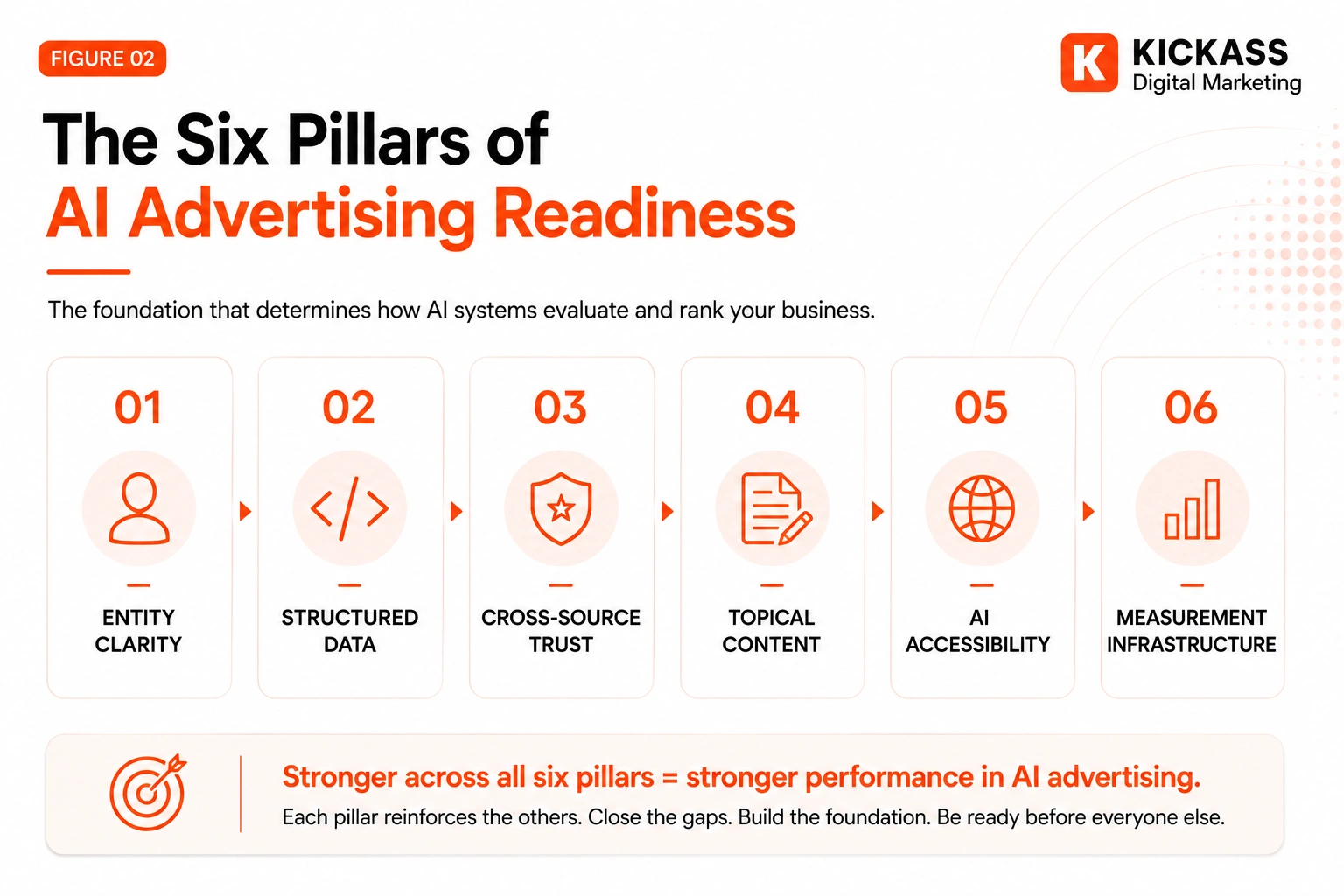
Figure 02. The Six Pillars of AI Advertising Readiness — the foundation businesses need before AI advertising becomes a meaningful acquisition channel.
Figure 02. The Six Pillars of AI Advertising Readiness (Framework: KickAss Digital Marketing, 2026).
Score each item 0 (not done), 1 (partially done), or 2 (fully done). Total each pillar, then add all six for your overall score.
Prefer a downloadable version? The full checklist is also available as a free Excel template — enter your scores and every pillar subtotal; your overall score and readiness band will calculate automatically — no formulas to build yourself.
| # | Item | Score |
|---|---|---|
| 1 | Business name is identical across website, Google Business Profile, and social profiles | ⬜ |
| 2 | Business category/type is consistent across every platform listing | ⬜ |
| 3 | Address and service area match across all directories and profiles | ⬜ |
| 4 | Website “About” content and Google Business Profile description say the same thing, not contradictory versions | ⬜ |
| 5 | Business has been searched in ChatGPT/Perplexity/Gemini to check how it’s currently described — and the description is accurate | ⬜ |
Pillar 1 subtotal: ___ / 10
| # | Item | Score |
|---|---|---|
| 6 | Organization schema is present on the website | ⬜ |
| 7 | Service schema is present for each core offering | ⬜ |
| 8 | Product schema is present (if applicable) | ⬜ |
| 9 | FAQ schema is implemented on relevant pages | ⬜ |
| 10 | Schema has been validated with no errors (Google’s Rich Results Test or equivalent) | ⬜ |
Pillar 2 subtotal: ___ / 10
| # | Item | Score |
|---|---|---|
| 11 | Business has at least 3 independent citations (directories, industry publications, not self-published) | ⬜ |
| 12 | Business has reviews on at least 2 independent platforms (Google, industry-specific, or general review sites) | ⬜ |
| 13 | Business is submitted to Bing Webmaster Tools — most Indian businesses have only ever submitted to Google Search Console, but ChatGPT and Perplexity draw significantly on Bing-indexed data | ⬜ |
| 14 | Business has at least one independent editorial mention (press, industry blog, guest feature) | ⬜ |
| 15 | Google Business Profile is fully complete — hours, category, photos, posts — not just claimed | ⬜ |
Pillar 3 subtotal: ___ / 10
| # | Item | Score |
|---|---|---|
| 16 | Website content answers the actual questions a buyer or AI system would ask about the category, not just keyword-targeted copy | ⬜ |
| 17 | Content is specific to the business’s actual expertise, not generic industry boilerplate | ⬜ |
| 18 | Content is structured for extraction — clear headings, direct answers, not buried in dense paragraphs | ⬜ |
| 19 | Content is updated regularly — stale content is a lower-confidence signal for AI systems | ⬜ |
| 20 | Business has content addressing its specific service area/city, not just national-level generic claims | ⬜ |
Pillar 4 subtotal: ___ / 10
| # | Item | Score |
|---|---|---|
| 21 | Website does not block AI crawlers (GPTBot, PerplexityBot, ClaudeBot) via robots.txt | ⬜ |
| 22 | An llms.txt file exists at the website root | ⬜ |
| 23 | Content uses canonical, direct answer formatting — not buried behind interactive elements or excessive JavaScript rendering | ⬜ |
Pillar 5 subtotal: ___ / 6
| # | Item | Score |
|---|---|---|
| 24 | Conversion tracking (Conversions API or equivalent) is implemented, not just legacy pixel tracking | ⬜ |
| 25 | UTM conventions are standardized across campaigns | ⬜ |
| 26 | Attribution model has been reviewed for conversational/multi-touch journeys, not just last-click | ⬜ |
| 27 | Google Business Profile insights and Search Console are actively monitored, not just set up and forgotten | ⬜ |
| 28 | A process exists for testing brand visibility directly in ChatGPT/Perplexity/Copilot periodically, not just relying on traditional rank tracking | ⬜ |
Pillar 6 subtotal: ___ / 10
Total possible score: 56
| Score range | What it means |
|---|---|
| 45-56 | Strong readiness. Entity signals are largely in place — focus on maintaining consistency and monitoring as platforms scale in India. |
| 28-44 | Meaningful gaps exist. Prioritize the lowest-scoring pillar first — usually Structured Data or Cross-Source Trust for most Indian businesses — before increasing any AI ad spend. |
| Below 28 | Foundational work is needed. Budget will not compensate for weak entity signals once these platforms reach meaningful scale in India — this is the highest-leverage place to start. |
If you’re unsure how to interpret your score or where to prioritize, an AI Readiness Audit does this diagnostic work in detail — not just scoring the gaps, but sequencing what to fix first based on your specific category and market.
The usual argument for building AI advertising readiness is future-proofing — get ready before ChatGPT Ads reaches India, before the auction opens, before competitors who prepared early have a head start.
That argument still holds. But our own testing adds a sharper edge to it: part of this infrastructure is not future speculation. Google AI Overview ads have been technically eligible in India since December 2025. The absence of visible ad volume right now is not evidence the shift is far away — ShodhDynamics’ research into the ChatGPT Ads India window makes the same point about the ChatGPT timeline: the preparation window closes quietly, not with an announcement.
None of the 28 items in this checklist require India-specific platform access to complete. Every one of them can be built today, and every one of them also strengthens how a business appears in Google AI Overviews right now — the one AI advertising surface confirmed to already be switched on here.
→ See the full ChatGPT Ads Agency & Consultant readiness process This checklist covers the entity foundation. The full readiness process covers account setup, creative, and product feed preparation for when ChatGPT Ads access opens in India — also referenced in our breakdown of why budget alone can’t fix entity gaps.
Are AI ads already live in India? Partially, and the distinction matters. Google AI Overview ads — sponsored placements inside the AI summary box in regular Google Search — have been officially eligible in India since December 2025 for businesses already running Search, Shopping, or Performance Max campaigns. This is different from the separate “AI Mode” conversational tab, whose ad rollout is confirmed only in the US so far. ChatGPT Ads is not live in India. Our own testing in August 2026 found no visible ad placements on Google (AI Overview) or Microsoft Copilot from India, despite the underlying eligibility already existing for Google — suggesting real ad volume has not yet caught up with platform eligibility.
What’s the difference between Google AI Overviews and Google AI Mode? AI Overviews is the AI-generated summary box that appears within regular Google Search results, alongside traditional blue links. AI Mode is a separate, dedicated conversational search tab. They’re often conflated, but their ad rollouts have moved on different timelines — AI Overview ads are confirmed eligible in India, AI Mode ad rollout has only been confirmed in the US. Testing “AI Mode” alone and finding nothing does not mean AI Overview ads are absent, and vice versa.
Is a 0-2 scoring scale detailed enough, or should I use a finer scale? 0-2 (not done / partial / complete) is deliberately simple to keep the self-assessment honest and fast — a business can complete all 28 items in under 20 minutes. Finer scales tend to introduce false precision at the self-assessment stage. If a formal audit is needed, an AI Readiness Audit applies more granular scoring against category-specific benchmarks.
Should I complete this checklist even if I have no plans to run ChatGPT Ads or Google AI ads? Yes. Every item on this checklist also strengthens organic AI visibility — the likelihood that ChatGPT, Perplexity, or Google AI Overviews mention or recommend a business without any ad spend at all. Paid AI advertising and organic AI visibility draw on the same underlying entity signals; building this foundation pays off whether or not paid spend ever enters the picture.
Is there a downloadable template for this checklist, or do I need to build my own spreadsheet? A free downloadable Excel template is available with all 28 items pre-built and automatic scoring — pillar subtotals, overall score, and readiness band all calculate instantly as you enter scores from 0 to 2. No spreadsheet setup or formula-building required; just download and start scoring.
How often should this checklist be re-scored? Quarterly is reasonable for most businesses — entity signals don’t shift dramatically week to week, but platform rollouts (like the Google AI Overview ads eligibility change in December 2025) can shift the stakes of a given score without any change on the business’s end. Re-testing brand visibility directly in ChatGPT, Perplexity, and Copilot (Pillar 6, item 28) is worth doing more frequently, since that’s the fastest-changing signal.
The businesses that score well on this checklist aren’t guessing about AI advertising readiness. They’ve done the specific, checkable work — entity consistency, structured data, independent citations, content that actually answers real questions, technical accessibility, and measurement that’s ready before the first campaign launches.
Right now, in India, that work has a rare property: it’s not speculative. Part of what it feeds into is already live. The rest is confirmed to be coming. Neither timeline rewards waiting.
→ Score your business, then talk to us about closing the gaps — start with an AI Readiness Audit