Get Marketing Insights First
Subscribe to receive actionable strategies, growth tips, and industry insights delivered straight to your inbox.

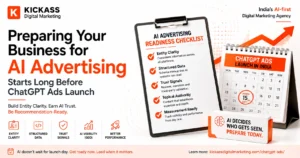
Build entity clarity, structured data, and cross-source trust signals now — the same three conditions that determine whether AI systems recommend a business organically also determine ChatGPT Ads placement quality once the platform opens. This work has no dependency on India’s launch date and starts producing results in Google AI Overviews immediately.
Yes. ChatGPT Ads placement depends on entity trust, not just bid amount — a business with weak or absent organic AI presence will underperform in the auction even with a strong budget, because the system evaluates whether it can confidently describe the advertiser before showing the ad.
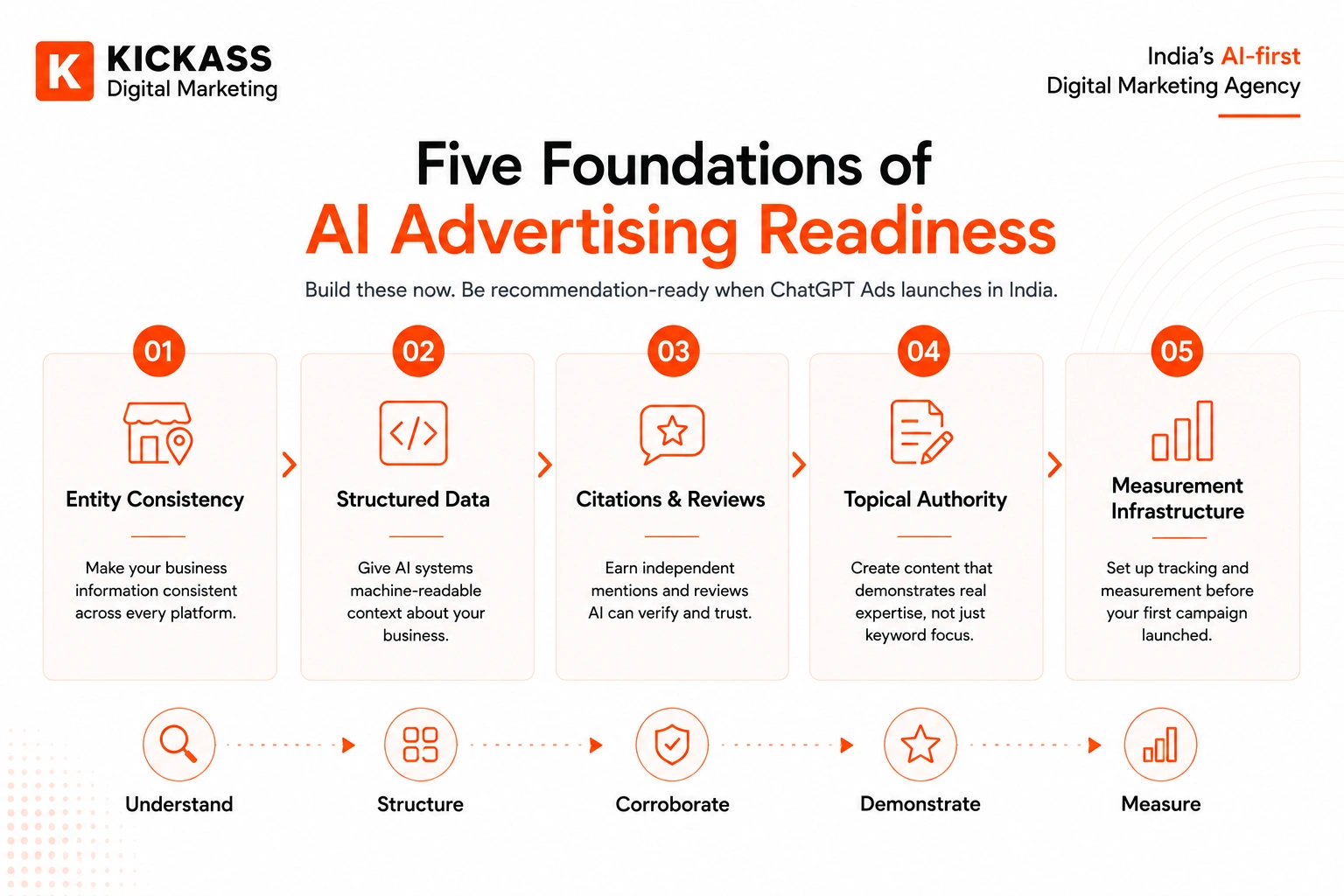
Five things, in order: consistent entity information across every platform, structured data (schema) on the website, independent third-party citations and reviews, content that establishes topical authority, and measurement infrastructure ready before the first campaign launches.
A marketing manager at a mid-sized B2B software company set a calendar reminder for the day ChatGPT Ads opens in India.
Her plan: the moment access opens, brief the team, get a campaign live within the week, and be first among competitors to test the channel.
It’s not a bad instinct. But it assumes the wrong starting line.
ChatGPT Ads doesn’t work like a channel you switch on. It works like a channel that reads what already exists — about the business, across every source it can find — and decides how much to trust what it reads before it decides whether an ad performs. A business that waits for launch day to start is not first in line. It’s starting six months behind the businesses that used the wait differently.
This is what those six months are for.
Here’s what will actually happen when India access opens.
A wave of businesses will rush to set up ad accounts, write creative, and set budgets — treating it exactly like flipping on a new Google Ads or Meta campaign. Account created, campaign launched, wait for results.
Some of those campaigns will perform well immediately. Most won’t — not because the creative is weak or the targeting is wrong, but because ChatGPT Ads doesn’t evaluate a business the way Google Ads does. Google’s auction rewards bid and Quality Score. ChatGPT’s auction reads something closer to reputation — can the system confidently describe this business, has it seen consistent signals about it across multiple sources, does it trust what it finds enough to recommend it inside a conversation.
ShodhDynamics’ research into ChatGPT Ads failure conditions identifies this precisely: ChatGPT Ads don’t fail at the campaign level. They fail before the ad is served — because of no organic AI presence, unclear entity signals, or a mismatch with where the buyer actually is in their decision. None of those three causes gets fixed by launching faster. They get fixed by starting earlier.
This is the part most marketing teams find counterintuitive, so it’s worth stating plainly.
In Google Ads, a strong budget and a well-optimized campaign can outperform a competitor with a bigger brand and a weaker campaign. The auction rewards execution.
ChatGPT Ads runs differently. OpenAI’s own Ads Manager documentation confirms placement runs on a relevance-weighted auction — meaning the system’s confidence in what it knows about the advertiser is a direct input into whether the ad shows at all, not just how much it costs. ShodhDynamics’ comparison of the two platforms puts it plainly: entity trust is a prerequisite for placement, not a modifier. An advertiser with low entity confidence may not surface even when the conversation is exactly the right context — because the AI isn’t willing to recommend an entity it can’t confidently describe.
Here’s the practical version, described in ShodhDynamics’ analysis of AI Discovery vs search advertising: a resort in Coorg with a well-managed Google Ads campaign asked an AI system to recommend a quiet, elderly-friendly hospitality property. It didn’t appear — not because it was a worse property, but because its entity signals didn’t clearly communicate accessibility for elderly guests or the specific positioning the query required. Two other properties were mentioned, with no ad served at all. The decision was shaped before any search happened.
Google Ads will keep working for that resort when a user searches with intent already formed. But a growing share of consideration is happening earlier, inside conversations Google Ads was never built to reach — and no amount of bid increase changes what the AI already believes about a business.
This is precisely why ShodhDynamics’ ESC™ Framework treats pre-advertising readiness as one of its named applications, not a separate discipline: AI-native advertising performs poorly when Entity Clarity, Semantic Authority, and Cross-Source Trust are not already in place. Organic readiness isn’t preparation for the paid channel — it’s the precondition the paid channel depends on.
The one exception worth naming — budget size does matter for small businesses, but not the way most assume. ShodhDynamics’ research on small businesses and ChatGPT Ads found that the platform doesn’t discriminate by budget or brand size — it discriminates by entity clarity. A small business with strong, specific, verifiable entity signals can outperform a larger competitor with a bigger budget and a generic, ambiguous digital presence. Clarity is not a function of company size. It’s a function of whether the work has been done.
This is the checklist version — the part a marketing or SEO team can turn into a work plan this week, independent of India’s launch timeline.
1. Consistent entity information across every platform
The business name, category, description, and location need to say the same thing everywhere — the website, Google Business Profile, industry directories, social profiles, review platforms. Inconsistency here is the single most common reason AI systems describe a business inaccurately or hedge when asked about it. This is a data-cleanup task, not a creative one, and it’s usually the fastest of the five to complete.
2. Structured data (schema) your website is likely missing
Schema markup is how a website tells AI systems, in a format they can parse directly, what the business is, what it offers, and how it’s organized. Most Indian business websites have partial or no schema implementation — Organization schema is common, Service and Product schema far less so. This is a technical task, usually a few days of developer time once the entity information from step one is settled.
3. Independent citations and reviews AI can verify
AI systems weigh third-party corroboration heavily — a business’s own website claiming expertise carries less weight than an independent directory, publication, or review platform saying the same thing. This is the slowest of the five to build and the one most businesses under-invest in, because it requires outreach and relationship work rather than a one-time technical fix.
4. Content that builds topical authority, not just keyword rankings
Content written to rank for a keyword and content written to establish that a business genuinely understands its category are not the same exercise. AI systems reward the second kind — specific, substantive answers to the actual questions a buyer or the AI itself would ask, not generically optimized copy.
5. Measurement infrastructure ready before day one
Once ChatGPT Ads does open in India, conversion tracking setup, the Conversions API, and UTM conventions need to already be in place — not something built after the first campaign launches. Standard last-click attribution doesn’t map cleanly onto conversational ad journeys, so getting this wrong at launch means the first weeks of data are unreliable, right when reliable data matters most.
| Step | What it fixes | Typical timeline | Who owns it internally |
|---|---|---|---|
| 1. Entity consistency | AI describes the business ambiguously or inaccurately | 1–3 weeks | Marketing / brand |
| 2. Structured data | AI can’t extract structured facts about the business | 2–4 weeks | SEO / dev |
| 3. Citations & reviews | AI has nothing independent to verify claims against | Ongoing, 2–6 months | Marketing / PR |
| 4. Topical content | AI doesn’t associate the business with genuine expertise | Ongoing | Content / SEO |
| 5. Measurement setup | Campaign data is unreliable from day one | 1–2 weeks | Marketing / dev |
This is the part worth taking to whoever controls the budget, because it removes the “why spend on an unlaunched platform” objection entirely.
None of the five items above are ChatGPT-Ads-specific. Every one of them also strengthens how Google AI Overviews represents a business today — the AI-generated summaries that already appear above traditional results on a large share of Google searches in India. Entity clarity, structured data, and citations are the same signals AI Overviews weighs when deciding what to say about a business and whether to say it with confidence.
So the honest framing for a budget conversation isn’t “invest now, speculatively, for a platform that might launch in Q3.” It’s: this work improves AI visibility on a platform Indian businesses are already being evaluated by daily, and it happens to be the same groundwork that determines ChatGPT Ads performance whenever that specific date arrives. The ChatGPT Ads timeline is uncertain. The value of the underlying work is not.
This is where the checklist above becomes a scoped engagement rather than a five-item to-do list a busy marketing team never quite gets to.
An AI Readiness Audit examines exactly where a business currently stands across all five areas — what AI systems currently say when asked to describe or recommend the business, where entity signals are weak, contradictory, or missing entirely, and what needs to change, in what order, to close the gap. It’s the diagnostic step before any of the five-point work begins, so effort goes toward the actual gaps rather than a generic checklist applied uniformly.
For businesses already planning paid advertising — across Google, Meta, or ChatGPT Ads once it’s available — the readiness work and the paid strategy are built as one connected plan, not two disconnected workstreams that happen to share a budget line.
If the team is currently deciding whether to handle this internally or bring in outside help, our guide to vetting a ChatGPT Ads agency in India and our agency briefing checklist both walk through exactly what a real readiness engagement should look like — useful as a comparison point regardless of who ends up doing the work.
→ See the full ChatGPT Ads Agency & Consultant readiness process
This is where the entity, account, and creative groundwork described above rolls up into one tracked process — the same one referenced throughout our ChatGPT Ads Manager walkthrough and budget planning guide.
How long does AI advertising readiness take to complete?
Entity consistency and structured data can typically be completed in three to six weeks. Citations, reviews, and topical content-building are ongoing efforts that continue to compound over two to six months and beyond. There’s no single “done” date — but a business that starts now has a meaningful head start over one that starts when the platform launches in India.
Can a small business compete in AI advertising without a large budget?
Yes. Independent research shows ChatGPT Ads placement is determined by entity clarity, not company size or budget. A small business with specific, consistent, well-corroborated entity signals can outperform a larger competitor with a bigger budget and a generic digital presence.
What happens if a business waits until ChatGPT Ads launches in India to start preparing?
It enters the auction at a structural disadvantage that budget alone cannot fix. Entity trust is built over time from accumulated signals — it can’t be assembled the week a platform opens. Competitors who started preparation months earlier will have stronger relevance scores from day one.
Do I need to build all five readiness areas before ChatGPT Ads launches, or can I prioritize?
Prioritize entity consistency and structured data first — they’re the fastest to complete and form the foundation the other three areas build on. Citations and topical content take longer and can run in parallel once the foundation is in place.
Is this preparation work useful if ChatGPT Ads never launches in India, or launches later than expected?
Yes — this is the same groundwork that improves how a business appears in Google AI Overviews today, which is already live and already influencing buyer decisions in India. The investment isn’t contingent on ChatGPT Ads’ specific timeline.
They’re the ones who spent the months before launch building something the platform could actually trust.
ChatGPT Ads will open in India on its own schedule — not yours, and not your competitors’. What’s within a business’s control right now is whether, when that date arrives, the entity signals a relevance-weighted auction depends on are already in place, or whether the work starts from zero on launch day, at the exact moment competitors who prepared are already running.
→ Start with an AI Readiness Audit — find out exactly where the gaps are before the auction opens, not after.