Get Marketing Insights First
Subscribe to receive actionable strategies, growth tips, and industry insights delivered straight to your inbox.

ChatGPT Ads requires a different operating model from Google or Meta. This guide explains how Indian advertisers should structure context hints, creative variations, budgets, eligibility checks, product feeds, landing pages and measurement before spending.
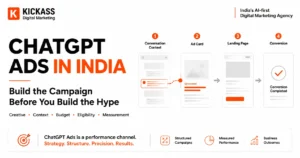
For an Indian brand preparing its first ChatGPT Ads campaign, the important decisions are not the launch date or the first CPM screenshot. Get five things right first: advertiser eligibility, conversation-fit targeting, creative coverage, landing-page or product-feed readiness, and measurement.
ChatGPT Ads is not simply Google Ads with a conversational interface.
The platform can consider the context and intent of a conversation, advertiser-supplied context hints, the ad and landing page, and — when a user has enabled ad personalisation — selected signals from the user’s broader ChatGPT experience.
That changes how a campaign should be built.
The operating question is no longer only:
“Which keyword do we want to buy?”
It becomes:
“In which buyer situations is this offer genuinely useful, what should we say in that moment, and can we measure what happens after the click?”
That is the practitioner lens for this guide.
If you need the commercial execution layer rather than the strategy alone, see our ChatGPT Ads Agency in India service. For the broader media stack, see Paid Advertising.
Yes. Ads began appearing to eligible ChatGPT users in India on 27 August 2026. However, advertiser-side self-service availability is still in transition: OpenAI’s campaign documentation already lists an India minimum daily budget of ₹725, while its Ads Manager availability page had not yet listed India as self-service available when this guide was updated on 28 August 2026.
That distinction matters.
Consumer availability and advertiser self-service access are not the same thing.
For campaign planning, the useful facts are:
Do not build the campaign around a rumoured access date. Build it so the account can launch when access is actually available.
For a walkthrough of the buying interface and campaign structure, see How ChatGPT Ads Manager Works.
ChatGPT Ads does not use context hints as exact-match keywords. Build ad groups around coherent customer needs, situations and use cases instead of copying a Google Ads keyword list into a new platform.
OpenAI’s current campaign guidance says an ad group can include context hints describing:
A context hint does not instruct ChatGPT to show an ad whenever a particular phrase appears.
It helps the delivery system understand the broader situations in which the ad may be relevant.
running shoes
cushioned everyday running shoes for beginners training for their first 5K
The difference is not “long-tail keywords”.
The stronger version communicates need + use case + product fit.
Do not create one giant ad group called:
Skincare
and fill it with every product, audience and use case.
Split meaningfully different needs where the creative or landing page should also differ.
For example:
Ad group: daily acne-prone skincare
Ad group: sensitive-skin moisturising
Those are different buyer situations.
They deserve different messages and possibly different landing destinations.
OpenAI itself recommends keeping ad groups focused on a common theme, product category or customer need and using multiple ads inside each group.
A ChatGPT Ads creative strategy should use multiple distinct title-and-copy variations for each meaningful use case. One compressed ad adapted from Google or Meta is not enough.
OpenAI currently recommends:
More importantly, OpenAI recommends a high volume and diverse set of ads so the system has different useful messages available for different contexts.
That changes the creative brief.
The job is not:
“Write the best headline.”
It is:
“Create enough genuinely different value propositions to cover the situations in which the product may be useful.”
We use a simple creative discipline for this:
If the central idea cannot be understood like a useful text message, the ad is probably trying to carry too much.
The SMS Rule does not mean every title must be under 20 characters or that shorter copy automatically performs better.
It means each ad should communicate one useful idea.
No stacked value proposition.
No corporate mission statement.
No secondary argument hidden inside the description.
No inherited Google Display headline plus a Meta-style body paragraph squeezed into a smaller box.
Suppose a travel brand sells weekend stays in Goa.
Do not write twelve near-identical variations of:
Goa Weekend Deals
Instead, build different angles around real use cases:
The product may be the same.
The conversation-fit reason to show it is different.
That is where creative coverage becomes more valuable than simple copy rotation.
On ChatGPT Ads, the landing page is not just where the click ends. OpenAI includes the landing page among the signals used to assess relevance, so a generic homepage can weaken both message continuity and delivery context.
OpenAI recommends sending users to the most relevant destination available:
That creates a practical rule:
Context hint → ad message → landing page should describe the same buyer situation.
Before launch, check:
This is ordinary performance-marketing hygiene, but it matters more when the system itself considers the landing page as part of relevance.
Do not assume that a business is eligible simply because its product could fit a broad category such as “local services”. OpenAI separates advertiser/content eligibility from placement safety, and several regulated categories remain restricted or prohibited outside the US.
OpenAI’s current policy says the early program is primarily focused on consumer categories such as:
But the detailed policy matters more than the category label.
Do not plan an Indian healthcare campaign on the assumption that healthcare is now generally available case-by-case.
OpenAI currently says health services outside the US are generally prohibited. The case-by-case path described in the policy applies to eligible US advertisers and categories.
Do not assume an Indian bank, lender, insurer or investment business can enter through the US restricted-advertiser route.
OpenAI currently says financial-services ads outside the US are generally prohibited.
Legal advice, representation and legal services are not permitted.
General legal education or media may be allowed where no legal service is being sold.
This needs particular care for Indian advertisers.
OpenAI’s current policy prohibits ads for individual housing rentals or sales. Platforms containing housing listings may be eligible if the ad and landing page do not reference a specific listing.
So a RERA-registered developer should not assume that being a “local service” automatically makes a specific apartment or project campaign eligible.
Check the current policy before building the campaign.
For the execution side — buyer-intent ad groups, real-estate context hints, ad-copy examples, negative phrases, landing-page alignment, tracking and qualified-lead measurement — see our ChatGPT Ads for Real Estate in India: End-to-End Campaign Blueprint.
If you need campaign implementation rather than the practitioner guide, see our ChatGPT Ads Services for Real Estate.
A skincare, nutrition or wellness brand may appear straightforward until the creative starts making medical, treatment, weight-loss or unsupported health claims.
Eligibility depends on both the underlying product and the claims made in:
Even an otherwise eligible advertiser cannot expect ads to appear beside sensitive conversations.
OpenAI excludes ads from contexts involving vulnerable or sensitive user situations, including personal health and other high-stakes conversations.
That means:
Advertiser eligibility answers “may this business advertise?”
Placement policy answers “is this conversation appropriate for an ad?”
Do not merge the two.
OpenAI currently lists ₹725 as India’s minimum daily campaign budget. That number tells you the minimum campaign setting — not the CPM you should expect, the amount required for statistical confidence, or the budget that will produce a profitable test.
OpenAI itself says ChatGPT Ads does not yet have performance benchmarks across advertisers, industries or campaign types.
So we would not build an India media plan around an imported US CPM, CPC or ROAS assumption.
ChatGPT Ads Manager supports three campaign objectives:
| Objective | Optimises for | Billing |
|---|---|---|
| CPM | Reach / impressions | Per 1,000 impressions |
| CPC | Clicks / traffic | Per valid click |
| oCPC | Clicks more likely to lead to a selected conversion | Per valid click |
For conversion-optimised campaigns, the advertiser must first have supported conversion tracking configured.
OpenAI currently supports conversion measurement through its pixel and/or Conversions API.
Do not ask:
“Is ₹725 per day enough?”
Ask:
“What amount can we spend long enough to learn something without forcing a premature conclusion?”
Your first campaign budget has to fund:
There is another operational detail worth noting: OpenAI describes a daily budget as an average delivery target, not a strict same-day cap. Daily spend can fluctuate, subject to the platform’s stated multi-day controls.
So the minimum should never be treated as a guarantee of exact daily spend.
For the broader India budgeting question, see ChatGPT Ads Budget Planning for India.
For ecommerce advertisers, a clean product feed may be more valuable than producing dozens of standalone ad cards manually. OpenAI’s feed campaigns can create ads from a catalogue at scale and keep product details and availability current.
OpenAI says product-feed advertisers have been among the strongest performers in its program to date.
That does not mean a product feed guarantees performance.
It does mean retailers have a concrete preparation task that is useful before campaign launch.
Audit:
During the current beta, OpenAI says products uploaded through the Ads Manager feed are eligible for ads, not automatically for organic ChatGPT product recommendations.
So:
Paid feed eligibility ≠ organic recommendation visibility.
Do not sell the product feed as a way to buy organic ChatGPT recommendations.
For the broader paid-versus-organic distinction, see Google Ads vs ChatGPT Ads.
ChatGPT Ads is relevance-gated inventory. A commercial-looking conversation does not guarantee an impression, and advertisers cannot buy their way into the model’s answer.
OpenAI says ads appear below ChatGPT responses and are visually separated from the answer.
Its current system considers multiple signals when deciding whether and which ads to show.
It is also important to update one early assumption about the format:
ChatGPT can show one or more ad units below a response, and a unit may contain one or more items or advertisers.
So campaign planning should not be based on the outdated idea that every eligible response has exactly one exclusive advertiser slot.
More importantly:
Buying an ad does not buy a recommendation inside ChatGPT’s answer.
Paid placement and organic inclusion are separate systems.
A brand may simultaneously need:
Do not collapse those into one service or one KPI.
A ChatGPT Ads test is not ready until the campaign objective, conversion event, UTMs and reporting logic are defined. Screenshots of ads appearing in ChatGPT are not performance measurement.
Ads Manager currently reports metrics including:
Advertisers can also use UTMs in landing-page URLs.
For conversion optimisation, OpenAI supports a JavaScript pixel and/or Conversions API.
For a lead-generation campaign:
Impression → Click → Qualified landing-page session → Lead → Qualified lead → Sale
For ecommerce:
Impression → Click → Product view → Add to cart → Purchase → Revenue
For a high-consideration service:
Impression → Click → Engaged session → Enquiry → Qualified opportunity
Do not declare success because CTR is high if the downstream traffic is weak.
Do not declare failure because CPM is high if qualified conversions are strong.
And do not compare early ChatGPT Ads results directly with mature Google Search or Meta benchmarks without accounting for the different inventory, targeting logic and stage of the platform.
OpenAI says advertisers receive campaign reporting rather than access to individual user chats, chat history, memories, names, email addresses or sensitive personal information.
That means your reporting system should be built around campaign outcomes, not an expectation that the advertiser will receive the conversation that triggered an ad.
Different business models should prepare different assets. There is no useful universal “ChatGPT Ads readiness checklist” unless it changes with the product, eligibility and buying journey.
| Business type | First preparation priority | Why |
| D2C fashion / home / consumer retail | Clean product feed + multiple conversation-angle creatives | Feed-based campaigns can scale catalogue advertising |
| Travel / hospitality | Use-case ad groups + focused landing pages | Buyer needs vary by trip type, timing, budget and context |
| Education / digital products | Need-state context hints + conversion tracking | The platform can match around problems and learning goals rather than exact keywords |
| B2B SaaS | Narrow use-case tests + lead-quality measurement | Do not assume broad conversational reach equals qualified pipeline |
| Specific housing listings / projects | Policy review before creative production | Housing sales/rental policies can restrict specific-listing promotion |
| Healthcare / financial services in India | Do not build on assumed eligibility | Current OpenAI policy generally prohibits these categories outside the US |
This is a better starting point than asking which Indian industry will “win” ChatGPT Ads first.
Nobody has enough India performance data to answer that responsibly yet.
A sensible first ChatGPT Ads campaign should be small enough to diagnose but structured enough to teach you something.
Use this sequence.
Check the current OpenAI Ads Policy against:
Do not mix reach, traffic and conversion expectations inside one test.
Choose CPM, CPC or oCPC based on what you actually want the campaign to optimise.
Each group should represent a meaningfully different buyer need, product category or situation.
Use the SMS Rule for clarity, but build coverage, not one perfect message.
Each creative should introduce a different useful angle.
Avoid the homepage unless it is genuinely the best destination.
UTMs, pixel, Conversions API and supported conversion events should not be an afterthought.
₹725 is the documented floor.
Your actual test budget should be based on the amount of signal you need to make a decision.
Write the decision thresholds before you see the numbers.
That protects the account from post-hoc storytelling.
| Do | Don’t |
| Build ad groups around real needs and use cases | Copy Google Ads keywords into “context hints” |
| Create multiple genuinely different ads per use case | Produce one “perfect” ad and wait |
| Keep each card focused on one useful idea | Compress a full Meta ad into a smaller box |
| Match context hint, message and landing page | Send every click to the homepage |
| Check category and claim eligibility first | Assume a broad category label guarantees approval |
| Treat ₹725 as a platform minimum | Treat ₹725 as a recommended or sufficient test budget |
| Configure UTMs and conversions before launch | Judge the campaign from screenshots or CTR alone |
| Clean product data before retail launch | Treat a paid product feed as organic recommendation optimisation |
| Separate paid placement from organic AI visibility | Assume ad spend can influence ChatGPT’s answer |
Yes. Ads began appearing to eligible ChatGPT users in India on 27 August 2026. Advertiser self-service availability should still be checked against OpenAI’s current Ads Manager availability page before assuming a new account can launch immediately.
OpenAI’s current campaign documentation lists ₹725 INR as the minimum daily campaign budget for India. That is a minimum budget setting, not a recommended test budget, CPM benchmark or expected daily return.
Not in the Google Ads exact-match sense. Advertisers can provide context hints describing relevant needs, products, situations, topics or phrases, but OpenAI says these are not exact-match controls and do not guarantee delivery in specific conversations.
OpenAI currently recommends titles of 16–24 characters and ad copy of 32–48 characters; the documented maximums are 50 characters for a title and 100 for copy. Images should be square and no larger than 1200×1200.
Use the underlying offer and evidence, but rewrite the creative for ChatGPT’s conversational context and shorter card format. OpenAI recommends multiple distinct creative variations rather than one repeated message.
Do not assume so. OpenAI’s current policy prohibits ads for individual housing rentals or sales. Housing platforms may be allowed under narrower conditions, so a developer should check the live policy before building a specific-project or listing campaign.
Current OpenAI policy generally prohibits health-services and financial-services ads outside the US. Do not rely on the US case-by-case approval language when planning an Indian campaign.
No. ChatGPT Ads are sponsored placements separate from the model’s answer. Paid advertising should not be confused with organic citations, mentions or recommendations.
Not by itself. OpenAI currently says feed products uploaded through Ads Manager are eligible for advertising during the beta and do not automatically appear in organic ChatGPT conversations.
Measure the campaign against its chosen business objective and downstream outcomes, not only impressions or CTR. Use UTMs, Ads Manager reporting and conversion tracking so clicks can be connected to leads, purchases or another defined action.
ChatGPT Ads is a new paid-media surface.
That does not require a new theory of marketing.
The fundamentals remain familiar:
eligible offer → useful audience context → clear creative → relevant destination → reliable measurement → commercial decision
What changes is the matching environment.
Conversation context gives advertisers a richer way to describe when an offer is useful, but it also punishes lazy translation from keyword and feed-based channels.
If your team is preparing for ChatGPT Ads in India, start with the campaign architecture — not the announcement.
For execution support, see our ChatGPT Ads Agency in India service.
For campaigns that need ChatGPT Ads to sit alongside Google, Meta and other paid channels, see Paid Advertising.
If you are still deciding whether to build internally or use an agency, read How to Vet a ChatGPT Ads Agency in India.