Get Marketing Insights First
Subscribe to receive actionable strategies, growth tips, and industry insights delivered straight to your inbox.

Learn how ChatGPT Ads Manager works—from advertiser account setup and conversational targeting to bidding, conversion tracking, and campaign measurement. Based on OpenAI documentation and the live US rollout, this guide helps Indian businesses prepare before ChatGPT Ads launches in India.
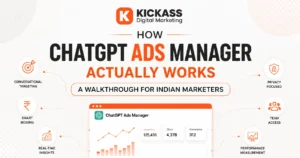
ChatGPT Ads Manager is OpenAI’s self-service advertising platform for creating, managing, and measuring advertising campaigns within ChatGPT. Businesses create an advertiser account, complete business verification, configure billing, and invite team members before launching campaigns.
Campaigns are targeted using conversational context rather than keywords. Advertisers can choose available bidding models such as CPC or CPM, depending on market availability, and measure performance using aggregated reporting, conversion tracking, and privacy-preserving analytics.
Unlike traditional search advertising, ChatGPT Ads matches advertisements to the context of a user’s conversation instead of individual search terms. As of mid-August 2026, the platform is live in nine markets — the US, Canada, Australia, New Zealand, the UK, Japan, South Korea, Mexico, and Brazil — while India has not yet been officially announced, though some Indian users received a preparatory privacy-policy email in mid-August 2026.
Search “ChatGPT ads India” and you’ll find plenty of pages using the phrase. Almost none of them explain the platform itself — how an account actually gets set up, how targeting works, how bidding is priced, what gets measured. That’s the gap this piece fills, built from OpenAI’s own documentation and verified reporting on the live US rollout, not speculation.
India hasn’t launched yet. Everything below describes how the platform works where it’s already running — so you know exactly what you’re preparing for. (For where India specifically stands, see Current Status on our ChatGPT Ads readiness page.)
The timeline below shows how conversational AI, AI-powered search, and ChatGPT Ads evolved from public launch to international rollout.
| Date | Company | Key Development | Why It Matters |
|---|---|---|---|
| November 2022 | OpenAI | ChatGPT launches publicly. | Introduces conversational AI to a mass consumer audience, accelerating mainstream adoption of AI assistants. |
| May 2023 | Search Generative Experience (SGE) is unveiled at Google I/O. | Marks Google’s first public move toward AI-generated search answers, signalling a major shift beyond traditional search results. | |
| May 2024 | SGE is rebranded as AI Overviews and rolls out across the United States. | AI-generated answers become part of Google’s mainstream search experience. | |
| August 2024 | AI Overviews expands to India, the UK, Japan, Mexico and Brazil. | Brings AI-powered search to several major international markets, including India. | |
| Mid-2025 | AI Overviews reaches more than 200 countries while Google begins testing ads within AI-generated answers. | Demonstrates that AI search is becoming Google’s default experience and introduces early AI-native advertising. | |
| 9 February 2026 | OpenAI | ChatGPT Ads launches in the United States as an invitation-only pilot. | Creates the first commercial advertising platform inside ChatGPT. The launch is US-only, with a $60 flat CPM and a US$200,000–250,000 minimum commitment. |
| 26 March 2026 | OpenAI | OpenAI announces expansion to Canada, Australia and New Zealand. | Confirms the platform is beginning its first international rollout beyond the United States. |
| 16–17 April 2026 | OpenAI | Canada, Australia and New Zealand officially go live. | Ads begin serving in three additional countries roughly ten weeks after the US launch, confirming a phased rollout strategy. |
| 21 April 2026 | OpenAI | CPC bidding is introduced using a relevance-weighted second-price auction. | Expands advertiser buying options beyond CPM, with recommended starting bids of US$3–5 per click. |
| 5 May 2026 | OpenAI | Self-serve Ads Manager opens across the four live markets. | Removes minimum spend requirements, launches Conversions API and pixel tracking, and broadens advertiser access through agency and ad-tech partners. |
| 7 May 2026 | OpenAI | OpenAI announces the next expansion to the UK, Mexico, Brazil, Japan and South Korea. | Signals continued global rollout into Europe, Asia and Latin America. |
| 2 June 2026 | OpenAI | EU advertising policy is updated ahead of the UK launch. | Introduces explicit user opt-in consent for advertising, reflecting stricter privacy requirements than the US model. |
| 6 June 2026 | OpenAI | The United Kingdom becomes the first European ChatGPT Ads market. | Marks OpenAI’s entry into Europe, with UK advertisers billed in GBP rather than USD. |
| 19 June 2026 | OpenAI | Self-serve Ads Manager Beta opens to UK advertisers. | Shows an accelerated rollout compared with the original US launch timeline. |
| July 2026 | OpenAI | Japan officially goes live. | Establishes ChatGPT Ads in Asia, with reports indicating rapid advertiser adoption. |
| By 11 August 2026 | OpenAI | Brazil and Mexico move from “Coming Soon” to confirmed live, expanding the footprint to nine markets: US, Canada, Australia, New Zealand, UK, Japan, South Korea, Mexico, Brazil. | Nine markets now share the same CPC/CPM pricing mechanics — no evidence yet of country-specific rates anywhere, including the newest two. |
| Mid-August 2026 | OpenAI | Some ChatGPT users in India receive a privacy-policy email explaining how ads would work if introduced — not a launch announcement, no rollout date confirmed, India not listed among expansion markets. | The same category of preparatory signal OpenAI has sent roughly 4-6 weeks ahead of launch in past markets — worth watching, not yet worth treating as live. Q3–Q4 2026 remains a widely cited industry estimate rather than a confirmed window. For a detailed analysis, see ShodhDynamics’ full analysis of the India timing question. |
ShodhDynamics’ investigation into the Ads Manager launch makes a point worth sitting with: self-serve ad managers almost never arrive this early in an ad platform’s life. Meta, Twitter, and Snapchat all sold ads for years before building self-serve tools. The one real precedent is Google — AdWords and its self-serve manager launched together in 2000, and that became one of the most profitable advertising businesses ever built. OpenAI building its self-serve layer this early isn’t an accident; the investigation digs into what that signals about where this is headed, including two reporting metrics with no real precedent in digital advertising.
The flow, in order: create an account, complete business verification (handled through Persona, OpenAI’s identity verification partner), set up billing, then invite team members before launching campaigns.
The detail that catches most agencies off guard: there’s no agency-level account type. The client has to create their own advertiser account first — an agency cannot create it on the client’s behalf. The agency gets added afterwards as a team member, with either admin or campaign-level access. If you plan to have an agency run this, please budget time for your team to complete the first step before handoff. (This is exactly what we coordinate in Phase 2 of our readiness process — so it doesn’t stall in your legal or IT queue.)
Not keywords. ChatGPT Ads reads the conversational context of what someone’s actively discussing and matches ads to that, rather than matching a typed search query. Early versions of the platform (April 2026) supported only free-text targeting hints plus country restriction — no demographic targeting. That’s noticeably more limited than Google or Meta’s targeting stack, and it’s a structural difference, not a temporary gap: the whole mechanism runs on conversation relevance rather than audience segments.
Pricing has moved fast. It started as CPM-only at $60 per thousand impressions during the earliest pilot, dropped to around $25 in some transactions as the pilot matured, and CPC bidding arrived at $3–5 per click once the self-serve platform opened in May. Advertisers can now choose between CPM and CPC depending on campaign goals — CPC for performance-driven spend, CPM where impression volume matters more.
None of these figures are India numbers. Pricing in a new market typically reflects local inventory and demand, not a direct import of US rates — worth knowing before anyone quotes you a number for India today.
Through a Conversions API and pixel-based tracking, both introduced alongside the May self-serve launch — the same category of tooling Google and Meta advertisers already expect. Reporting is aggregated: advertisers see performance data (clicks, impressions, conversions) but get no access to individual conversations or personal user data. That’s a deliberate privacy boundary OpenAI has been explicit about, not a current limitation waiting to be lifted.
Here’s why that tooling matters more than it sounds like it should. Standard last-click attribution assumes a clean, linear path — someone clicks an ad, lands on a page, converts, and that click gets the credit. A ChatGPT Ads conversion doesn’t necessarily follow that path. A user might see a sponsored card, keep chatting, ask follow-up questions across several more turns, and convert without ever generating a single trackable “last click” in the traditional sense. That’s a structural difference, not a minor implementation detail — it’s the actual reason server-to-server tracking exists here instead of being optional.
Permitted categories reported so far include consumer goods, local services, travel, entertainment, and digital or educational products. Categories excluded outright, regardless of market: healthcare and medicine, legal services, most financial services, gambling, political content, adult content, dating, alcohol and tobacco, and recreational drugs.
If your business sits in an excluded category, this isn’t a “wait for it to open” situation — it’s a structural exclusion. (Full breakdown on our ChatGPT Ads readiness page.)
Mechanically, it resembles both — a self-serve dashboard, bidding, conversion tracking. Strategically, it isn’t. ShodhDynamics’ comparison of ChatGPT Ads and Google Ads argues that placement here depends on the entity trust the AI system already has in an advertiser, not purely on bid price — meaning the groundwork that makes an ad perform starts before the campaign does, not inside it. Treating this like a fourth programmatic channel to bolt onto an existing media plan misses what makes it different.
No. Everything above describes markets where ChatGPT Ads is already live — the US, Canada, Australia, New Zealand, UK, Japan, South Korea, Mexico, and Brazil, as of mid-August 2026. India hasn’t been officially confirmed by OpenAI, though some Indian users received a preparatory privacy policy email this month — a signal, not a launch. For what’s actually confirmed and what we’re preparing now, see our ChatGPT Ads Agency & Consultant readiness page.
No. The advertiser must create the ChatGPT Ads account and complete business verification before an agency can access it. Agencies are then invited as team members with the appropriate permissions to manage campaigns on the advertiser’s behalf.
ChatGPT Ads is designed around conversational intent rather than keyword matching. Google Ads primarily targets search queries, while ChatGPT Ads places advertisements based on the context of an ongoing conversation. Both platforms support campaign management, bidding, and performance measurement, but the targeting model and user experience are fundamentally different.
No. ChatGPT Ads uses conversational context instead of keywords. Rather than matching ads to individual search terms, the platform evaluates the subject and intent of a conversation to determine whether an advertisement is relevant.
Pricing depends on the market and campaign type. During the US rollout, ChatGPT Ads introduced CPC bidding in the range of approximately US$3–5 per click, alongside CPM buying options. OpenAI has not announced pricing for India, so businesses should avoid assuming US pricing will apply when the platform launches locally.
ChatGPT Ads measures campaign performance using aggregated reporting, conversion tracking, and privacy-preserving analytics. Advertisers can monitor metrics such as impressions, clicks, and conversions without receiving access to individual conversations or personally identifiable user information.
No. As of mid-August 2026, OpenAI has not officially launched ChatGPT Ads Manager in India. The platform is now live in nine markets — the US, Canada, Australia, New Zealand, the UK, Japan, South Korea, Mexico, and Brazil. Some Indian users received a privacy-policy email in mid-August 2026 previewing how ads would work, but this is not a launch announcement and no rollout date has been confirmed.
Eligibility depends on OpenAI’s advertising policies. Consumer brands, local businesses, travel, entertainment, education, software, and many digital products have been reported as eligible during the rollout. Categories such as healthcare, legal services, political advertising, gambling, adult content, alcohol, tobacco, recreational drugs, and certain financial services are currently restricted or excluded.
Understanding the mechanics is step one. Getting your entity data, ad accounts, and product feeds ready is step two — and that’s the part that determines whether your first campaign performs like your hundredth, or your first.
→ See our ChatGPT Ads Agency & Consultant readiness process
This walkthrough draws on OpenAI’s own Ads Manager documentation and independent research published at ShodhDynamics, India’s AI discovery intelligence platform. Written and reviewed by Anurag Gupta — AI Discovery & Decision Funnel Strategist, founder of ShodhDynamics and KickAss Digital Marketing. Published research: ORCID 0009-0007-1480-4308 · Google Scholar.