Get Marketing Insights First
Subscribe to receive actionable strategies, growth tips, and industry insights delivered straight to your inbox.

Real estate developers don’t have a lead generation problem—they have a lead management problem. Most enquiries fail to convert due to slow response, lack of follow-up, and no structured nurturing system. This guide shows where leads are lost and how to fix the system without increasing ad spend.

Real Estate · Lead Management · Marketing Automation · CRM · Lead Nurturing · Lead Conversion
A developer in Pune called us last year with a familiar complaint.
He had been running Google Ads for eight months. Spending ₹2.5 lakhs a month. Getting consistent enquiries — 120 to 150 a month. His portal listings on 99acres were live. His Instagram was active.
But in those eight months, his team had closed eleven deals.
Eleven deals from roughly 1,100 enquiries.
He wanted us to fix his ads. Better targeting. Better creative. More budget.
We asked him one question first: “What happened to enquiry number twelve?”
He did not know. His sales manager did not know. The answer was somewhere across four personal WhatsApp accounts, an Excel sheet no one had updated in six weeks, and a call log on a phone that a salesperson had since left the company.
That is not a lead generation problem. That is a lead management problem.
And it is the most common — and most expensive — problem in real estate marketing in India today.
Real estate lead management is the system that captures, tracks, responds to, nurtures, and reactivates buyer enquiries from first contact to final decision. It includes response speed, follow-ups, buyer context tracking, and long-cycle nurturing to convert enquiries into deals across markets like India, Goa, Pune, and Dubai.
Real estate leads stop converting due to slow response, lack of structured follow-up, missing buyer context, and no long-cycle nurturing. In markets like India, Goa, and Dubai where buyers evaluate multiple projects, these system failures lead to lost deals.
Lead generation is acquiring enquiries through ads, portals, SEO, or referrals. Lead management is what happens after — response, follow-up, nurturing, and conversion. Most real estate revenue loss happens in poor lead management, not lead generation.
Real estate buyers in India have long decision cycles and compare multiple projects before deciding. Without structured response and follow-up systems, a large percentage of enquiries are lost. Lead management ensures consistent engagement, improving conversion rates across cities like Pune, Goa, and Mumbai.
This needs to be said plainly, because most conversations about real estate marketing begin in the wrong place.
Developers in Goa, Pune, Mumbai, Hyderabad, and Dubai are running Google Ads. They have portal listings on 99acres and MagicBricks. They are posting on Instagram and running Meta campaigns. And enquiries are coming in.
The problem is not the top of the funnel. The problem is what happens inside it.
A 2018 study published in Harvard Business Review found that companies responding to web leads within an hour were nearly seven times more likely to have meaningful conversations with decision-makers than those who waited even sixty minutes longer. In real estate — where a buyer researches multiple projects simultaneously — that window is tighter, not wider.
The leads are not bad. The system that handles them is absent.
If you want to fix the lead revenue leakage, contact us now for AI Lead Generation & Management in India.
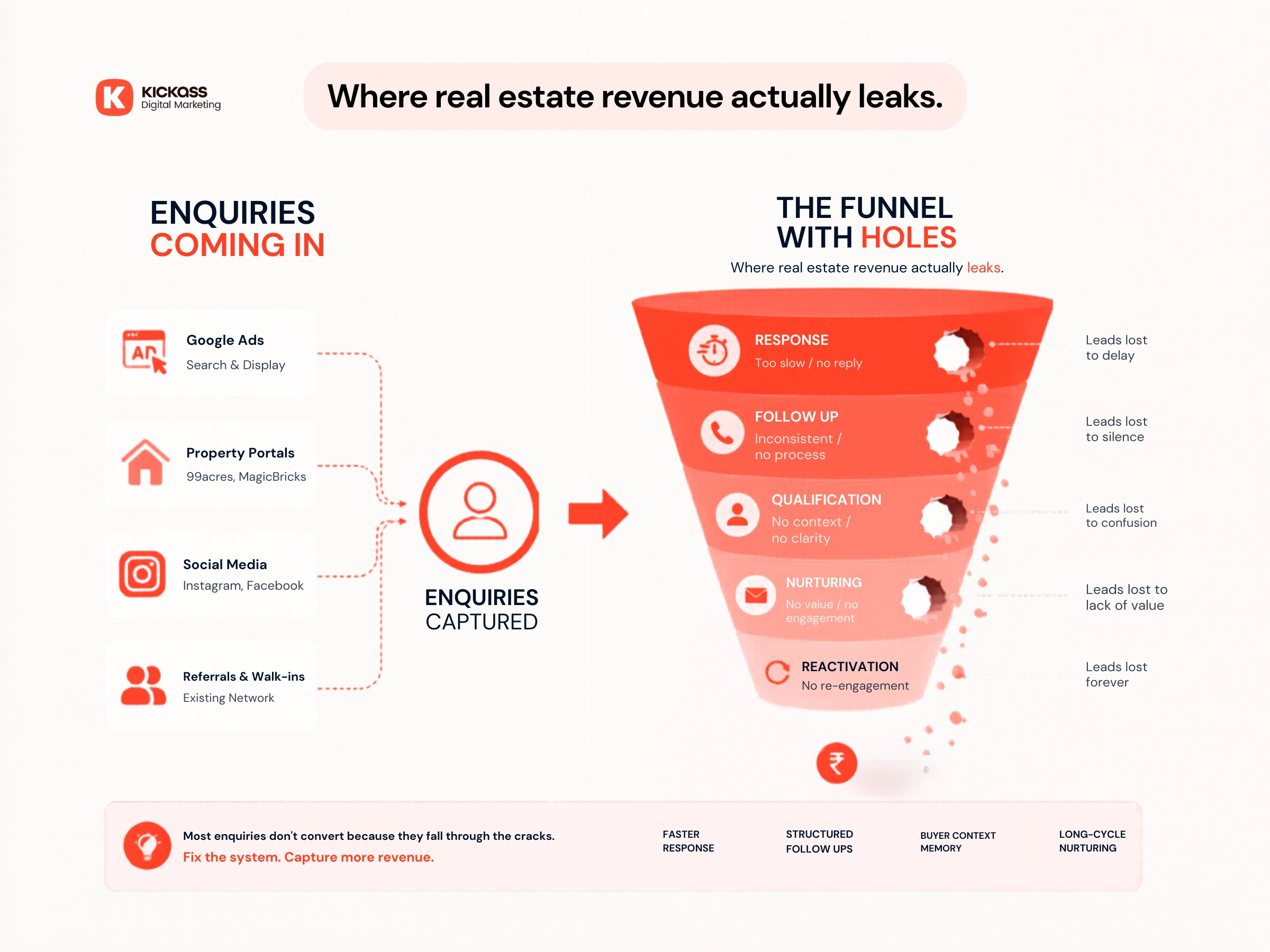
Most real estate developers track cost per lead. Very few track cost of lead loss.
Here is the calculation that changes the conversation:
5 enquiries per day = 150 enquiries per month = 1,800 enquiries per year = 9,000 enquiries over five years
Now apply a modest conversion rate:
| Conversion Rate | Deals Closed (5 years) | At ₹80L avg deal value | At ₹2Cr avg deal value |
|---|---|---|---|
| 2% | 180 deals | ₹144 Cr | ₹360 Cr |
| 5% | 450 deals | ₹360 Cr | ₹900 Cr |
| 10% | 900 deals | ₹720 Cr | ₹1,800 Cr |
Now the real question: what happened to the enquiries that did not convert?
They did not disappear. They bought from someone else. They delayed long enough to forget you. They lost trust because no one followed up. They were never nurtured through a three-month decision cycle that required eight touchpoints, not one.
The gap between your current conversion rate and a system-supported conversion rate is not a marketing problem. It is a revenue infrastructure problem. And unlike ad spend, fixing infrastructure compounds — every improvement works on every future lead, not just the next campaign.
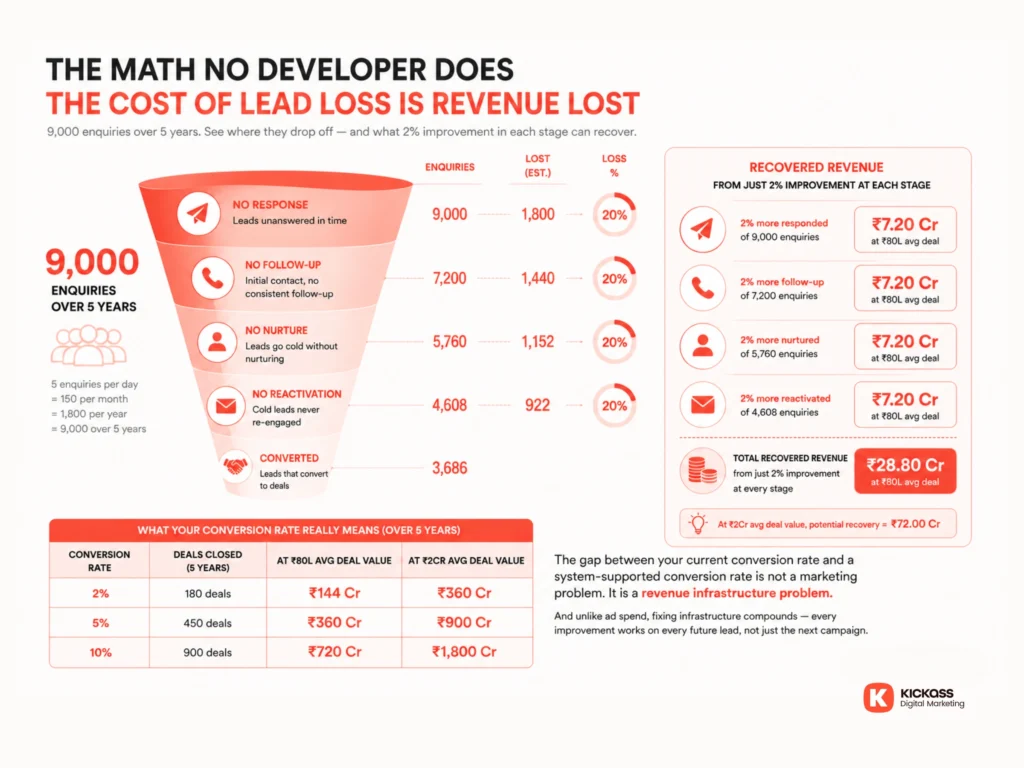
This section is the diagnosis. Every developer who reads it will recognise at least three of these in their own operation.
A buyer fills in an enquiry form at 11am. Your team calls back at 4pm.
In those five hours, the buyer has:
Studies consistently show that lead contact probability drops by over 90% after the first hour. In real estate, where buyers are simultaneously evaluating multiple projects, being third or fourth to respond is functionally the same as not responding.
Speed is not about being pushy. It is about being present when the buyer is still in the decision mindset.
One call. No answer. No callback scheduled. No reminder set. No note made.
Seven days later, the lead is cold. The salesperson has forgotten the context. The buyer — if they pick up — is treated like a first contact.
A structured follow-up system does not mean aggressive calling. It means a defined sequence: call within the hour, WhatsApp acknowledgment with project details, follow-up call at day three, email with relevant content at day seven, check-in at day fourteen. Each touchpoint logged. Each response tracked. Each buyer moving through a defined pipeline, not sitting in someone’s contact list.
This is the most common and most damaging system failure in Indian real estate sales.
The situation: four salespeople, four personal phones, four WhatsApp accounts. Every buyer conversation happening in a personal chat. No shared visibility. No conversation history accessible to management. No record of what was promised, what was discussed, what the buyer’s specific requirements were.
When the salesperson leaves — and they always leave — the buyer relationship walks out with them.
WhatsApp is an excellent communication tool. It is a catastrophic CRM substitute.
A buyer in Dubai enquires about a Goa villa in January. Asks specific questions about RERA registration, handover timeline, NRI financing options. Your team answers, logs nothing, moves on.
In March, the same buyer follows up. A different salesperson picks up the call. Asks: “So what are you looking for?”
Trust resets. Momentum is gone. The buyer — who was three conversations away from a site visit — starts from zero.
Memory is not a CRM feature. It is a trust mechanism. A buyer who feels remembered feels valued. A buyer who has to re-introduce himself feels like a number.
Real estate is not e-commerce. A buyer does not decide in forty-eight hours.
In mid-segment markets like Pune or Bangalore, decision cycles run 30 to 60 days. In luxury and NRI markets — Goa second homes, Dubai investment properties, premium Mumbai — they run 90 to 180 days. Some run longer.
A system that stops following up after two weeks has already lost the long-cycle buyer. And the long-cycle buyer is almost always the highest-value buyer.
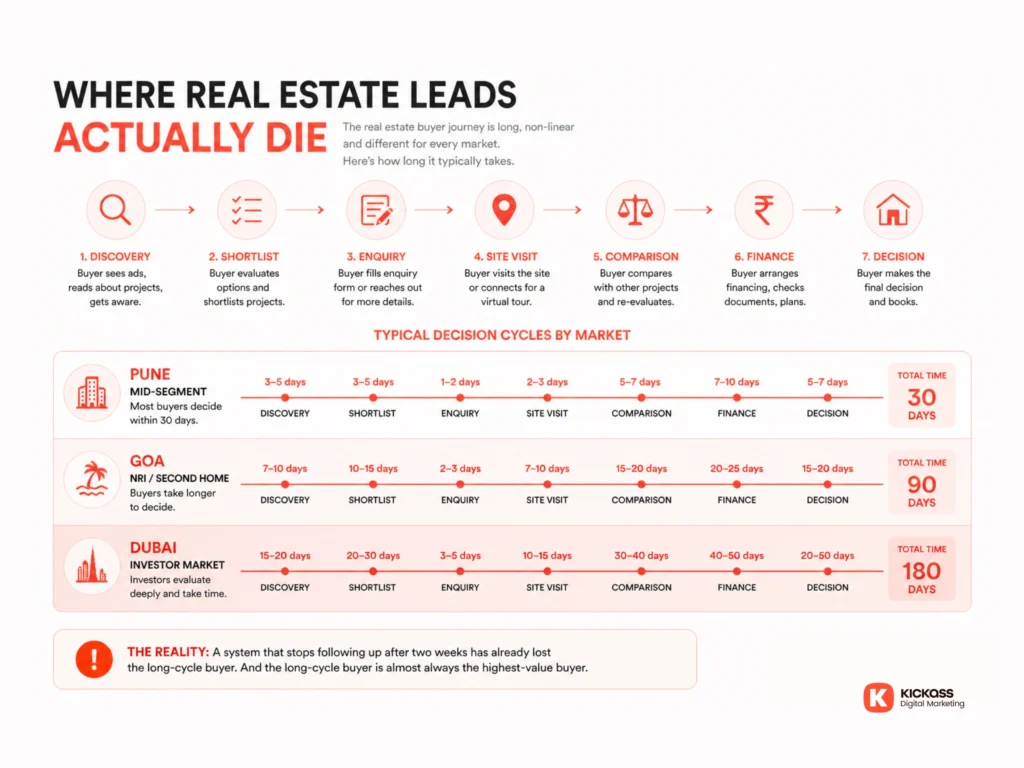
The property portal model — generate volume, expect immediate response, close fast — trains developers to think in short cycles.
The actual buyer journey looks like this:
For NRI buyers considering Goa or Dubai, step two alone can take six weeks. Family-influenced decisions add another cycle. Capital allocation decisions in investment-driven markets add compliance and cross-border complexity.
If you disappear during this journey, you do not lose the lead. You lose the decision.
The developer who stays present — with relevant, context-aware communication at each stage — is the one the buyer calls when they are finally ready. Not the one who spent the most on ads.
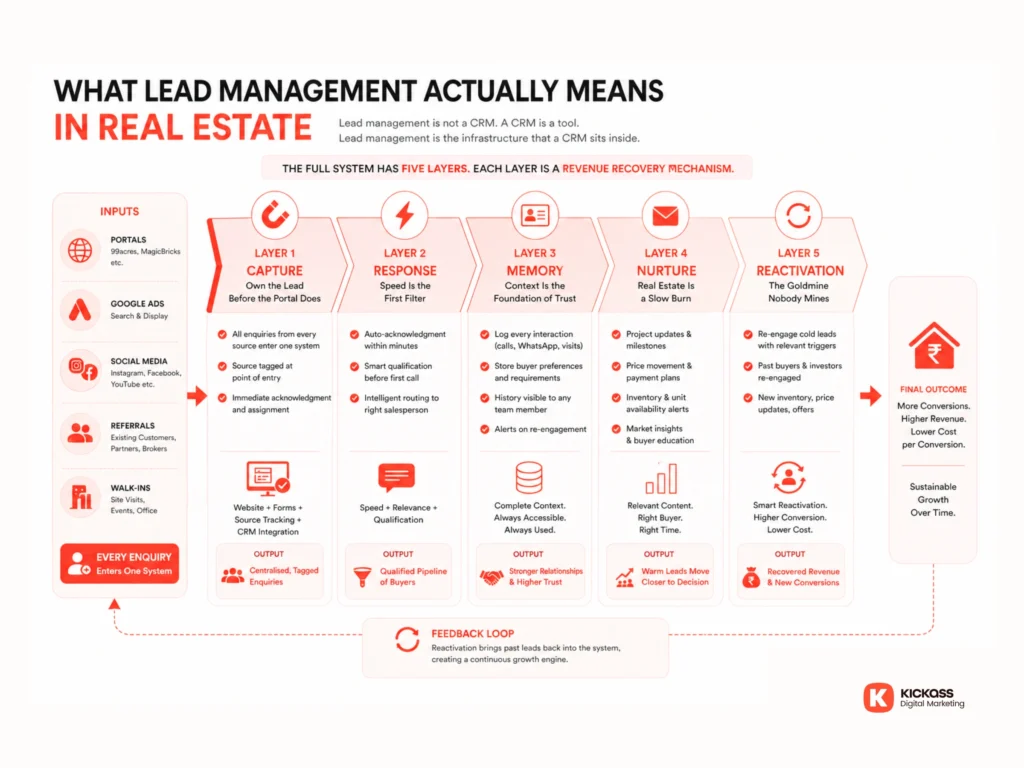
Lead management is not a CRM. A CRM is a tool. Lead management is the infrastructure that a CRM sits inside.
The full system has five layers. Each layer is a revenue recovery mechanism:
Most Indian real estate developers receive enquiries from multiple sources — portals, Google Ads, social media, referrals, walk-ins. Most of those enquiries land in different places with no unified record.
A capture layer means:
The foundation of capture is a properly structured website — not a brochure site, but a decision system with structured forms, source tracking, and direct CRM integration. A portal gives you the lead and keeps the data. Your website gives you the lead and you keep the data.
Response within the first hour is the single highest-leverage change most real estate operations can make.
This does not require a human to be available at all hours. It requires:
The buyer who receives an intelligent, specific response within five minutes experiences your brand very differently from the buyer who receives a call six hours later from someone who has not read the enquiry.
Every interaction with every buyer must be recorded, accessible, and used.
This means:
When a buyer returns after six weeks of silence and your salesperson opens with “Mr. Sharma, last time we spoke you were comparing our 3BHK in Phase 2 with another project — are you still looking at that configuration?” — that is not a CRM feature. That is the moment trust is built.
Most real estate leads are not ready to buy when they first enquire. They are gathering information, building confidence, and watching the market.
A nurture engine keeps your project present through that process with content that is relevant, not generic:
In Goa, nurture content for NRI buyers might cover monsoon season construction timelines, NRI financing options through Indian banks, and rental yield data for the micro-market. In Pune, it might cover infrastructure projects affecting the corridor, possession timeline comparisons, and resale market data.
The nurture layer is not email blasts. It is marketing automation — structured, triggered, personalised to where each buyer is in their journey.
Every real estate operation has a database of leads that went cold. Buyers who enquired, visited, went quiet. Previous buyers who completed a purchase two or three years ago. Investors who asked about one project and then bought elsewhere.
This database is not a graveyard. It is an underserved asset.
Reactivation campaigns — timed to new inventory, price announcements, or seasonal buyer cycles — consistently produce the highest conversion rates in real estate marketing, at the lowest cost per conversion. These are people who already know your brand. The trust gap is smaller. The objection set is known.
Most developers do not have a reactivation system because they do not have the preceding layers. If your data is scattered across personal phones and outdated Excel sheets, reactivation is impossible. If your data is centralised, tagged, and current — reactivation is your highest-ROI marketing activity.
There is significant noise around AI in real estate marketing. Most of it conflates productivity tools with infrastructure.
Here is what AI genuinely does inside a lead management system:
What AI does:
What AI does not do:
“AI without a system is faster chaos.”
The developers who will get value from AI in their sales process are the ones who first build the capture, response, memory, and nurture layers. AI amplifies a system. It cannot substitute for one.
For a deeper look at how AI changes real estate buyer discovery — the layer before the enquiry — read the Real Estate AI Marketing Guide.
99acres. MagicBricks. Housing.com. Bayut. These platforms have a clear and limited role: they generate enquiry volume.
What they do not do — and are not designed to do:
Portal dependency creates a structural business risk: you are renting attention rather than building an asset. When portal costs increase — and they do, consistently — you have no alternative pipeline to fall back on.
The answer is not to exit portals. It is to build the parallel infrastructure that owns the relationship after the portal delivers the enquiry.
| Property Portals | Lead Management System | |
|---|---|---|
| Purpose | Generate enquiries | Convert enquiries |
| Data ownership | Portal owns the data | You own the data |
| Relationship tracking | None | Full buyer history |
| Follow-up system | None | Structured and automated |
| Long-cycle nurturing | None | Built in |
| Reactivation capability | None | Systematic |
| Cost model | Ongoing spend per lead | Infrastructure investment |
| Compounding value | None | Grows with every lead added |
This is the section most agencies skip because it requires them to have built all three capabilities.
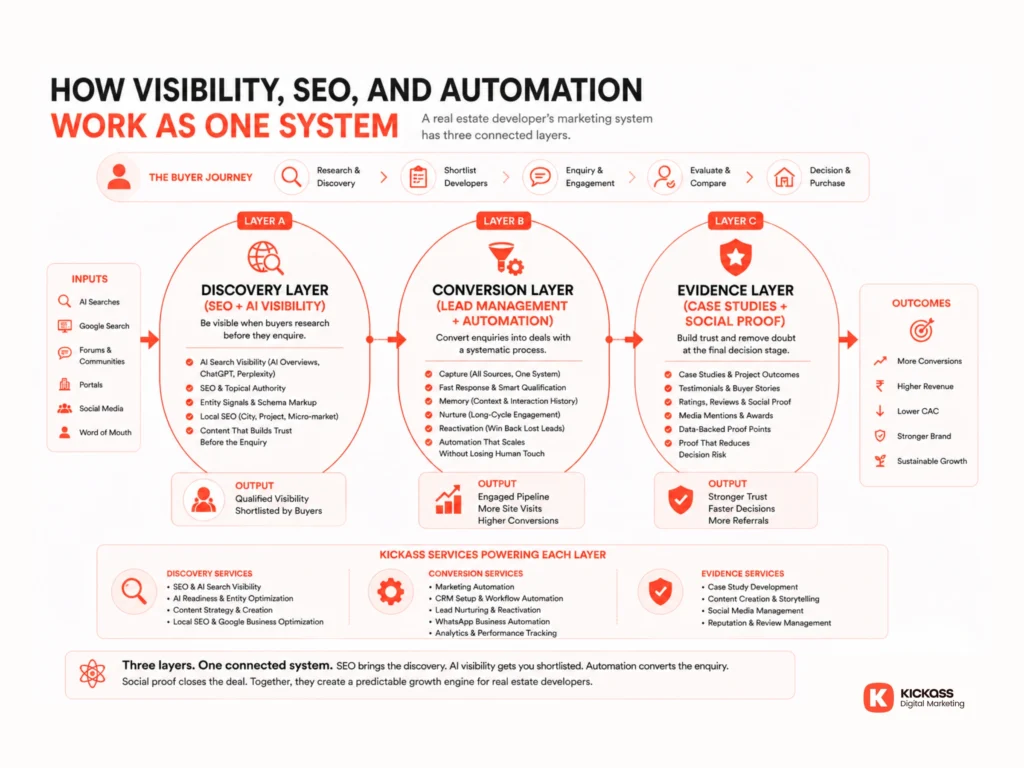
A real estate developer’s marketing system has three connected layers:
Layer A — Discovery (SEO + AI Visibility) Before a buyer enquires, they research. Increasingly, that research happens inside AI conversations — ChatGPT, Perplexity, Google AI Overviews — where buyers ask “which developers in Pune should I consider for mid-segment apartments?”
The developers who appear in those AI-generated answers are the ones with structured SEO and AI search visibility — entity signals, schema markup, consistent cross-source information, and content that establishes topical authority in their geography and property category.
Developers who are absent from AI answers are invisible to the segment of buyers who never open a portal or click an ad. AI Readiness work fixes that.
For developers operating in Goa, this is explored in depth in the North Goa Real Estate AI Visibility guide. For a broader view of how KickAss approaches AI discovery, see The Goa Advantage.
Layer B — Conversion (Lead Management + Automation) Once the buyer enquires, the lead management system — capture, response, memory, nurture, reactivation — converts discovery into deals. This is the layer this post covers.
Layer C — Evidence (Case Studies + Social Proof) Buyers researching high-value purchases look for evidence. Case studies, testimonials, project outcome data — these are the signals that close the gap between shortlisting and decision. See how this works in practice in the Horizon Goa case study.
The three layers are not independent services. They are a connected system. SEO brings the discovery. AI Readiness ensures the pre-enquiry shortlisting includes you. Marketing Automation converts the enquiry. Social Media builds the recall that makes buyers remember you between touchpoints. Paid Advertising accelerates volume when the system is ready to handle it.
Real estate lead management is not one-size-fits-all. Buyer behaviour, decision timelines, and system priorities vary significantly by market.
| Location | Buyer Type | Decision Cycle | Biggest Challenge | System Priority | Market Guide |
|---|---|---|---|---|---|
| Goa | NRI / Second Home | 90–180 days | Long cycle, seasonal demand | Nurture + Memory | North Goa Real Estate Guide |
| Pune | Mid-segment volume | 30–60 days | High enquiry volume, fast decisions | Response speed + Routing | Pune Real Estate Marketing |
| Dubai | Investors | 60–120 days | Cross-border trust, compliance | Structured follow-up + CRM | Dubai Real Estate Marketing |
| Abu Dhabi | Investors | 60–90 days | Compliance + trust signals | CRM workflows | Abu Dhabi Real Estate Marketing |
| Singapore | High-value buyers | 90+ days | Data-driven decisions | Personalisation | Singapore Real Estate Marketing |
| Mumbai | Premium buyers | 45–90 days | High competition, brand noise | Speed + Brand signals | Real Estate Sigital Marketing in Mumbai |
| Delhi | Mixed segment | 30–60 days | Market noise, lead filtering | Lead scoring + Routing | Delhi Real Estate Marketing |
| Bangalore | Tech buyers | 45–75 days | Research-heavy, high standards | Content + Nurture | Real Estate Marketing in Bangalore |
| Hyderabad | Growth market | 30–60 days | Inventory volume management | Automation + Routing | Hyderabad Real Estate Marketing |
| Chennai | Conservative buyers | 45–90 days | Trust-first, low impulse | Consistent nurturing | Chennai Real Estate Marketing |
| Ahmedabad | Investor mix | 30–60 days | Data gaps, tracking | Structured tracking | Real Estate Digital Marketing Agecny in Ahmedabad |
| Gurugram | Premium + corporate | 30–60 days | Speed + enterprise buyers | Lead routing + Speed | Gurugram Real Estate Marketing Agecny |
| Indore | Affordable housing | 30–45 days | Follow-up gaps | CRM basics | Indore Real Estate Marketing |
| Bhopal | Emerging market | 45–60 days | Awareness + education | Education + Nurture | Bhopal Real Estate Marketing |
| Jabalpur | Local buyers | 30–60 days | Low digitisation | Lead capture basics | Real Estate Marketing in Jabalpur |
| Silvassa | Emerging / industrial | 45–75 days | Market awareness | Capture + Education | Real Estate Lead Management in Silvassa |
Lead management system requirements vary by market, but the conversion gap — between enquiries generated and deals closed — exists in every one of these markets. The infrastructure is the constant. The configuration is local.
This guide — and the lead management infrastructure behind it — is designed for a specific type of real estate business.
It is built for:
It is not built for:
If you are generating enquiries and not seeing proportional conversions — and if you can identify at least three of the failure modes described in this post in your own operation — this is built for you.
It is lost in the silence that follows.
The buyer who enquired about your Goa villa and heard nothing for five days found another developer in those five days — one whose salesperson called back in twenty minutes, sent the brochure on WhatsApp, and scheduled a video call for the following morning.
The investor who asked about your Hyderabad project in January and was treated like a new lead in March bought somewhere else — from a developer whose system remembered him.
The NRI couple researching second homes in Goa who sent you three emails and got one generic reply — they booked a site visit with a competing project that had a structured follow-up sequence and a dedicated NRI advisory process.
These are not lost leads. They are system failures. And unlike poor market conditions or competition from better-funded developers, system failures are entirely within your control to fix.
The leads are there. The buyers are real. The infrastructure to convert them — capture, response, memory, nurture, reactivation — is what most real estate businesses in India have never fully built.
See where your lead system is leaking — request a Lead Flow Audit
Most real estate teams don’t lose leads at the top of the funnel—they lose them in execution. These are the key questions developers and sales teams across India, Goa, Pune, and Dubai ask when building a lead management system that actually converts.
No. Marketing automation handles repetitive tasks like follow-ups and nurturing, but relationship-driven activities such as site visits, negotiation, and closing require human judgment. Automation supports sales teams by reducing manual workload.
Lead leakage is the loss of potential buyers after they enquire but before they convert, usually due to slow response, poor follow-up, or lack of nurturing. In many real estate markets, a significant portion of enquiries are lost before meaningful engagement.
Lead management applies to all real estate segments, but execution differs. Affordable housing markets like Indore or Bhopal prioritize speed and volume, while luxury and NRI markets like Goa, Dubai, and Singapore require longer nurturing cycles and personalized communication.
CRM fails when it lacks workflows, consistent data entry, and automation. Without defined processes for capturing, updating, and acting on data, it becomes a static contact list rather than a lead management system.
A CRM is a tool, not a system. Without defined capture workflows, response protocols, nurture sequences, and reactivation campaigns built around it, a CRM becomes an expensive contact list. Real estate lead management requires the architecture around the CRM — the processes, automations, and content that determine how the tool is actually used — not just the software itself.
A basic system — unified capture, auto-response, structured follow-up sequences, and centralized data — can be operational within 30 days. A full system including memory layers, long-cycle nurture campaigns, and reactivation infrastructure typically takes 60 to 90 days to build and another 60 to 90 days to tune based on actual lead behaviour. The compounding effect begins from day one — every lead that enters a working system from that point forward is handled better than it was before.
Yes, significantly. NRI buyers — particularly those considering Goa, Dubai, or investment properties in Tier-1 Indian cities — have longer decision cycles (90 to 180 days), higher trust requirements, cross-border financial complexity, and family-influenced decisions that require more touchpoints. The nurture layer for NRI buyers needs to cover NRI financing options, RERA registration details, rental yield data, and property management options — not generic project updates. The memory layer is especially critical: NRI buyers often have gaps of weeks between conversations, and being remembered across those gaps is the primary trust signal.
The first step is a lead flow audit — mapping where your current enquiries come from, where they enter your system, at what stage they stop responding, and what the current response time and follow-up frequency look like. Most developers discover in this audit that 60 to 70% of their lead loss happens in the first 48 hours — slow response and no structured follow-up. Fixing those two failure points alone typically produces a measurable conversion improvement before any new infrastructure is built. Start with an AI Visibility and Lead Flow Audit — we will show you exactly where your system is leaking.
Real estate marketing decisions are local. Buyer behaviour, portal preferences, decision timelines, and trust signals vary significantly by market.
Explore KickAss real estate marketing guides for your market: