Get Marketing Insights First
Subscribe to receive actionable strategies, growth tips, and industry insights delivered straight to your inbox.

Google Ads captures intent after it's declared. ChatGPT Ads may influence decisions while they're still forming. Here's how the two platforms differ, why AI visibility now matters, and what Indian businesses should prepare before ChatGPT Ads launches in India.
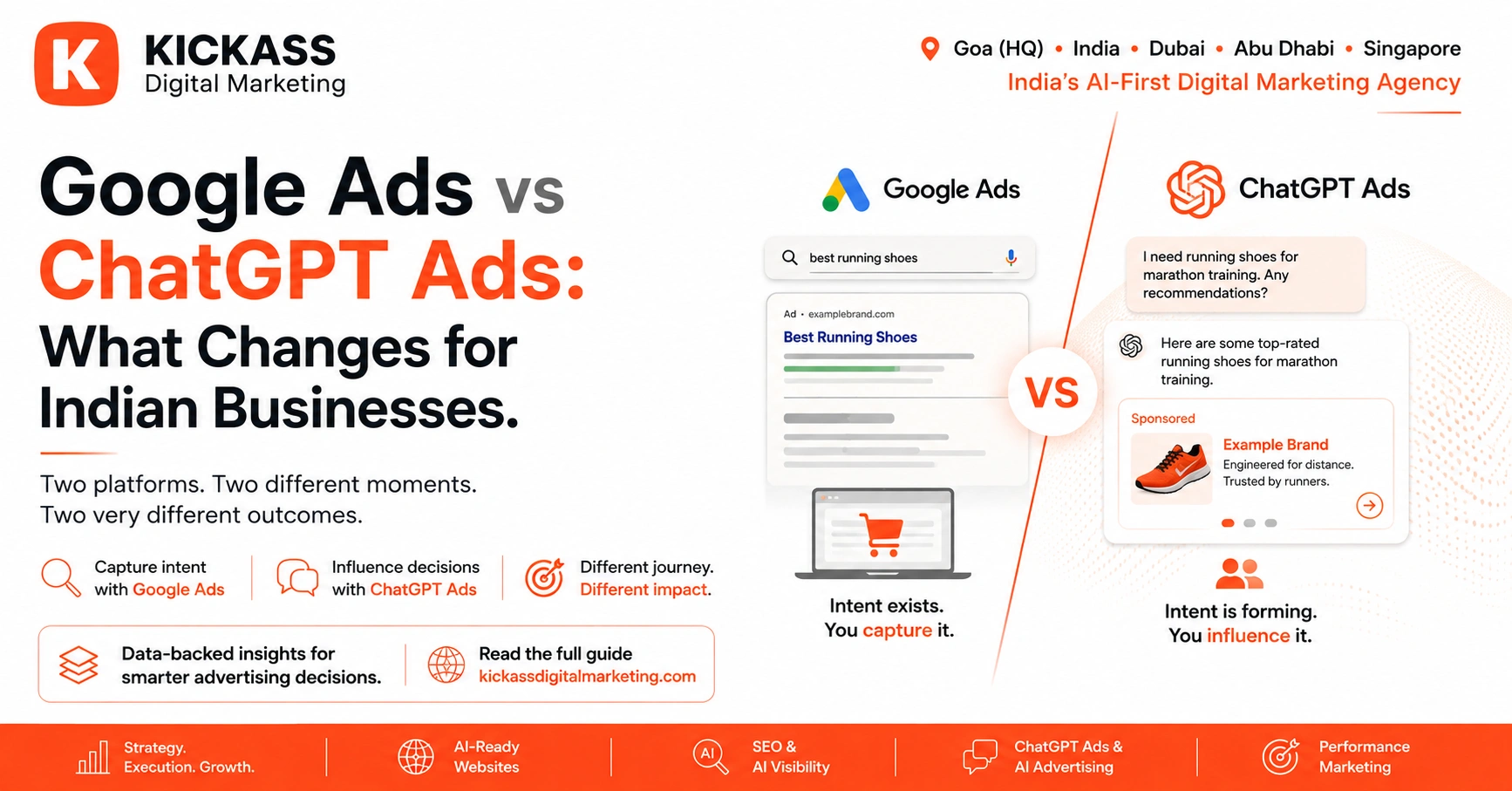
Google Ads captures intent that a user has already declared through a typed search query. ChatGPT Ads appear inside a conversation while the user’s decision is still forming, matched to context rather than keywords. The practical result: Google competes for the click, ChatGPT competes for the recommendation.
Not into a live rate card yet — ChatGPT Ads has launched in India, but self-serve access and confirmed India pricing are still opening. What Indian businesses should do now is build the entity clarity and structured data that determines performance once pricing exists, since that groundwork is spendable and useful today regardless of platform.
Yes. ChatGPT Ads launched in India on 27 August 2026, with the initial rollout reaching logged-in adults on Free and Go plans. Self-serve Ads Manager access is scheduled for 4 September 2026, moving India from the pre-launch preparation phase into the live ChatGPT Ads market.
For nearly twenty-five years, digital advertising has been built around a simple mechanic: someone searches, advertisers bid, Google decides who appears. The entire discipline of search marketing exists because intent shows up as a typed query, and that query can be auctioned.
AI assistants introduce a different moment in the buyer journey. People increasingly ask questions before they know exactly what they’re looking for — comparing options, thinking out loud, narrowing down a decision across several turns of conversation. If advertising enters that moment, it isn’t simply another search auction with a different interface. It’s showing up earlier, while the decision is still being formed rather than after it’s been declared.
That’s the actual difference between Google Ads and ChatGPT Ads, and it’s worth stating as plainly as possible before going further:
Google Ads captures intent that already exists. ChatGPT Ads may influence intent while it’s still forming.
Everything below builds on that one idea. If you remember nothing else from this article, remember that sentence — it’s the reason this comparison matters more than a typical “platform A vs platform B” writeup, and it’s the reason the two channels aren’t actually competing for the same rupee.
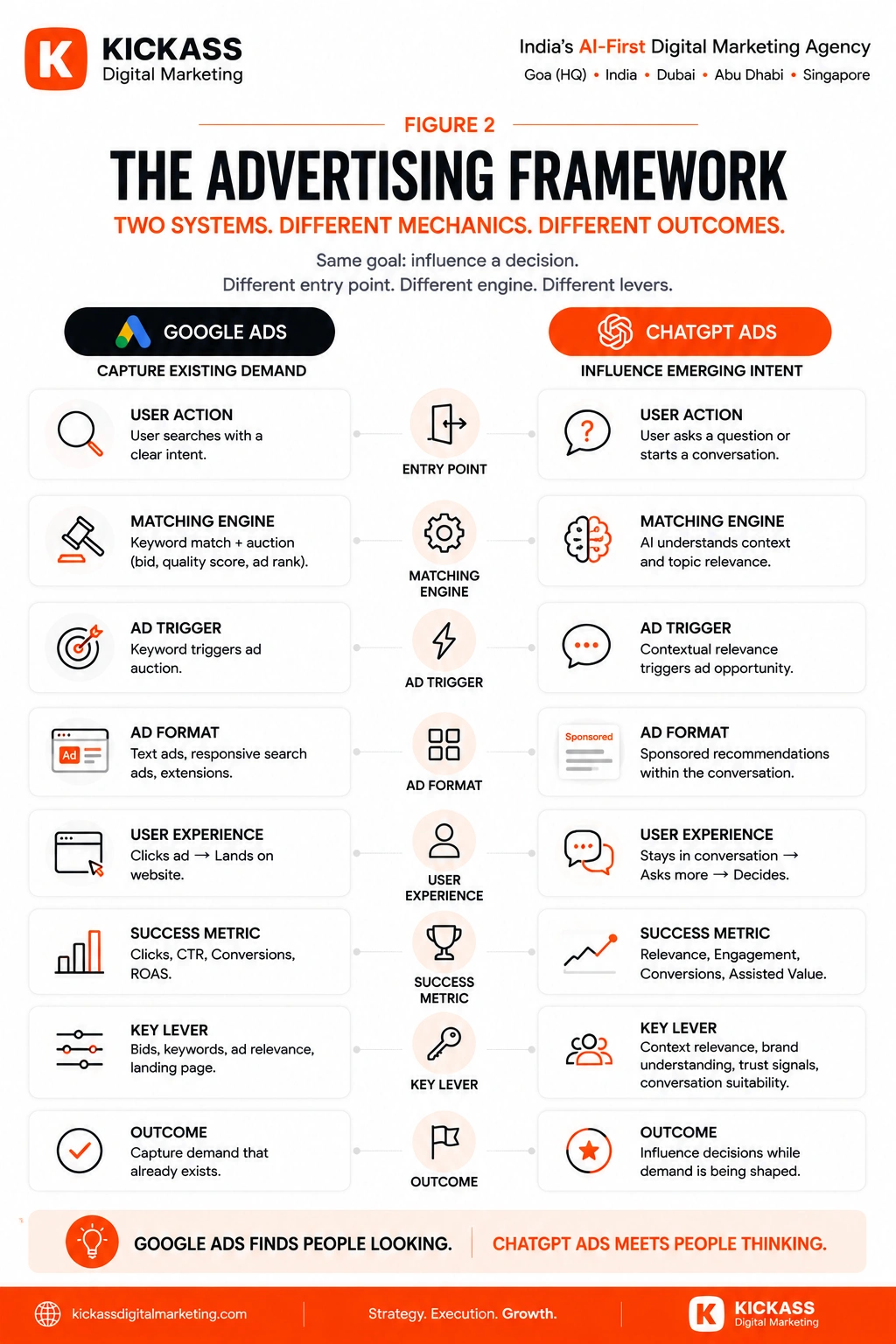
Google Ads runs on keyword-triggered auctions. A user types a query, Google matches it against advertiser bids and Quality Score, and the highest-ranking combination of bid and relevance wins the placement — a mechanism refined over two decades and understood by nearly every performance marketer in India.
ChatGPT Ads, as OpenAI’s live rollout shows, does not use keyword targeting at all. It reads the conversational context of what a user is actively discussing and matches advertising to that context. There’s no query box to bid against — there’s a conversation, and the platform decides whether an ad is relevant to what’s being discussed.
That single structural difference cascades into everything else: how targeting works, how pricing is set, and — most importantly for Indian advertisers — how much of the outcome depends on your bid versus how much depends on whether the AI system already understands and trusts your business as an entity. ShodhDynamics’ independent breakdown of the two systems goes deeper on trigger, placement, and trust mechanics than we will here; our walkthrough of how ChatGPT Ads Manager actually works covers the account setup and bidding mechanics. This article focuses on what that mechanical difference means for a business deciding where to put its next rupee.
The clearest way to see the shift is to lay the two journeys side by side. TRADITIONAL SEARCH JOURNEY: Google search → paid or organic result → website → purchase. AI-MEDIATED JOURNEY: Conversation → AI recommendation → comparison → website → purchase
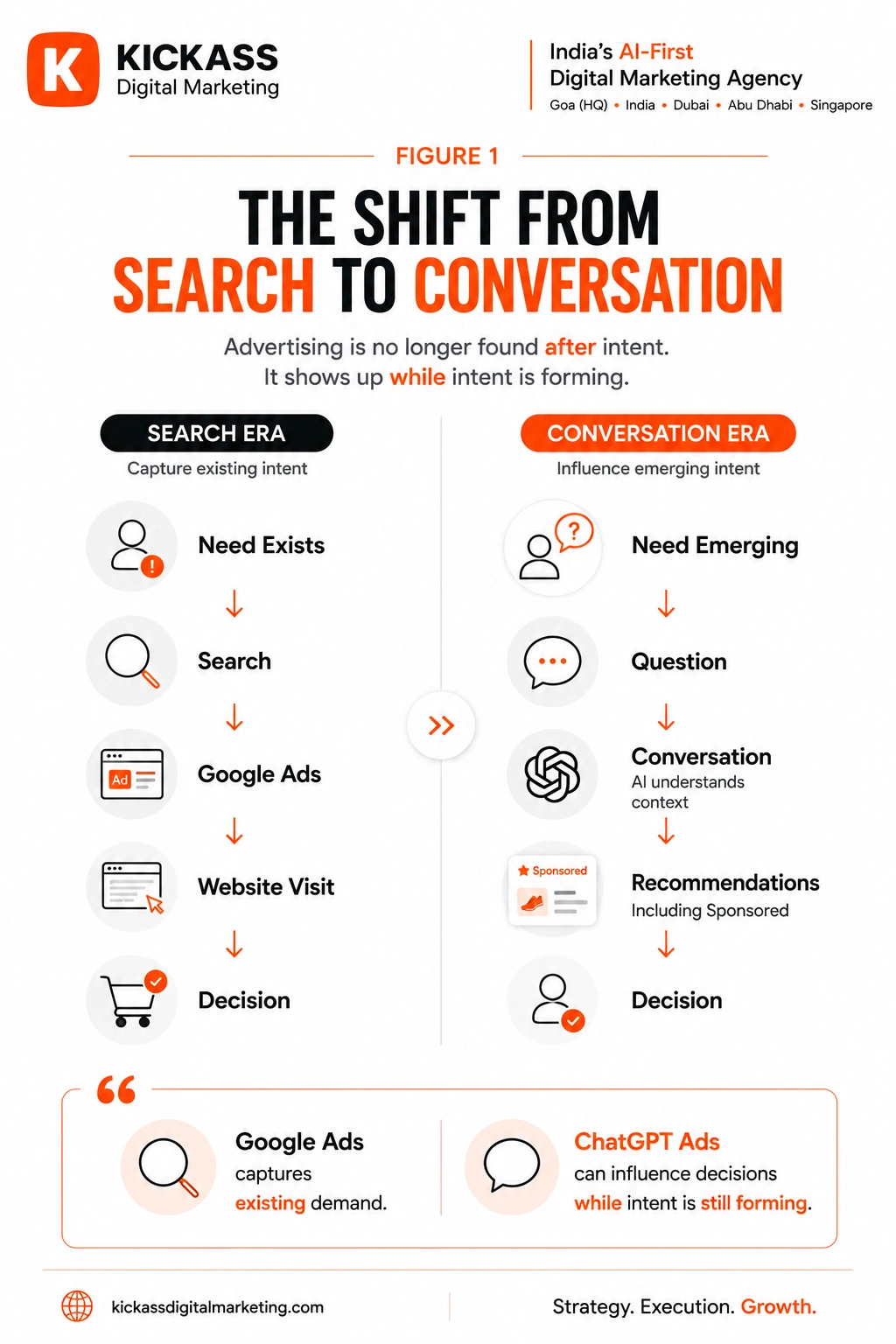
In the traditional journey, the business only needs to win one moment: the click. Everything before that click — brand awareness, positioning, reputation — matters, but the transaction that advertising actually buys is a single click at a single point in time.
In the AI-mediated journey, there’s a new step before the click: the recommendation itself.
Take someone planning a long weekend in Goa. On Google, they type “boutique hotels Goa,” see ten blue links and a handful of ads, and click through to compare. Google never had to understand the traveler — just match a query.
On ChatGPT, the same person might write: “planning a quiet 3-day trip to Goa in December, not a party crowd, want something walkable to the beach, budget around ₹15,000 a night.” There’s no keyword to bid on in that sentence. The assistant has to synthesize an answer from what it already knows about which properties genuinely fit — quiet, walkable, that price band, that season. A property that’s excellent on all four counts but thin on structured content, inconsistent across directories, and invisible in independent reviews is, to the AI system, simply unknown. It won’t be recommended, and it won’t be a candidate for an ad slot inside that recommendation either. Bid alone doesn’t create that legibility — the business has to already be understood before the conversation happens.
This is the piece most comparisons between Google Ads and ChatGPT Ads skip entirely, and it’s the reason a pure “which platform should I use” framing misses the point.
An AI system’s willingness to recommend or advertise a business runs on a dependency chain — we’ve started calling it the AI Trust Stack internally, and it’s worth naming because each layer is a precondition for the one above it, not an alternative to it:Brand → Website → Structured content & data → Entity clarity → AI visibility → AI advertising performance
A business with an inconsistent NAP (name, address, phone) across directories, thin or generic web content, and no structured data is an entity the AI system understands poorly, regardless of how much it later spends on ChatGPT Ads. Advertising sits at the top of the stack. It cannot fix a weak foundation underneath it — it can only amplify whatever is already there.
Here’s a comparison worth sitting with: Google’s Quality Score has spent two decades determining how efficiently a bid turns into a result, after a campaign has already launched. We increasingly think of AI visibility as doing the same job one step earlier — determining whether a business is understood well enough to be a candidate for recommendation or advertising before any campaign exists. Quality Score is a mid-campaign multiplier. AI visibility is a pre-campaign gate. Whether that analogy holds up perfectly as the platforms mature is beside the point — the useful version of it is simply this: the businesses spending the most energy worrying about ChatGPT Ads bidding strategy today are often the same ones that haven’t yet done the entity-clarity work the bidding strategy depends on.
That pattern shows up consistently in the audits we run. The businesses most eager to advertise on AI platforms are frequently the ones with the weakest digital foundations underneath them — inconsistent business information across the web, generic service pages that say nothing a competitor’s page doesn’t also say, and almost no independent citations an AI system could use to verify who they are. The businesses least prepared for AI advertising today are, somewhat counterintuitively, often the ones most excited about it.
This groundwork is what’s generally called AI visibility or generative engine optimization (GEO) elsewhere. Here, it’s simply the base of the stack. We go deeper on the mechanics of entity clarity and structured data in our AI Advertising readiness overview.
The comparison in this article’s title is slightly misleading, and it’s worth admitting that directly: framing this as Google Ads on one side and ChatGPT Ads on the other understates how far Google itself has already moved in the same direction.
Google introduced AI Overviews — AI-generated summaries that appear above traditional search results — at Google I/O in May 2024, expanding it to India, the UK, Japan, Mexico, and Brazil by August 2024, and to over 200 countries by mid-2025. By 2026, AI Overviews were showing on a substantial share of Google searches globally, and Google had already begun running ads inside AI Overviews themselves in several markets, India among them.
That matters because it means the shift from keyword-triggered results to AI-synthesized answers didn’t start with ChatGPT. It started inside Google Search. ChatGPT Ads is the second, more conversationally native version of the same underlying shift — advertising placed inside an AI-generated answer rather than beside a list of links.
Seen this way, the more accurate progression isn’t Google Ads versus ChatGPT Ads. It’s:
Google Ads → Google AI Overviews → ChatGPT Ads → whatever AI advertising surface comes next (Perplexity, Gemini, and others are all moving in the same direction).
Businesses that treat this as a one-time platform decision — “should I move budget from Google to ChatGPT” — are asking the wrong question. The more durable question is whether the business is building the kind of entity clarity and structured presence that performs across all of these surfaces, since none of them are going away and none of them will be the last one.
| Google Ads | ChatGPT Ads | |
|---|---|---|
| Targeting mechanism | Keyword and audience-based | Conversational context |
| Buying model | CPC, CPM, CPA, various | CPC and CPM on a relevance-weighted, second-price auction (India pricing not yet announced) |
| Attribution | Click-based, mature multi-touch models | Conversions API / server-side (no reliable “last click” — see how ChatGPT Ads is measured) |
| Market availability | Fully live, mature market including India | Live in the US, Canada, Australia, New Zealand, UK, Japan, South Korea, Mexico, and Brazil before India; live in India as of 27 August 2026 via managed/agency-placed ads, with self-serve access opening separately. Current status: see our ChatGPT Ads readiness page |
| Category restrictions | Broad, category-specific policies | Healthcare and most financial services: case-by-case approval with additional verification, no longer excluded outright. Legal services: prohibited, except general legal education content. Gambling, political, and adult content: excluded outright, unchanged. |
| Minimum spend | None | None currently, once self-serve opened |
| What drives performance | Bid, Quality Score, ad relevance | Bid, plus how well the AI system already understands and trusts the business as an entity |
This table describes the live rollout as it stands across the markets ChatGPT Ads currently runs in. India-specific pricing, minimum spend, and exact targeting parameters have not been announced by OpenAI, and shouldn’t be assumed to mirror figures from other markets once they are.
The mechanical table above is useful for planning. This shorter one is the version worth actually remembering:
| Question | Google Ads | ChatGPT Ads |
|---|---|---|
| When does advertising appear? | After intent already exists | While intent is still forming |
| What is the business competing for? | The click | The recommendation |
| What does success depend on? | Bid + Quality Score | Bid + entity trust |
The timeline below shows how conversational AI, AI-powered search, and ChatGPT Ads evolved from public launch to international rollout.
| Date | Company | Key Development | Why It Matters |
|---|---|---|---|
| November 2022 | OpenAI | ChatGPT launches publicly. | Introduces conversational AI to a mass consumer audience, accelerating mainstream adoption of AI assistants. |
| May 2023 | Search Generative Experience (SGE) is unveiled at Google I/O. | Marks Google’s first public move toward AI-generated search answers, signalling a major shift beyond traditional search results. | |
| May 2024 | SGE is rebranded as AI Overviews and rolls out across the United States. | AI-generated answers become part of Google’s mainstream search experience. | |
| August 2024 | AI Overviews expands to India, the UK, Japan, Mexico and Brazil. | Brings AI-powered search to several major international markets, including India. | |
| Mid-2025 | AI Overviews reaches more than 200 countries while Google begins testing ads within AI-generated answers. | Demonstrates that AI search is becoming Google’s default experience and introduces early AI-native advertising. | |
| 9 February 2026 | OpenAI | ChatGPT Ads launches in the United States as an invitation-only pilot. | Creates the first commercial advertising platform inside ChatGPT. The launch is US-only, with a $60 flat CPM and a US$200,000–250,000 minimum commitment. |
| 26 March 2026 | OpenAI | OpenAI announces expansion to Canada, Australia and New Zealand. | Confirms the platform is beginning its first international rollout beyond the United States. |
| 16–17 April 2026 | OpenAI | Canada, Australia and New Zealand officially go live. | Ads begin serving in three additional countries roughly ten weeks after the US launch, confirming a phased rollout strategy. |
| 21 April 2026 | OpenAI | CPC bidding is introduced using a relevance-weighted second-price auction. | Expands advertiser buying options beyond CPM, with recommended starting bids of US$3–5 per click. |
| 5 May 2026 | OpenAI | Self-serve Ads Manager opens across the four live markets. | Removes minimum spend requirements, launches Conversions API and pixel tracking, and broadens advertiser access through agency and ad-tech partners. |
| 7 May 2026 | OpenAI | OpenAI announces the next expansion to the UK, Mexico, Brazil, Japan and South Korea. | Signals continued global rollout into Europe, Asia and Latin America. |
| 2 June 2026 | OpenAI | EU advertising policy is updated ahead of the UK launch. | Introduces explicit user opt-in consent for advertising, reflecting stricter privacy requirements than the US model. |
| 6 June 2026 | OpenAI | The United Kingdom becomes the first European ChatGPT Ads market. | Marks OpenAI’s entry into Europe, with UK advertisers billed in GBP rather than USD. |
| 19 June 2026 | OpenAI | Self-serve Ads Manager Beta opens to UK advertisers. | Shows an accelerated rollout compared with the original US launch timeline. |
| July 2026 | OpenAI | Japan officially goes live. | Establishes ChatGPT Ads in Asia, with reports indicating rapid advertiser adoption. |
| Early August 2026 | OpenAI | South Korea goes live, expanding the confirmed footprint to seven markets. | Confirms availability in the US, Canada, Australia, New Zealand, the UK, Japan and South Korea, while Brazil and Mexico remain “Coming Soon.” |
| By 11 August 2026 | OpenAI | Brazil and Mexico move from “Coming Soon” to confirmed live, bringing the footprint to nine markets. | No evidence of country-specific pricing in either new market — same CPC/CPM bands as the rest of the rollout. |
| Mid-August 2026(India) | OpenAI | Some ChatGPT users in India receive a privacy-policy email explaining how ads would work if introduced. | Not a launch announcement at the time — India was not yet listed among the expansion markets. The email became a notable pre-launch signal ahead of India’s eventual rollout. For the detailed pre-launch analysis, see ShodhDynamics’ full analysis of the India timing question. |
| 27 August 2026 | OpenAI | ChatGPT Ads launches in India. | India enters the live ChatGPT Ads market, with the initial rollout reaching logged-in adults on Free and Go plans. Self-serve Ads Manager access is scheduled for 4 September 2026, moving Indian advertisers from the preparation phase toward direct campaign access. |
A note on how to read this: the dated milestones above are settled history and won’t change. The list of markets where ChatGPT Ads is fully live, priced, and self-serve does keep moving — check our ChatGPT Ads readiness page for the current snapshot rather than treating any specific country list here as fixed.
The pattern across this broader timeline is consistent: each AI system moves from answering questions, to being trusted with recommendations, to monetizing those recommendations through advertising — and once a self-serve ad platform exists, international expansion has moved faster than most advertisers expect, even if the very first move (US-only, then a roughly two-and-a-half-month gap before the next three markets) was more cautious than it’s sometimes remembered. Google’s path from SGE to monetised AI Overviews took roughly two years. ChatGPT Ads reached nine confirmed markets within six months of its US-only launch, with the pace of new-market additions accelerating rather than slowing. Whether India specifically follows the faster recent pace or the slower opening one isn’t something anyone outside OpenAI can confirm yet — which is exactly why we’re treating it as a labelled estimate rather than a forecast.
Not every business category will benefit from ChatGPT Ads at the same pace, and category eligibility rules make some of this predictable rather than speculative.
Businesses in categories OpenAI has confirmed as eligible — consumer goods, local services, travel and hospitality, entertainment, education, and digital or software products — are the ones positioned to test ChatGPT Ads directly once India access opens. These are also categories where conversational research (comparing hotels, courses, apps, services) already happens naturally, which is likely why they were among the first permitted. (The full eligible and excluded category list is in our Ads Manager walkthrough if you need to check a specific one.)
Healthcare and financial services aren’t excluded anymore the way they were at launch — OpenAI moved both to case-by-case approval with extra verification through policy updates in April, July, and August 2026. Legal services remain prohibited except for general legal education content with no service being sold, and gambling and political advertising remain excluded outright with no case-by-case path. For healthcare and finance businesses, the practical takeaway is different too: eligibility and placement are separate gates. Even an approved advertiser’s ad won’t appear next to a user’s personal health or financial-distress conversation — so budget for a longer review cycle, not for exclusion. For these businesses, the relevant work isn’t advertising readiness at all. It’s AI visibility: making sure the business is still described accurately and recommended fairly when someone asks an AI assistant an unpaid, informational question about it, since that channel remains open even where paid placement isn’t.
B2B businesses sit in between. There’s no confirmed exclusion, but conversational ad formats tend to suit shorter, higher-frequency decisions better than long B2B sales cycles — so B2B advertisers may see less immediate use for the ad product itself, even as B2B buyers increasingly use AI assistants during vendor research.
There’s also a nearer-term angle worth naming directly, separate from India’s own launch date. Category eligibility isn’t the only thing that determines whether ChatGPT Ads matters for an Indian business right now — geography does too, for businesses that already sell across borders. Hospitality operators, real estate developers marketing to the diaspora, and education businesses with an NRI or international audience already have customers physically inside markets — the UK, Australia, Canada, Japan, South Korea, Mexico, and Brazil — where ChatGPT Ads is live today. If a competitor’s entity signals are strong enough to be recommended inside a ChatGPT conversation happening in London or Toronto, that shortlist moment is lost regardless of when India itself opens. For that specific slice of businesses, this isn’t a “wait and prepare” situation. It’s a “the window is already open somewhere your buyer already is” situation.
The honest answer still isn’t a percentage split. But the premise has shifted since this section was first written: ChatGPT Ads is no longer pre-launch in India. As of 27 August 2026, ads are running for logged-in Free and Go users, with WPP, Omnicom, and more than 50 brands already live through the managed, agency-led route.
What’s still missing is the entry point most small and mid-sized Indian businesses would actually use — self-serve access — along with a verified India rate card to plan a real budget against. Self-serve is expected in the first days of September 2026; OpenAI’s own channels have shown both 1st and 4th September at different points, so treat the exact date as unconfirmed until access actually opens rather than fixed. Anyone quoting a specific India CPC or daily budget before that happens is estimating, not reporting.
Our ChatGPT Ads budget planning guide for India walks through the full live-market pricing data and a clearly-labeled rupee ballpark. This article’s short version hasn’t changed, and if anything it matters more now that launch has actually happened: two separate budgets, not one. Readiness work — entity clarity, structured data, a clean product feed — is real and spendable today. Campaign budget is still a placeholder, but it’s a placeholder that could turn real within days rather than months.
If you’re weighing whether to handle that readiness work internally or bring in outside help, our guide on vetting a ChatGPT Ads agency in India and our agency briefing checklist both walk through that decision in more detail.
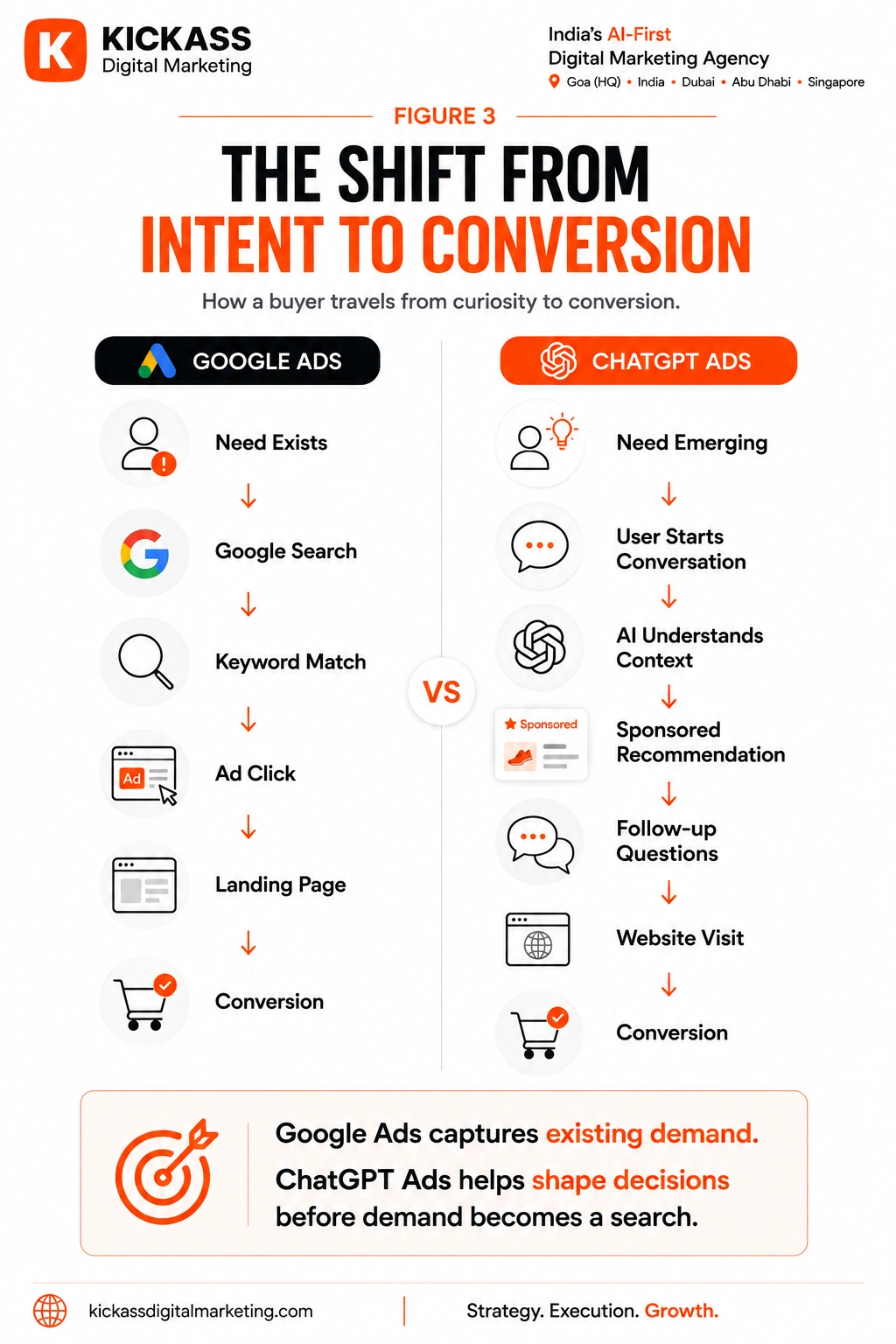
Everything above describes what’s different. It’s worth being equally direct about what isn’t, because a reader could finish this article assuming the entire discipline is being rebuilt from scratch. It isn’t.
Landing pages still need to convert once someone arrives. Reviews and reputation still matter, arguably more, since AI systems weigh them as trust signals rather than just social proof. Brand still compounds over time rather than appearing overnight. Measurement discipline — knowing what a conversion is actually worth — still separates businesses that scale advertising profitably from ones that just spend. And good content, written for an actual reader rather than an algorithm, still outperforms thin content on every surface that’s emerged so far, including this one.
Our working estimate, and it’s an estimate rather than a measured figure, is that roughly 80% of what makes advertising work stays the same across this shift. The 20% that changes — how intent is expressed, when advertising enters the decision, and what “relevance” means to the system doing the matching — is genuinely new, and it’s the part this article has focused on. But it’s a mistake to read that 20% as a reason to discard the fundamentals underneath it.
Is ChatGPT Ads replacing Google Ads in India? No. ChatGPT Ads targets conversational context, while Google Ads remains a mature, keyword-based channel already live across the market. The two are additive, not substitutive — budget moves from one to the other only once ChatGPT Ads is actually available and priced for India.
Which platform should a small business in India prioritize right now? Google Ads, since it’s the only one of the two currently operating in India. Google Ads remains the practical starting point since it’s self-serve and priced today, while ChatGPT Ads is live in India but not yet self-serve for a small business to operate directly.
Can the same ad creative work on both platforms? Not directly. Google Ads creative is built around keywords and search intent; ChatGPT Ads is built around conversational relevance, and the live rollout’s creative requirements are noticeably leaner (a short business description and a single hero image, rather than headlines, sitelinks, and callouts). Expect to adapt messaging and format, not just resize assets.
Does ChatGPT Ads use keyword bidding like Google Ads? No. ChatGPT Ads matches advertising to the subject and intent of an ongoing conversation rather than to typed search terms, which is a structural difference in the platform, not a temporary limitation. Our Ads Manager walkthrough covers the mechanics in full.
Is ChatGPT Ads live anywhere near India yet? Not in India itself, but closer than a US-only view suggests. As of mid-August 2026, the platform is confirmed live in nine markets — the US, Canada, Australia, New Zealand, UK, Japan, South Korea, Mexico, and Brazil. Some Indian users also received a preparatory privacy-policy email this month, though that’s not a launch signal — India isn’t listed among expansion markets and no rollout date is confirmed. That means NRI and international-facing Indian businesses already have customers inside a live market, even though India’s own launch date isn’t confirmed. See current status for the latest.
When will Indian businesses know real ChatGPT Ads pricing? Only once OpenAI officially launches the platform in India and self-serve access opens here, the way it did in the US, Canada, Australia, and New Zealand in February 2026. Q3–Q4 2026 is the widely cited industry estimate for India access, though OpenAI hasn’t confirmed a date. Until launch, any specific India CPC or CPM figure is an estimate — see our budget planning guide for the actual live-market numbers those estimates are based on.
Businesses don’t need to predict which AI advertising platform ultimately wins. They need to build the kind of digital presence that any AI system can confidently understand, recommend, and eventually advertise. That work begins long before the first campaign launches — which means it can start today, regardless of when ChatGPT Ads actually arrives in India.
→ See our ChatGPT Ads Agency & Consultant readiness process
This comparison draws on OpenAI’s own Ads Manager documentation, the live rollout across its current markets, and independent research published at ShodhDynamics, India’s AI discovery intelligence platform. Written and reviewed by Anurag Gupta — AI Discovery & Decision Funnel Strategist, founder of ShodhDynamics and KickAss Digital Marketing. Published research: ORCID 0009-0007-1480-4308 · Google Scholar.