Get Marketing Insights First
Subscribe to receive actionable strategies, growth tips, and industry insights delivered straight to your inbox.

Real estate websites are built for browsing. Buyers now expect a conversation. Here's the framework for the shift — what AI should handle, what stays with your sales team, and why the two together matter more than either alone.
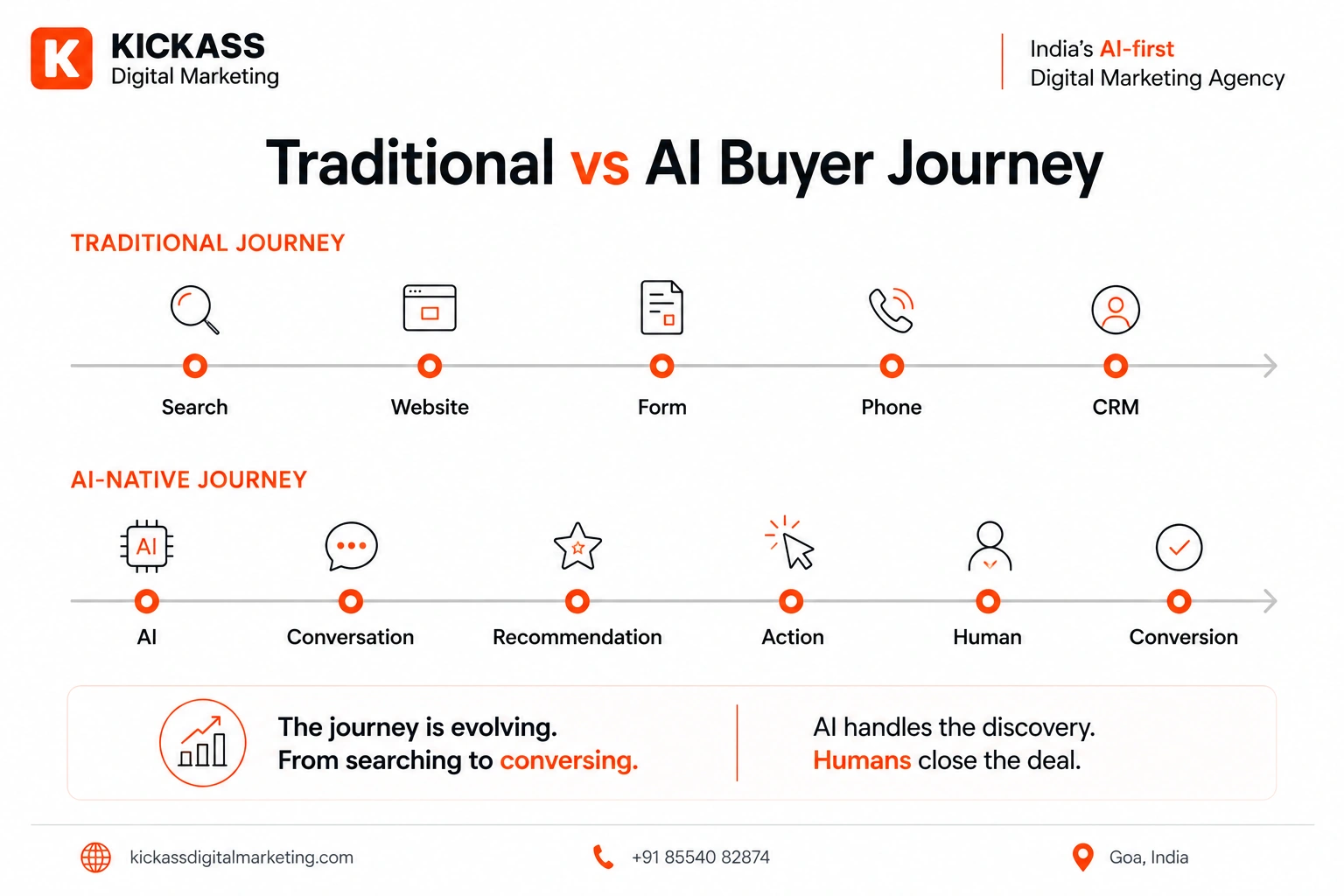
Most real estate websites are still built around 2015 assumptions. A visitor searches, lands on a page, scrolls through listings, and — if something catches their eye — fills out a form. Then they wait for a call.
That flow made sense when the internet was a library. It makes less sense now that buyers open ChatGPT and simply describe what they want.
The shift isn’t about adding a chatbot to an existing website. It’s about rethinking what happens between the moment someone starts looking and the moment they walk into a sales office. OpenAI recently published a case study on Cars24, an Indian marketplace that rebuilt its buying and selling journey around AI conversation rather than static pages. It’s not a real estate story, and this article isn’t about Cars24. But the underlying pattern — high-value purchases that involve research, comparison, and trust-building over days or weeks — maps closely onto how people actually buy property.
This article lays out that pattern as a framework: what an AI-native buyer journey looks like for real estate, what AI should handle, and — just as importantly — what it shouldn’t.
Being discoverable in Google or AI systems is only the first step. What happens after a buyer lands on your website is becoming equally important — and that second half is what this framework addresses.
It’s tempting to say AI changed how people buy real estate. That gets the order backwards.
Buyers started researching differently years before AI tools were good enough to answer property questions well. People were already comparing builders on WhatsApp groups, asking friends on Reddit, and reading reviews before they’d ever fill out an enquiry form. The behavior — research first, talk to a human later — existed before the technology caught up to support it properly.
What changed recently is that AI tools became capable enough to actually hold that research conversation. Earlier, a buyer’s only path was search, then a website, then a form, hoping someone would call back with real answers. Now a buyer can open ChatGPT, describe what they want in plain language, and get a reasoned response back immediately — no form, no wait.
This distinction matters for how you think about the investment. This isn’t really a technology upgrade. It’s building the infrastructure to finally match how buyers were already behaving.
It isn’t broken because the people running it are doing a bad job. It’s broken because it was built for a slower, less conversational internet.
A typical buyer today interacts with a builder’s website, a portal listing, a WhatsApp enquiry, and a phone call — often repeating the same information at each step. Budget, preferred location, family size, and timeline get asked and re-asked, because none of these systems talk to each other. For an Indian buyer, that often means re-explaining a home loan pre-approval, whether parents or a spouse are part of the decision, or RERA-related questions — each time, to a different person.
The result shows up in a few consistent ways:
Table 1: Traditional Website vs AI-Native Website
| Dimension | Traditional Website | AI-Native Website |
|---|---|---|
| Primary interface | Pages, filters, listings | Conversation |
| How a buyer finds a property | Manual browsing and filtering | Describes their needs, gets a shortlist |
| Information repeated | At every form and every call | Captured once, reused throughout |
| Lead capture | A static form, submitted once | An ongoing profile, built through conversation |
| Follow-up | Manual — depends on someone remembering | Automated and context-aware |
| Personalization | Absent until a human gets involved | Present from the first message |
| Buyer effort | High — the buyer does the filtering | Low — the system does the filtering |
| What the sales team receives | A name, a number, and a guess | Budget, timeline, preferences, and prior questions |
None of this is a technology failure exactly. It’s a design failure — the journey was built around forms and follow-ups, not around how a buyer actually thinks through a decision this large.
Cars24 is a used-car marketplace, not a real estate company, so the comparison only goes so far. But the principle behind what they built is worth understanding, independent of the industry.
Cars24 used AI to handle the parts of a high-consideration purchase that don’t require a human yet — collecting a buyer’s budget and preferences, recommending options from their catalog, booking a test drive, and following up afterward. According to OpenAI’s published case study, the approach now handles over a million conversation minutes a month and has recovered 12% of leads that would previously have gone cold after ten days of silence.
The pattern, stripped of the car-specific detail, looks like this: AI remembers context across a conversation, qualifies what the buyer actually needs, recommends a shortlist, and hands the qualified buyer to a person at the right moment. The company’s own framing is worth sitting with — as Cars24 builder Vikram Chopra put it, buying is “a journey, not a transaction,” and for years the quality of that journey depended entirely on who happened to pick up the phone.
Real estate is arguably a better fit for this pattern than cars. The decision cycle is longer, the amounts involved are larger, and the number of touchpoints before a decision is even higher — for a North Goa villa developer, that decision cycle often stretches across multiple weekend site visits, a home loan approval, and, frequently, an NRI buyer coordinating the whole process from a different time zone. If anything, real estate has more to gain from applying this thinking than the industry it originated in.
For where this connects to how buyers find a developer in the first place — before any conversation happens — see our AI marketing guide for real estate.
An AI-native buyer journey is a real estate sales process built around conversation as the primary interface, rather than pages and forms, with conversational AI handling the parts of that conversation that don’t yet require a human.
It sits downstream of a chain that’s worth making explicit: AI visibility gets a buyer to discover you in the first place, AI discovery is what surfaces you inside an AI system’s answer, and the buyer journey covered in this article is what happens next — conversation, lead qualification, a CRM record, a human consultant, and finally, conversion. Each of those is a distinct capability, and treating them as one thing is usually where implementations go wrong.
It has a few consistent components:
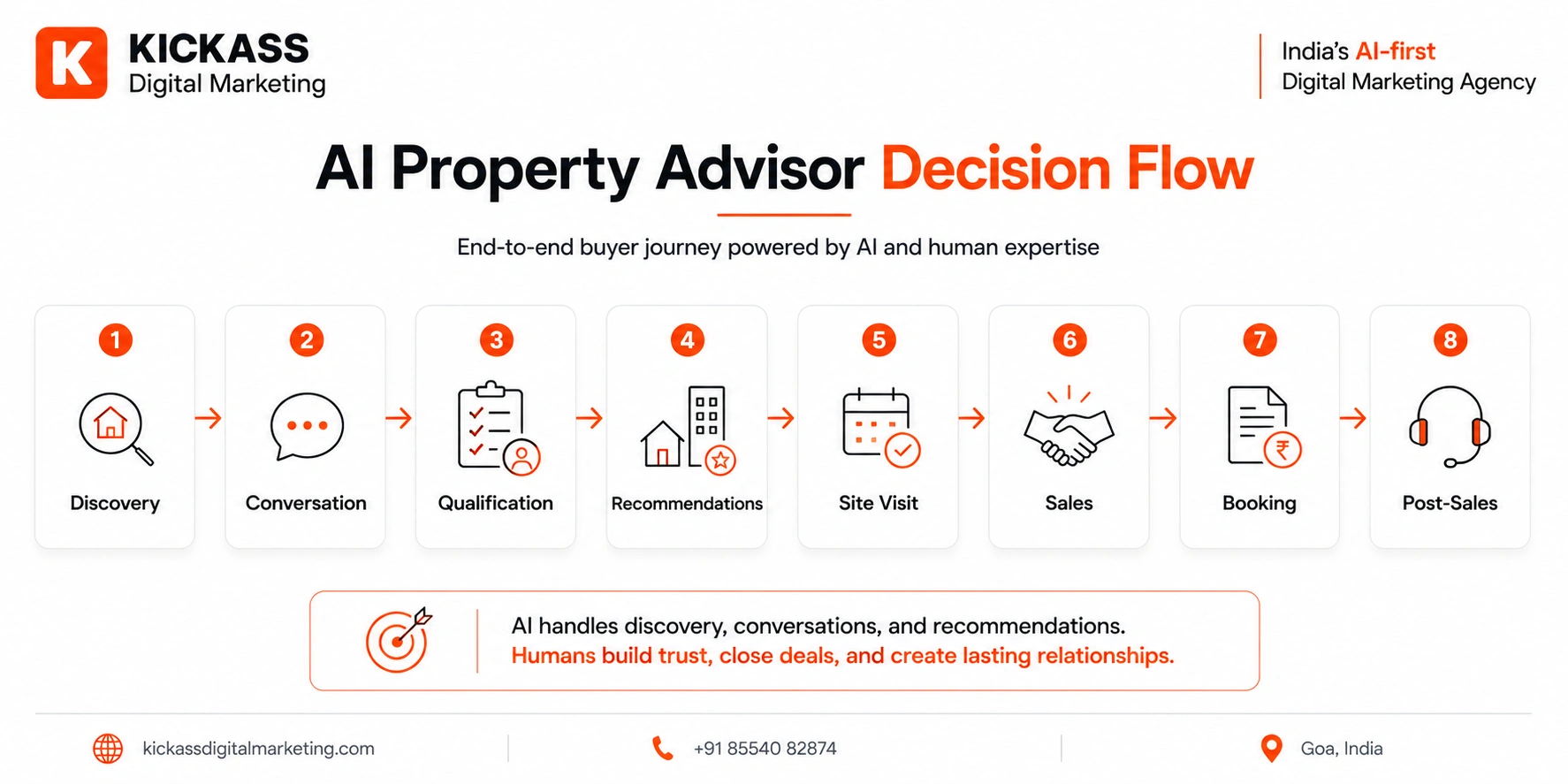
This isn’t a chatbot bolted onto an existing site. A chatbot answers questions. An AI-native buyer journey restructures the sequence of steps between “just looking” and “signed the booking form.”
Practically, it works by asking the questions a good sales consultant would ask on a first call — budget, location, property type, amenities, timeline, and whether the purchase is for personal use or investment — and using the answers to narrow down real inventory.
A conversation might establish that a buyer has a budget near ₹1.4 crore, wants a 3BHK, needs good school access, and is buying to live in rather than to rent out. Instead of returning a list of 140 matching listings, the advisor narrows that down to a small set of genuinely relevant options, explains why each one fits, and offers a next step — a site visit, a video walkthrough, or a call with a sales consultant.
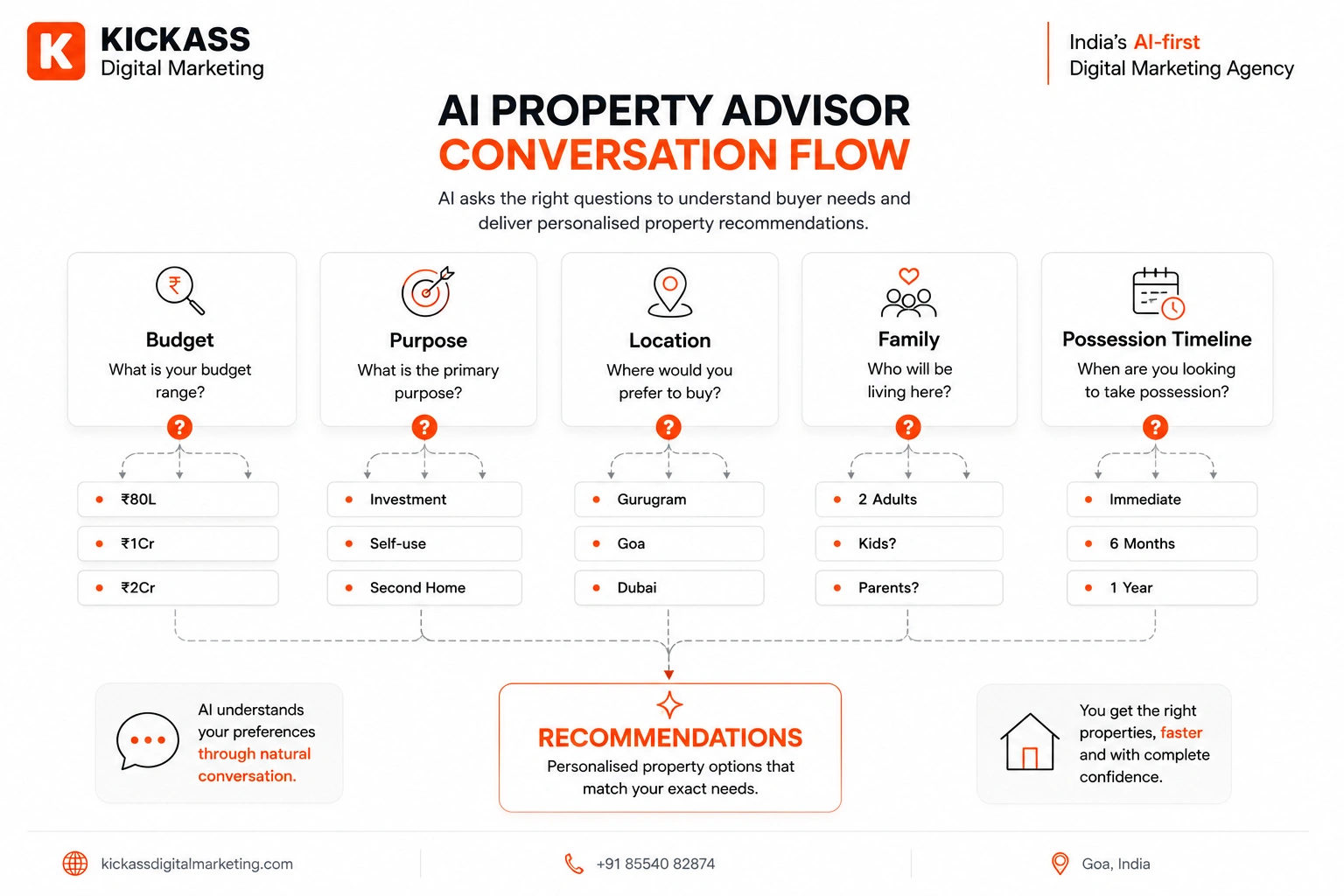
This is closer to how a buyer already expects an AI system to respond, because it’s how they’ve started expecting ChatGPT itself to answer questions. A property advisor that returns 140 unfiltered results feels like a step backward, not forward.
None of this requires deciding on software architecture upfront. It requires deciding what questions actually matter for your inventory and your buyers, and building the conversation around those.
Qualification is where AI creates the most immediate value, because it’s the part of the process that consumes the most sales time for the least certain return.
A useful qualification conversation covers budget, genuine intent versus casual browsing, purchase timeline, financing needs, family situation, whether the purchase is for investment or self-use, preferred location, and where the buyer sits in their decision — early research or ready to visit. For Indian buyers specifically, this often includes whether a home loan is pre-approved, whether the decision involves a joint family or parents, and whether the buyer is an NRI coordinating a purchase remotely — details that change how, and when, a salesperson should follow up.
Once that’s established, the information should flow directly into the CRM as structured data, not as a transcript someone has to read and summarize manually. A salesperson opening a new lead should see the buyer’s budget, timeline, and preferences already filled in, not a blank form and a phone number.
For how this connects to the follow-up and nurture side of the funnel once a lead is qualified, see our guide to real estate lead management in India.
This is the part of the framework that matters most, and the part most AI marketing content gets wrong.
AI is good at answering repetitive questions, educating a buyer on the basics, scheduling a visit, and summarizing what’s already been discussed. It is not good at building trust with a first-time buyer making the largest purchase of their life, negotiating final terms, handling the legal detail of a transaction, or closing a deal that depends on reading a room.
Table 2: Buyer Questions vs AI Response vs Human Intervention
| Buyer Question or Moment | AI Handles | Human Handles |
|---|---|---|
| “What’s available in my budget?” | Filters inventory, recommends matches | — |
| “Is this builder reliable?” | Shares available documentation and track record | Contextualizes reputation, answers nuanced concerns |
| “Can I negotiate the price?” | — | Negotiates terms |
| “What are the legal steps involved?” | Points to relevant documentation | Provides legal guidance |
| “Can I schedule a visit?” | Books the visit, sends reminders | Conducts the visit |
| “I haven’t decided yet — follow up later” | Remembers context, re-engages at the right moment | Builds the relationship across touchpoints |
| Final decision to buy | Summarizes everything discussed | Closes the transaction |
The goal isn’t to reduce headcount. It’s to make sure that by the time a buyer reaches a human, that conversation starts from an informed position instead of from zero. A salesperson who opens a call already knowing the buyer’s budget, timeline, and specific concerns is starting at minute twenty of a relationship instead of minute one.
Any framework that positions AI as a replacement for the sales team has misunderstood what actually drives a real estate decision to close.
Memory is what separates a genuinely useful AI property advisor from a chatbot that forgets everything between sessions.
A well-built system should retain a buyer’s preferred city, budget range, bedroom requirement, school proximity needs, whether they have pets, parking requirements, whether they’re buying for investment or to live in, which properties they’ve already viewed, questions they’ve previously asked, and their preferred language and communication channel.
This matters because real estate decisions rarely happen in one sitting. A buyer might return to a conversation three weeks later, and the difference between “welcome back — still looking at that 3BHK in Wakad with the school nearby?” and starting from a blank slate is the difference between feeling understood and feeling like a stranger every time.
Conversation-to-Conversion, or C2C, is a way of thinking about the buyer journey rather than a product to install. The idea is simple: instead of a website that exists to move visitors through pages, filters, and forms toward a CRM entry, the website exists to have a conversation that moves naturally toward a decision. Conversation is becoming the new navigation.
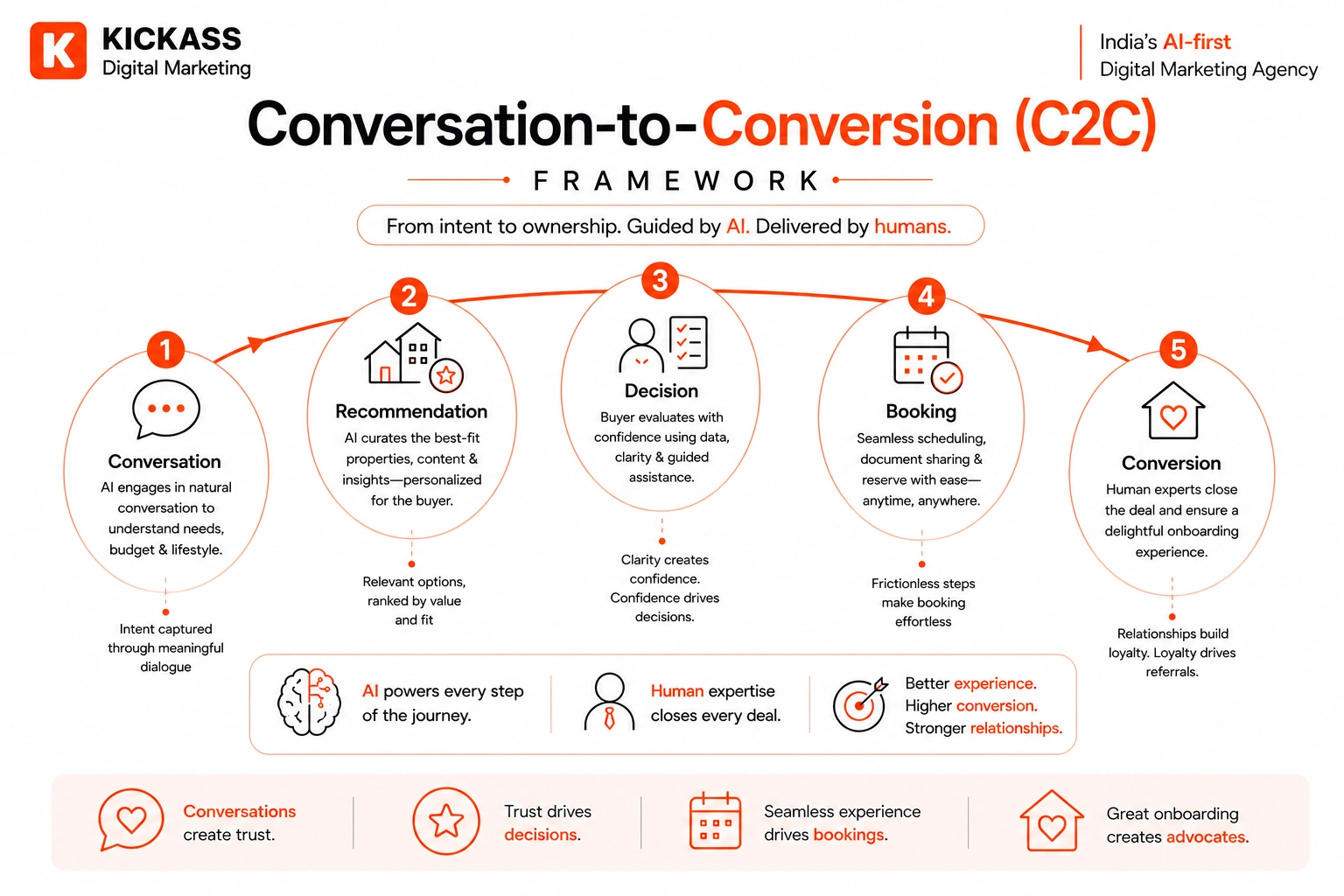
Under the old model, a website’s job was to present information and hope the visitor did the work of finding what mattered to them. Under a C2C model, the website’s job is to ask a few good questions and do that work on the visitor’s behalf.
This doesn’t mean removing pages or listings. It means the conversation becomes the primary path, and browsing becomes the secondary one — a reversal of how most real estate websites are currently built.
An AI-native buyer journey only works if the systems around it are connected, not because any single tool is complicated on its own.
At minimum, the conversation layer needs to connect to the CRM, so qualified leads become structured records instead of transcripts. It needs to connect to the booking and calendar system, so a site visit can actually be scheduled inside the conversation. It benefits from a WhatsApp and email connection, since that’s where most Indian buyers expect follow-up to happen. And it needs access to accurate property inventory data — pricing, availability, and specifications that are actually current, not a spreadsheet that was last updated two months ago.
Table 3: Technology Stack Required for an AI-Native Real Estate Business
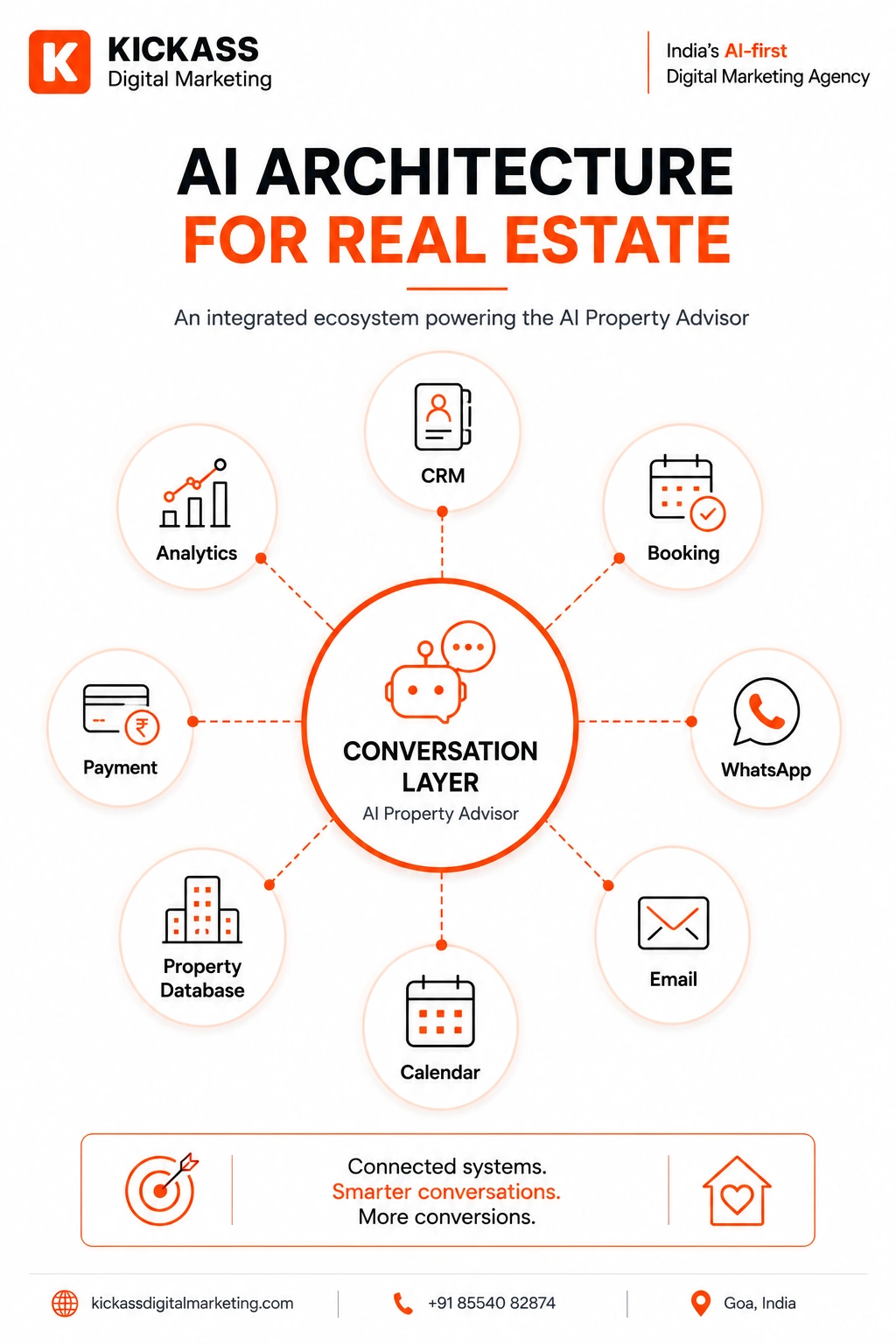
| Component | Purpose |
|---|---|
| Conversation layer | The AI property advisor itself — where buyer interaction happens |
| CRM | Converts conversations into structured, actionable lead records |
| Booking and calendar system | Schedules site visits, video tours, and sales calls |
| WhatsApp integration | Where most Indian buyers already expect follow-up |
| Structured nurture sequences and documentation | |
| Property database | Single source of truth for pricing, availability, and specifications |
| Payment systems | Booking amounts and transaction processing |
| Analytics | Measures conversation quality, not just form submissions |
None of this requires committing to a specific vendor stack before you’ve defined what the conversation itself should cover. Architecture follows the buyer journey — not the other way around.
This is the section that separates a trustworthy implementation from a risky one, and it deserves to be stated plainly.
AI should never give legal advice about a property transaction. It should never promise inventory availability it can’t verify in real time. It should never fabricate a price or a discount to move a conversation forward. It should never attempt to negotiate final contract terms. It should never present itself as a replacement for a human agent. And it should never hide uncertainty behind a confident-sounding answer — if it doesn’t know, it should say so and route the buyer to someone who does.
Getting this list right matters more than getting the conversational design right. A property advisor that occasionally sounds slightly robotic is forgivable. One that confidently quotes a wrong price or promises availability that doesn’t exist damages trust in a way that’s hard to recover from in a transaction this large.
Property transactions involve legal, financial, and emotional decisions. AI should support transparency, not replace professional advice. Buyers should always verify pricing, availability, and legal documentation directly with the developer or an authorised sales representative.
Starting doesn’t require building the full system at once. A practical first sequence looks like this:
For how this applies specifically to a high-context market like North Goa, where buyer research increasingly starts with AI tools rather than portals, see our AI visibility guide for North Goa real estate.
Can AI replace real estate agents? No. AI can handle qualification, scheduling, and repetitive questions, but trust-building, negotiation, legal detail, and closing a transaction this large still depend on a human agent.
What is an AI Property Advisor? An AI Property Advisor — sometimes called an AI buying assistant or AI sales assistant — is a conversational system that asks a buyer about their budget, preferences, and timeline, then recommends matching properties and helps schedule a next step, such as a site visit.
How does AI qualify buyers? By asking structured questions about budget, timeline, financing, family situation, and purchase intent, then passing that information to the sales team as usable data instead of a raw transcript.
Can AI schedule site visits? Yes. Once a buyer’s preferences and availability are established in conversation, scheduling a site visit, video tour, or sales call can happen inside the same conversation.
Does AI integrate with CRM? It should. Without CRM integration, a buyer’s conversation history stays trapped in the chat tool instead of becoming information the sales team can act on.
Is AI useful for builders? Yes, particularly for managing high volumes of early-stage enquiries across multiple ongoing projects, where manual qualification of every lead isn’t practical.
Is AI suitable for brokers? Yes. Brokers handling enquiries across multiple developers benefit from AI qualification even more than single-project developers, since the range of buyer questions is wider.
Can AI recommend properties? Yes, based on the preferences a buyer shares in conversation — budget, location, configuration, and amenities — narrowed to genuinely relevant options rather than a full inventory list.
How does AI remember previous conversations? Through persistent memory tied to the buyer’s identity, so preferences, previously viewed properties, and prior questions carry forward into later conversations.
How is an AI Buyer Journey different from a chatbot? A chatbot answers isolated questions. An AI Buyer Journey restructures the entire sequence from discovery to sale — qualification, recommendation, scheduling, and follow-up — around conversation rather than static pages.
Real estate websites are changing, not because a new technology arrived, but because buyer behavior already moved. People research property the way they research everything else now — by asking, comparing, and expecting an answer that accounts for what they’ve already said.
The future of a real estate website is not more pages. It’s better conversation. It’s not more form fields. It’s more context. And the goal isn’t more leads — it’s better-qualified buyers reaching your sales team ready to talk.
AI visibility helps buyers discover your business. An AI-native buyer journey helps them make decisions once they arrive. Together, they represent the next evolution of digital marketing for real estate — and most developers, builders, and brokers in India haven’t started building either one yet. This is the framework KickAss uses when designing both halves for real estate clients.
Just as mobile-first websites became the standard over the last decade, conversation-first websites may become the next competitive advantage. Businesses that start designing buyer journeys today will be better positioned as AI increasingly becomes the interface between customers and brands.
For more on the discovery side of this, see our real estate AI marketing guide, our guide to real estate lead management in India, and our AI visibility guide for North Goa real estate.