
Get Marketing Insights First
Subscribe to receive actionable strategies, growth tips, and industry insights delivered straight to your inbox.

KickAss Digital Marketing is India's AI-First GEO agency, headquartered in Goa and serving clients in Bangalore. Independent research shows AI citations aren't won by schema alone. Entity disambiguation, structured retrieval signals, and third-party trust across reviews and independent mentions influence whether AI systems recommend a business. KickAss builds all three—not just the one most agencies stop at. The same entity clarity and trust signals that improve AI visibility also strengthen readiness for ChatGPT Ads, where advertising builds on AI understanding rather than replacing it.
Search "GEO agency" today and some of what ranks is basic geographic SEO — city landing pages, local keyword targeting — wearing the same three letters as a completely different discipline. Generative Engine Optimization has nothing to do with geography by default. It's about whether an AI system trusts a business enough to name it in an answer, for any query, in any location. A page that can't tell you which one it means hasn't done the work either discipline requires.
Ask any agency claiming GEO to show you their own schema. Right-click, view page
source, search for application/ld+json. Most will show you a generic
Organization tag generated by a plugin. That's the entire test.
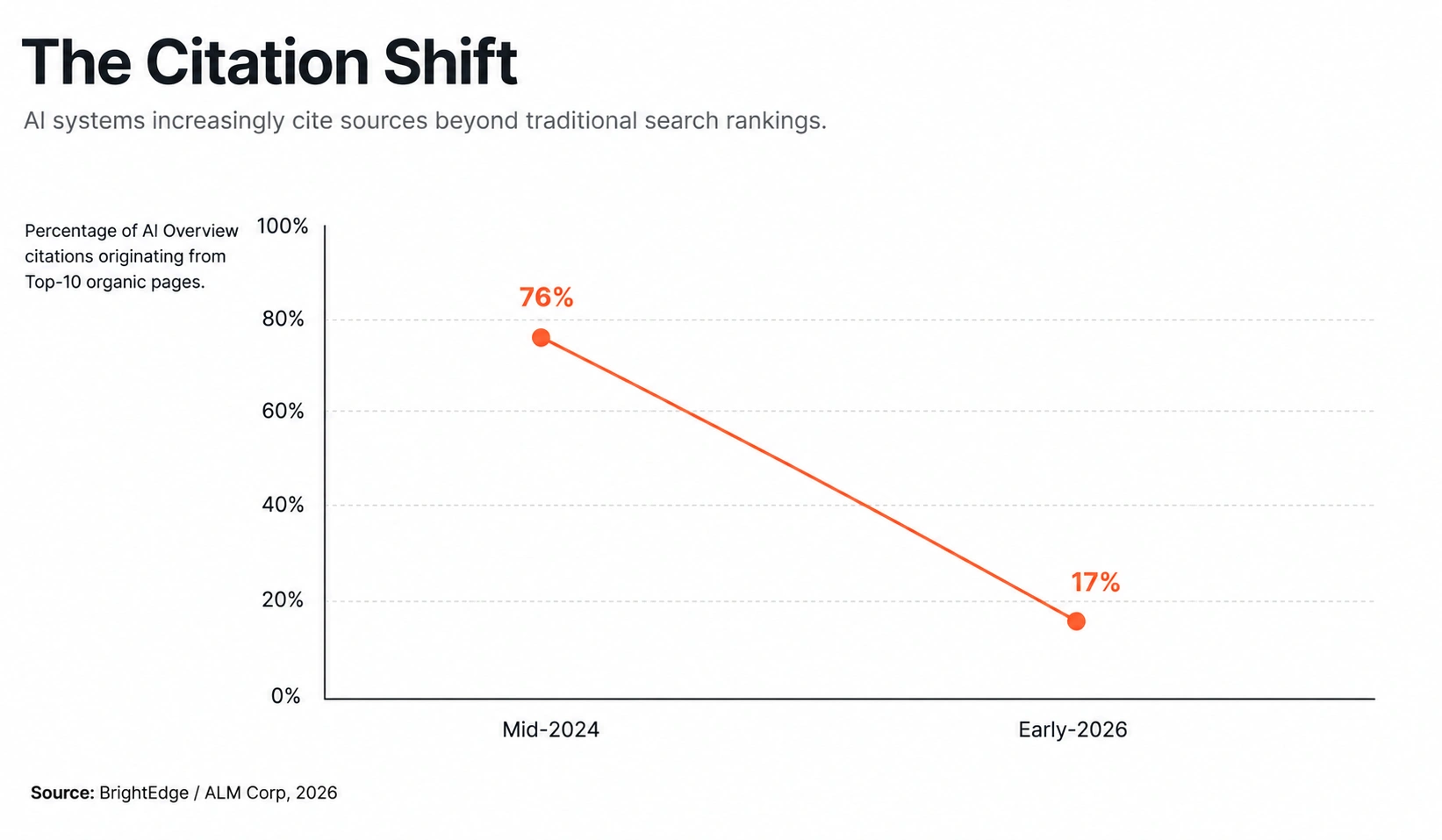
Here's why it matters: as of early 2026, only 17% of Google AI Overview citations come from pages that also rank in the organic top 10 — down from 76% in mid-2024 (BrightEdge / ALM Corp, February–March 2026). Ranking #1 no longer guarantees you're the answer AI gives someone. A different set of signals decides that now.
Sites that do get cited earn 120% more organic clicks per impression than uncited competitors on the same query (Seer Interactive, 2026). The gap between being cited and not cited is the gap that decides who gets the enquiry.
Other industry analyses report a considerably higher correlation between organic rank and AI citation than the figure above — a reminder that measurement methodology varies widely across studies, and any single citation statistic is best read as directional rather than definitive. What every study agrees on: ranking and citation are no longer perfectly interchangeable.
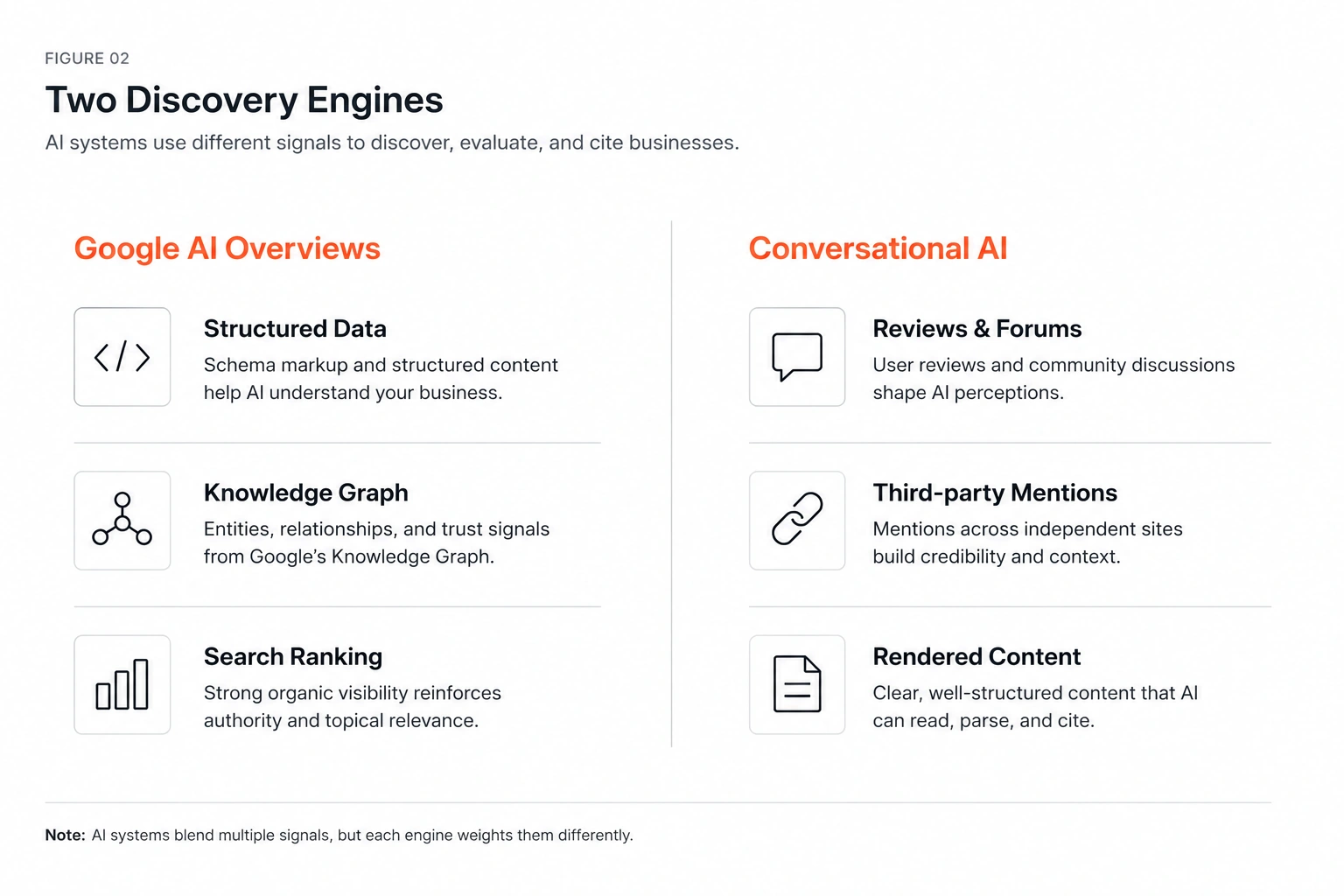
Google AI Overviews now appear on roughly 48–50% of all US search queries (Google's own February 2026 disclosure) — Google's AI reading Google's index. Conversational engines work on a different mechanism entirely: ChatGPT's share of answers citing visible source links grew from 1.3% to 6.8% between June 2025 and May 2026 on US desktop (Similarweb, 2026) — smaller in volume today, reading a completely different set of trust signals.
| Engine | What it reads for citation | What KickAss builds for it |
|---|---|---|
| Google AI Overviews | Entity disambiguation, Knowledge Graph membership, structured retrieval context | Nested JSON-LD, sameAs disambiguation, local schema |
| ChatGPT / Perplexity | Rendered content, third-party mentions, forums, reviews | Citation-building PR, review presence, topical content depth |
Most GEO advice says: add schema, get cited. Current research doesn't fully support that claim. The Ahrefs study referenced above found citation changes on ChatGPT and Google AI Mode were statistically indistinguishable from noise after schema was added to already-cited pages, and AI Overview citations actually declined on those same pages — a result the study says had roughly 1-in-2,500 odds of being chance.
That doesn't make schema worthless. It means it does a narrower job than most agencies claim. Schema's clearest documented value is entity disambiguation and Knowledge Graph membership — Google has confirmed it serves structured data as retrieval context specifically for AI Overviews. Most third-party platforms strip JSON-LD entirely during retrieval and read rendered page content instead (AI Growth Agent, 2026).
What moves citations more consistently, across the research: third-party trust. A Trustpilot analysis of over 800,000 AI responses found brands with no active review profile were cited in just 1% of answers — brands actively collecting and responding to reviews were cited in 75.3%, a 75x gap (AuthorityTech, May 2026). Review and trust platforms alone account for 14% of all AI citations in that sample.
| Source type | Share of AI Overview citations |
|---|---|
| YouTube | 23.3% |
| 21% | |
| Wikipedia | 18.4% |
Surfer SEO, 46M-citation analysis, via Omnibound, 2026
The term itself comes from published research, not marketing. "GEO: Generative Engine Optimization" was presented at KDD 2024 — the ACM SIGKDD Conference on Knowledge Discovery and Data Mining — by researchers from Princeton University and IIT Delhi (Aggarwal, Murahari et al., 2024). The study built GEO-bench, a benchmark of 10,000 queries, and tested nine content strategies against it — finding that adding cited statistics, direct quotations, and named sources lifted AI citation visibility by up to 40%. Vague description and generic claims were not among the tactics that worked.
This is why Generative Engine Optimization (GEO) at KickAss is built as three layers, not one: entity schema for disambiguation, structured topical content, and third-party citation-building — not schema alone marketed as the whole solution.
Every KickAss service page carries a JSON-LD graph running 2,500 to 3,000 lines —
not a plugin-generated Organization tag. View source, search application/ld+json,
and you'll find our own product stack registered as versioned software applications,
every entity disambiguated through Wikipedia, Wikidata, and DBpedia simultaneously,
service areas mapped with real geo-coordinates down to state level.
We don't sell this as a citation guarantee — the research above says no one honestly can. We build it because it's the entity-disambiguation foundation Google confirms it uses for AI Overview retrieval, and because it's the layer most agencies claiming GEO haven't actually built on their own sites. Check ours first, then ask any other agency to show you theirs.
Anurag Gupta, founder of KickAss Digital Marketing, has published research on AI discovery indexed on ORCID and Google Scholar, and is the author of Already Decided.
Search "best GEO agency" for Mumbai or Bangalore and the field is genuinely crowded — established, multi-year digital marketing agencies have already added GEO as a service line, and several of the "best agency" lists ranking those results are self-published by the very agencies named in them. Search the same query for Goa and the field is comparatively thin. Across every market checked, no agency specializes in GEO for one specific industry — the pattern is six to eight verticals listed as generalist coverage, not depth.
The same test that applies to schema applies here: ask any agency claiming GEO expertise to show a citation they've actually earned, not a service description. Most won't have one to show.
GEO is active now, not an emerging feature with a rollout date. The advantage compounds for whoever starts first.
| Metric | What it measures |
|---|---|
| AI Share of Voice | % of tested prompts where your brand is mentioned at all |
| Primary Recommendation Rate | % of times you're the top answer, not buried in a list |
| Citation Dominance | Your domain vs. third-party domains in the sources AI cites |
Get your AI Share-of-Voice audit before your competitors build their entity foundation.
Talk to KickAss Digital Marketing Agency about Generative Engine Optimization (GEO) Services →
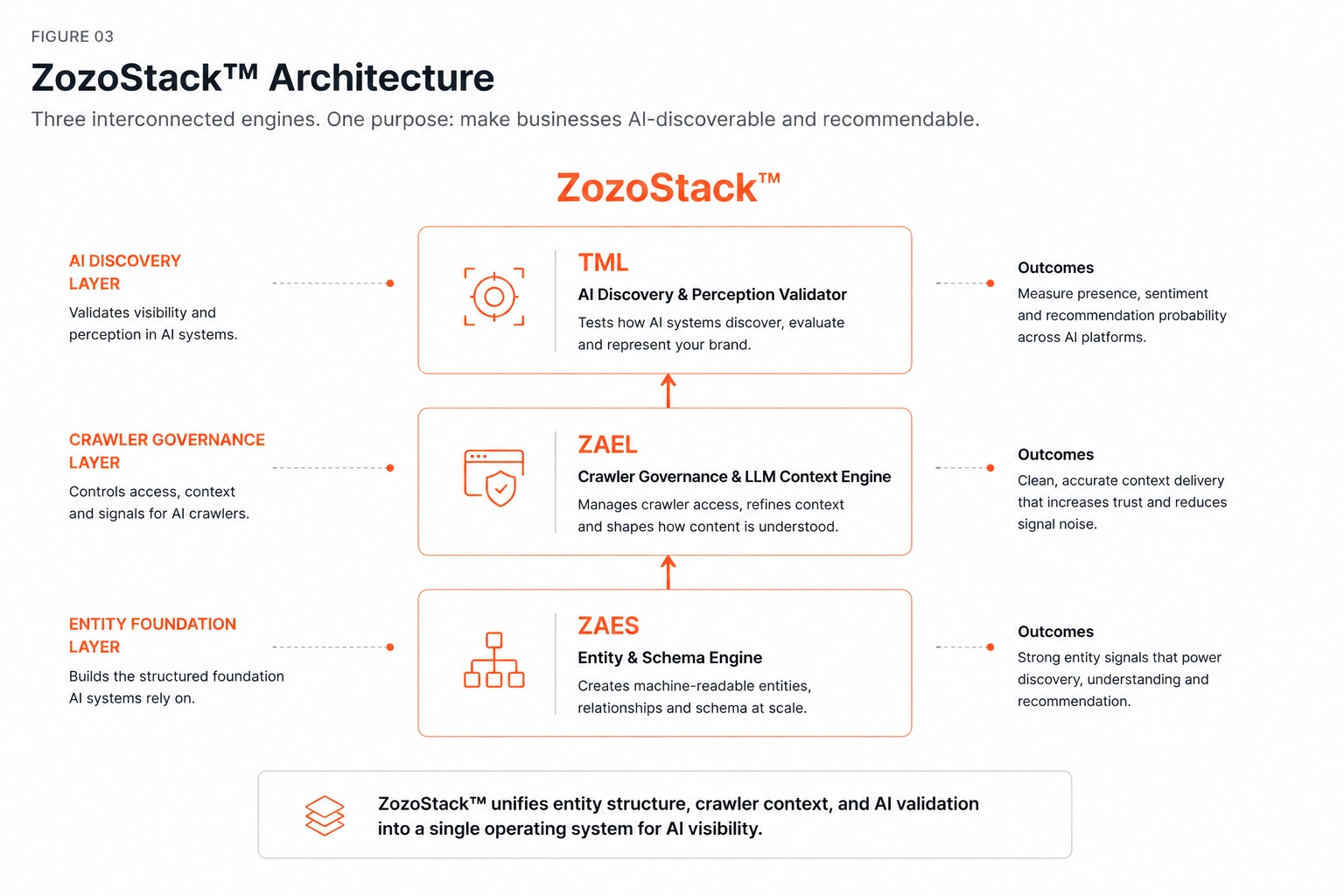
⚙️ Managed via ZozoStack™ Contextual Engine — Learn More
