
Get Marketing Insights First
Subscribe to receive actionable strategies, growth tips, and industry insights delivered straight to your inbox.

Your WooCommerce or Shopify store can look perfect to a customer and still be completely invisible to ChatGPT, Gemini, or Perplexity. We build the structured data layer that gets growing Indian e-commerce brands cited, not just ranked — and we run the same playbook on ourselves first.
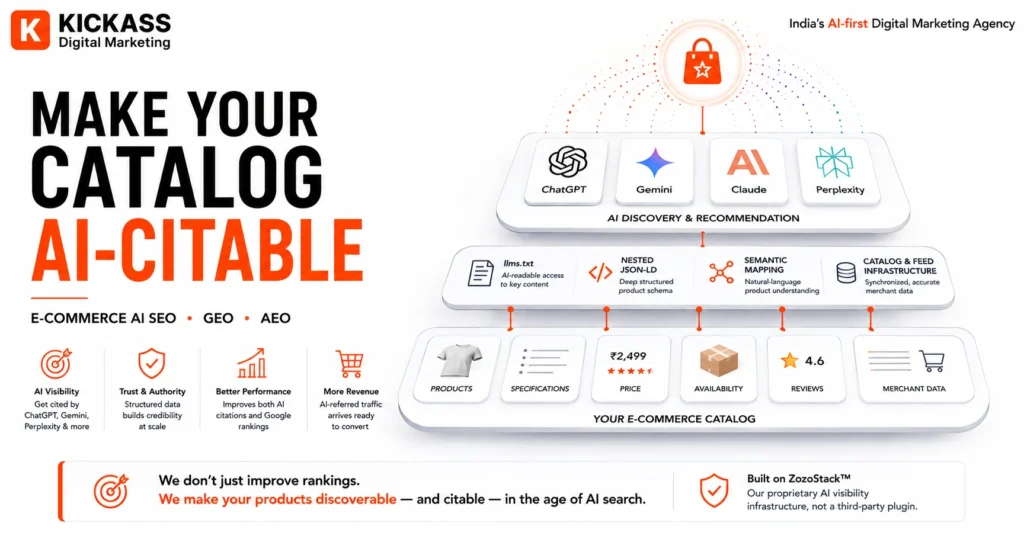
It restructures your product catalog and store metadata so AI platforms — ChatGPT, Gemini, Perplexity, Copilot — can read, verify, and cite your products in conversational answers. This means deploying llms.txt, deep nested JSON-LD schema, and semantic product mapping, on top of standard SEO.
No. This layer runs on top of your existing foundation. The technical cleanup involved — clean product data, better crawl paths, structured schema — improves classical Google rankings at the same time it builds AI visibility. That layered approach is what we formalise in the KickAss BASE™ Model for SEO & AI Search: Build on the existing SEO foundation, Add the product-data and AI-discovery infrastructure the new environment requires, Study platform-specific behaviours that are still emerging, and Exclude tactics that are being sold as proven AI ranking factors without sufficient evidence.
Not if it’s done right, and that’s a fair thing to be skeptical of — most agencies selling it are. The mechanics genuinely differ: classical SEO optimizes for keyword-and-backlink ranking; AI platforms retrieve a small number of pages under a strict token budget and synthesize a direct answer from whatever they can cleanly parse. A page can rank well and still never get cited. We explain exactly where that gap shows up below, and how we test for it — including on our own site.
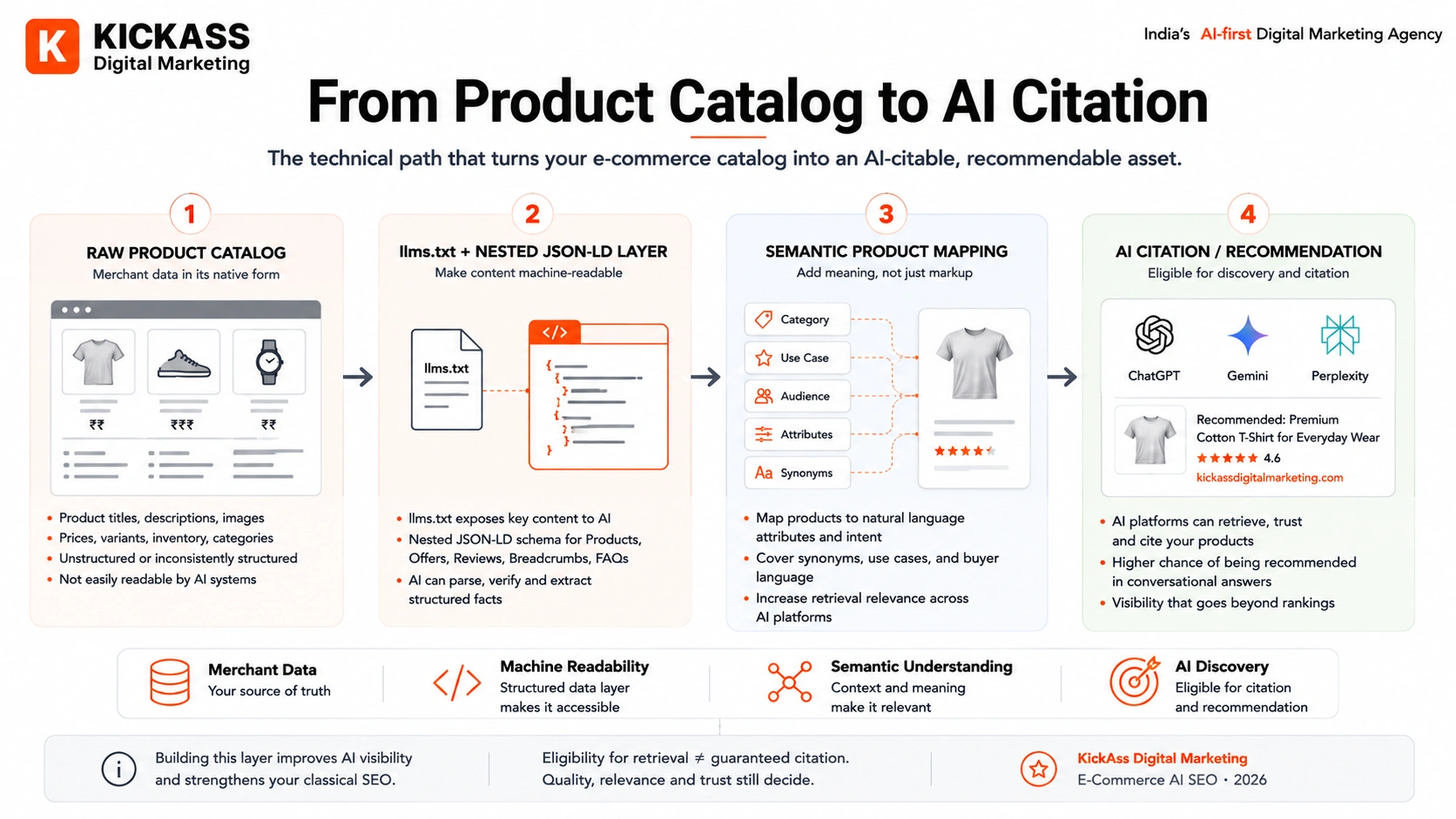
Figure 1: The technical path from a raw product catalog to an AI-cited recommendation — structured data first, semantics second.
Most agencies selling “AI SEO” are selling a rebranded version of the same keyword-and-backlink playbook. We don’t ask you to take our framework on faith — we hold our own site to the same standard we’re proposing for yours.
When we searched Google for “e-commerce AI SEO Agency in Goa,” KickAss Digital Marketing ranked at approximately position 21 in the classical organic results. For the same query in Google AI Mode, KickAss Digital Marketing was the first agency recommended.
That divergence — #21 in classical organic search, #1 in the AI-generated recommendation set — is the phenomenon this page is about. And in this case, it isn’t hypothetical. We observed it on our own domain.
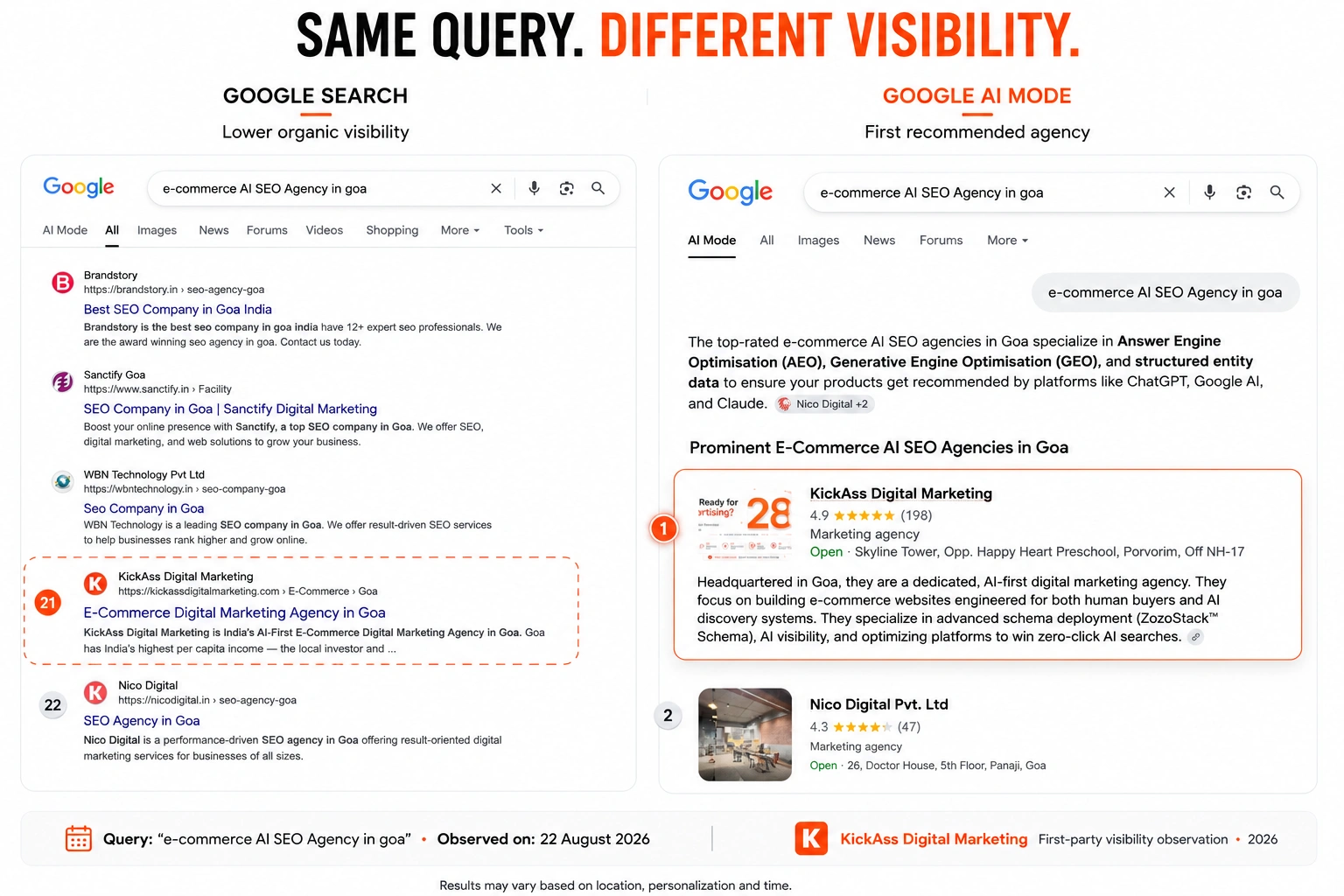
Figure 2: First-party observation, 22 August 2026. Google Search and AI Mode results can vary by location, personalization and time.
This is also why our own About page states plainly that every site we build is structured for AI readability from day one — entity schema and llms.txt included — powered by our own proprietary infrastructure, ZozoStack™, rather than a third-party SaaS plugin. If you want to see the underlying lexicon we use to talk about this — terms like Entity Debt and Source Gravity — that’s published openly on ShodhDynamics, our research arm.
Conversational AI doesn’t crawl the web evenly. When an AI platform processes a query with sparse local or niche web consensus — a specialty product, a regional brand, a smaller city — it defaults to what we call the Marketplace Moat: citing the nationwide conglomerate it already has abundant structured data on (Amazon India, a large marketplace, an established chain) rather than the smaller, equally legitimate business that simply hasn’t fed it machine-readable data.
We first documented this clearly through our own backyard: Goa-based queries for specialty, boutique, or artisanal businesses consistently defaulted to national marketplace citations over equally relevant local retailers, for one specific reason — the local retailers had no active Google Merchant Center feed or structured product data for the AI to verify stock, pricing, or legitimacy against. Without that feed, Gemini’s google_shopping:search tool and equivalent retrieval mechanisms on other platforms simply have nothing to cite. The pattern isn’t Goa-specific — it applies to any underserved category or region — but it’s where we first proved it, and it’s the reason structured data matters more for smaller and regional brands than for the marketplaces they’re competing against.
If your internal team is managing this with standard SEO plugins (Yoast, RankMath) alone, three specific technical failure points tend to show up:
priceCurrency: INR, or if the schema price, your Merchant Center feed price, and your on-page displayed price don’t match exactly, AI validation logic tends to flag the listing as unreliable and drop it rather than risk showing a user incorrect information.None of these are exotic problems — they’re common, fixable, and exactly what a plugin alone won’t catch because plugins are built for classical SEO’s rules, not these.
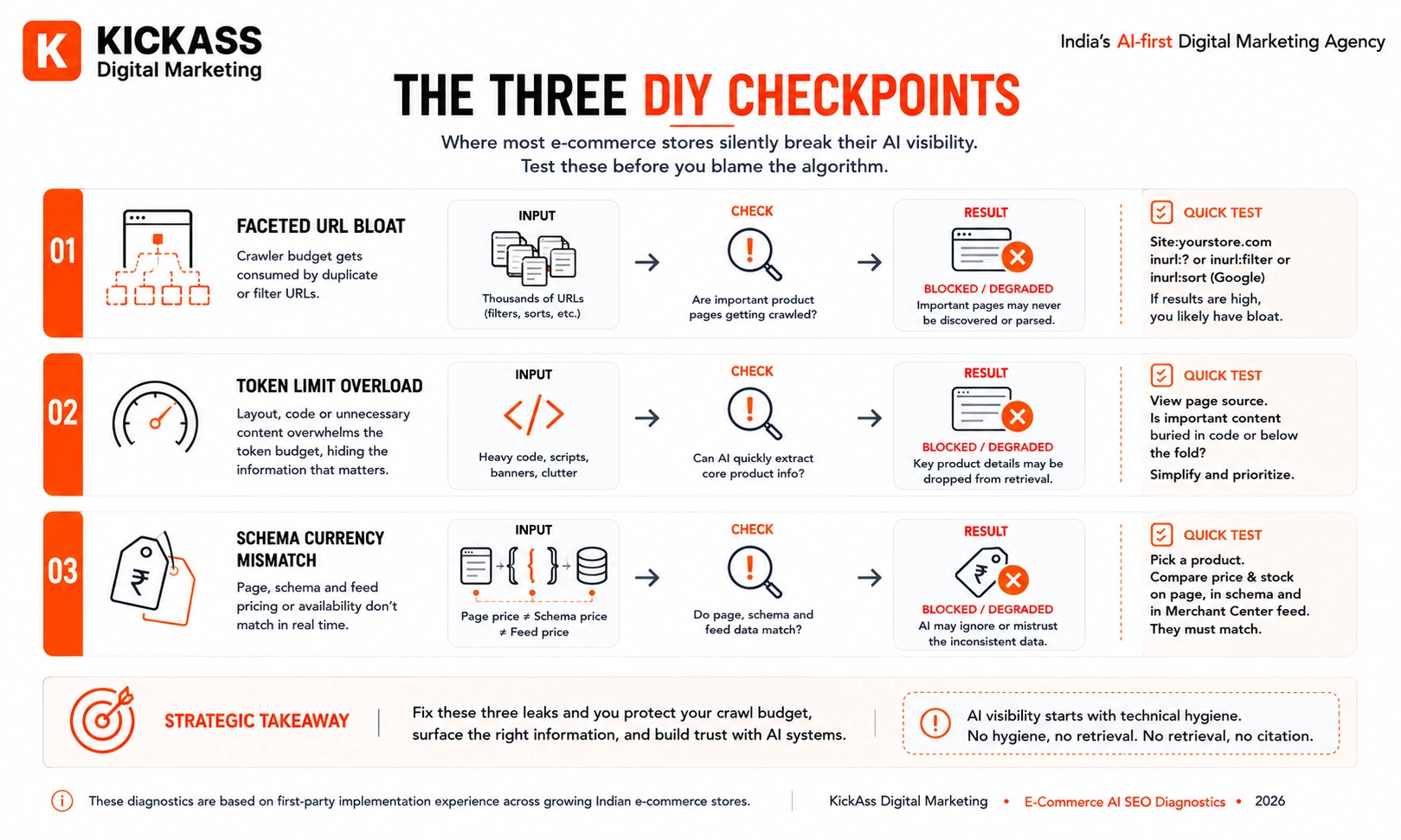
Figure 3: Standard SEO plugins alone typically miss these three failure points when it comes to AI crawler retrieval.
When AI platforms use explicit high-confidence language — “the standout option,” “our top recommendation” — it’s because an entity has a highly consistent, structured, and cross-verified digital footprint across three specific layers, not because of a persuasive product description:
@id so the AI can connect your brand entity to your product data rather than treating them as disconnected fragments.We’ve seen this pattern directly in our own testing: Perplexity labeled a specific double-door refrigerator “the standout option” because its technical specifications — compressor type, energy rating, capacity — were consistently defined in machine-readable form across the manufacturer’s listing, major marketplaces, and independent buying guides simultaneously. Separately, ChatGPT recommended a specific budget earbuds model by name, backed by consistent, verified community discussion of its exact noise-cancellation depth and battery life. In both cases, the AI wasn’t persuaded by marketing copy — it was verifying consistent, structured facts across multiple independent sources.
llms.txt deployment. A token-optimized, markdown-formatted roadmap at your domain root, giving AI crawlers your catalog structure, shipping policy, and brand context directly rather than forcing them to infer it from rendered HTML.priceCurrency (INR) and live price, real-time availability status, genuine aggregateRating data, and shippingDetails reflecting your actual delivery zones — all resolved under a single entity @id so specifications and brand authority stay connected, not scattered across disconnected schema blocks.Getting cited is the discovery half of the problem. The other half is not losing the buyer once they land on your site — this is where a lot of “AI SEO” offers stop short of being a complete service.
We work natively inside the platforms your team already runs — no forced migration to a headless stack that needs a dedicated engineering team to maintain.
This service is built specifically for growing Indian e-commerce businesses — bootstrapped D2C startups, small internal marketing teams, and brick-and-mortar retailers transitioning online — who need a structured implementation partner rather than a large retainer built for enterprise catalogs. If you’re running a multi-crore national catalog with an in-house engineering team, our AI Search Visibility enterprise track or our GEO and AEO service pages may be a more direct starting point than this one.
| Startup AI-Launch | Growth Catalog Engine ★ Recommended | Enterprise Catalog Dominance | |
|---|---|---|---|
| Best for | Brick-and-mortar stores moving online, small catalogs | Fast-scaling D2C brands (up to ~500 SKUs) | Multi-hundred SKU catalogs, multi-marketplace sellers |
| Platform scope | WooCommerce or Shopify | WooCommerce or Shopify | WooCommerce, Shopify Plus, or multi-platform |
| Core delivery | llms.txt + fixed nested JSON-LD deployment | Full semantic catalog remapping + schema automation | Custom catalog architecture, multi-marketplace schema sync |
| Operational layer | GMC feed setup, basic checkout hygiene | Real-time GMC sync, WhatsApp cart recovery, logistics integration | Full operational stack, dedicated scope |
| AI surfaces covered | ChatGPT, Gemini, Perplexity, Copilot | ChatGPT, Gemini, Perplexity, Copilot | ChatGPT, Gemini, Perplexity, Copilot |
| Monitoring | 30-day prompt-test validation | Bi-weekly prompt-matrix audits | Ongoing AI performance monitoring (platform-dependent) |
| Pricing floor | From ₹30,000 (one-time setup) | From ₹55,000/month | From ₹1,50,000/month, custom consultative scope |
Pricing floors reflect starting scope and scale with catalog size, platform complexity, and monitoring cadence — final scoping happens on a call, not a fixed checkout.
E-Commerce AI SEO in India – Frequently Asked Questions
Direct answer: It generally improves them alongside AI visibility, rather than trading one for the other. Technical insight: The cleanup involved — sanitized crawl paths, structured schema, clearer product data — are signals classical Google ranking already rewards. AI-specific work here is additive to your existing SEO foundation, not a replacement for it.
Direct answer: It varies by catalog size, crawl frequency, and platform — there’s no fixed guarantee, and any agency promising an exact week count is overselling a probabilistic, platform-dependent process. Technical insight: Initial technical fixes — Merchant Center sync, checkout hygiene — tend to show up in classical search and regional discoverability first, often within the first month. Broader AI citation and entity recognition compounds over a longer window and isn’t fully within any agency’s direct control, since it depends on each platform’s own indexing cadence.
Direct answer: Yes — that’s specifically who this is built for. Technical insight: We handle the backend schema, llms.txt configuration, and automation pipeline directly inside your WooCommerce or Shopify dashboard. Your team continues writing product descriptions normally; the system processes that into AI-readable structure behind the scenes.
Direct answer: No — this is a purely organic, structural visibility service. Technical insight: If you’re also evaluating paid AI-surface advertising, see our ChatGPT Ads coverage separately — that’s a distinct lane from the organic discovery work covered here.
Direct answer: Because visible isn’t the same as machine-readable. Technical insight: An AI crawler has to scrape rendered HTML and guess which text string is a price versus a delivery charge — a guessing process that introduces extraction errors and burns its limited retrieval budget. Explicit schema states the same information directly, removing the guesswork.
We work with growing e-commerce brands across these regional hubs. Select your city for location-specific context, or reach out directly if you’re elsewhere:
Tier-1 Hubs: Mumbai · Delhi · Gurugram · Bangalore · Chennai · Hyderabad · Pune
Regional Hubs: Ahmedabad · Indore · Bhopal · Jabalpur · Goa · Silvassa
International: Dubai · Abu Dhabi · Singapore
Skip the DIY learning curve on llms.txt configuration and broken JSON-LD. Book a strategy call to scope your catalog and platform.
